
Tag Archives: death valley

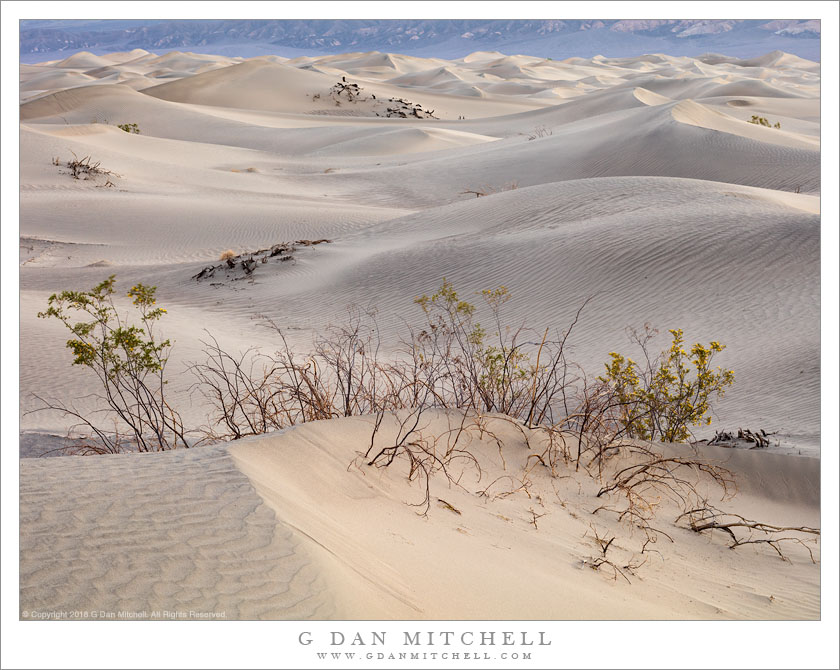
Dunes, First Light

Dunes, First Light
First light on Death Valley sand dunes

Dunes, First Light. © Copyright 2018 G Dan Mitchell – all rights reserved.

First light on Death Valley sand dunes

No matter how many times I experience it — and I’ve experienced it a lot! — the instant when the first sunlight suffuses the landscape is always magical. Invariably, it sneaks up on me, even though I plan to be there for it and have probably calculated the precise time of the light’s arrival. Perhaps it is because I’m engaged in photographing the pre-sunrise light, a phenomenon that also is transitory. To this day, it still somehow surprises me when this light arrives in complete silence and stillness. Somehow it seems like there should be music or a rising wind… but it is just the light.

Sand dunes provide unending possibilities for photography, and they are a remarkable canvas on which the light can paint. In the middle of the day this sand would be a sort of bland off-white color. But for a few moments at the start and end of the day the sand takes on almost gaudy colors of sky and sunlight, and the soft shadows both emphasize the forms of the dunes and produce their own shapes and lines. Non-photographers probably wonder how we can force ourselves out of bed a couple hours before dawn and drive or hike long distances the pre-dawn darkness. We wonder how the rest of the world can sleep through it!


G Dan Mitchell is a California photographer and visual opportunist. His book, “California’s Fall Color: A Photographer’s Guide to Autumn in the Sierra” is available from Heyday Books and Amazon.
Blog | About | Flickr | Twitter | FacebookGoogle+ | LinkedIn | Email


All media © Copyright G Dan Mitchell and others as indicated. Any use requires advance permission from G Dan Mitchell.
Dunes, Mountains, Haze

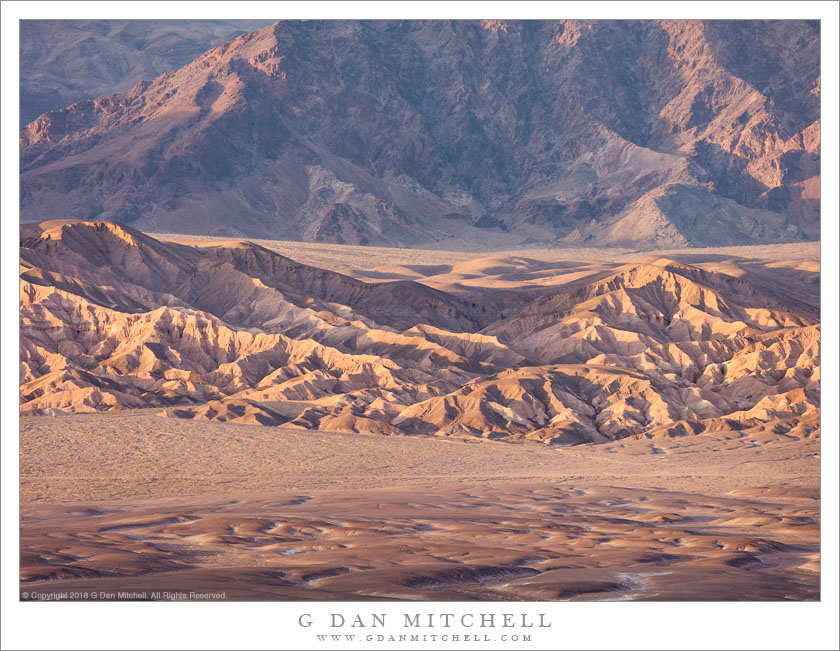
Dunes, Mountains, Haze
Afternoon winds and blowing sand soften the contours of sand dunes and desert mountains

Dunes, Mountains, Haze. © Copyright 2018 G Dan Mitchell – all rights reserved.

Afternoon winds and blowing sand soften the contours of sand dunes and desert mountains

For us, the drive to Death Valley from the San Francisco Bay Area is always a long one, even when we break it into sections as we did on this trip. We came through Trona and up the Panamint Valley, then following the newly reopened Wild Rose Canyon Road up into the mountains. Along the way to made a few stops in this range, and finally ended up in Death Valley itself in the middle afternoon. After getting settled in following the drive it is very tempting to just be lazy! However, we were there (mostly) to make photographs, so we got to work.

For me, the first photography of almost any trip amounts, to some extent, to a sort of warm-up exercise. I may (or may not) have a particular photograph or subject in mind, but it is important to get the camera out, head into the field, and start making photographs right away, if for no other reason than to “prime the pump” for the rest of the visit. We we headed to the dunes, stopping at a place where few others go, shouldered tripods, packs and cameras, and headed out to see what we could find. I had my sights on some low dunes where various vegetation grows, but along the way I looked toward the more distant higher dunes and spotted this beautiful backlight and haze as wind began to blow sand into the air from the dune ridges.


G Dan Mitchell is a California photographer and visual opportunist. His book, “California’s Fall Color: A Photographer’s Guide to Autumn in the Sierra” is available from Heyday Books and Amazon.
Blog | About | Flickr | Twitter | FacebookGoogle+ | LinkedIn | Email


All media © Copyright G Dan Mitchell and others as indicated. Any use requires advance permission from G Dan Mitchell.
Abandoned Mill

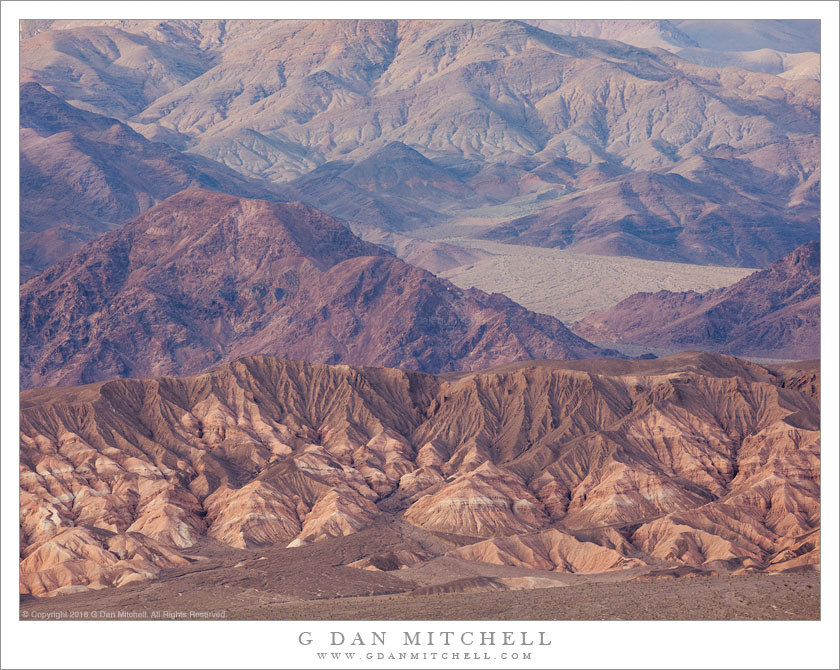
Abandoned Mill
The ruins of an abandoned mill in the desert backcountry

Abandoned Mill. Desert Mountains, California. April 4, 2017. © Copyright 2017 G Dan Mitchell – all rights reserved.

The ruins of an abandoned mill in the California desert backcountry

During the nearly twenty years since I first “discovered” California deserts, my experience with them has changed. To be honest, as a person largely focused on the coast and the Sierra, when I was younger I didn’t really know much about these wild places, and I wasn’t really attracted to them. It wasn’t until the late 1990s that I actually made a serious visit and began to “get it” about the things that make these areas so marvelous. At first, like almost anyone else, I focused on some of the most obvious and iconic places. But eventually as I returned to these places, especially to Death Valley National Park, I began to push out my boundaries bit by bit. As I did so I discovered many more interesting things about these places, both the natural wilderness and the human history. One of the first experiences that connected me to the human history was an accident. One evening I wandered away from a camp and just sat down on a boulder in an elevated location on an alluvial fan. I happened to look down to see an unusual rock. I picked it up and quickly realized that it was a cutting implement left their by the earliest people to make their lives here — and my notions of the depth and variety of human experience in the desert was profoundly altered.

That human influence has many facets. Certainly the experience of the people we now refer to as “native Americans” is central. (I like Canada’s term: “first people.”) Later settlers showed up for a range of reasons — pioneers passing through, prospectors chasing the dream of the big strike, folks looking for a job, people not well suited to living in the civilized world, and other. They all left traces. The prospectors and miners left lots of them all over the desert landscape, and you can’t travel around these places without running into it. The photograph is a detail from one amazing structure high on a desert ridge, abandoned only recently in the context of the larger scale of history, but still putting us in touch with an era that is mostly gone now from these places.


G Dan Mitchell is a California photographer and visual opportunist. His book, “California’s Fall Color: A Photographer’s Guide to Autumn in the Sierra” is available from Heyday Books and Amazon.
Blog | About | Flickr | Twitter | FacebookGoogle+ | LinkedIn | Email


All media © Copyright G Dan Mitchell and others as indicated. Any use requires advance permission from G Dan Mitchell.
Desert Hills, Evening Shadows

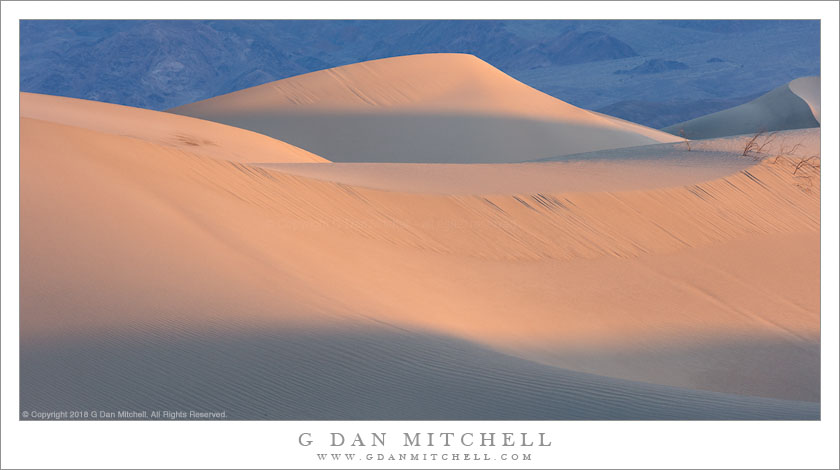
Desert Hills, Evening Shadows
Evening light and shadows on desert hills and Death Valley salt flats

Desert Hills, Evening Shadows. Death Valley National Park, California. April 5, 2017. © Copyright 2017 G Dan Mitchell – all rights reserved.

Evening light and shadows on desert hills and Death Valley salt flats

My first visit to the park was in the late 1990s, but I’ve been a regular since then. I visit Death Valley for about a week at least once each year, and have photographed all over the park. In a way, this first surprised me a bit, since when I was younger I was not attracted to the desert at all, having been brought up on the notion of the “desert wasteland,” and having been a huge fan of the high Sierra since I was young. So even though the desert was nearby I didn’t visit before a chance encounter that came about when I was one of the adult chaperones on a trip introducing high school and middle school kids to the place. Literally from my first view of the place (after crawling out of a tent in a high place at dawn to look across the valley), I was entranced.

The photographic subjects in this national park (and similar desert locations) range from intimate to immense, and several things always draw my attention. Because of the hot and dry environment, the landscape is laid bare in ways that are uncommon in other mountains. (Unless you go above tree line, into another of my favorite worlds.) The land-forming effects of uplift, mountain-building, water (!) and wind are easy to see. And this naked landscape is often painted and colored by the light in beautiful ways. This photograph, at least as I see it, offers several contrasts: between the low hills and the flatness of their surroundings, between the shadow and light, and between the small and the large.


G Dan Mitchell is a California photographer and visual opportunist. His book, “California’s Fall Color: A Photographer’s Guide to Autumn in the Sierra” is available from Heyday Books and Amazon.
Blog | About | Flickr | Twitter | FacebookGoogle+ | LinkedIn | Email


All media © Copyright G Dan Mitchell and others as indicated. Any use requires advance permission from G Dan Mitchell.