
Tag Archives: flight

Lesser Sandhill Crane

Lesser Sandhill Crane
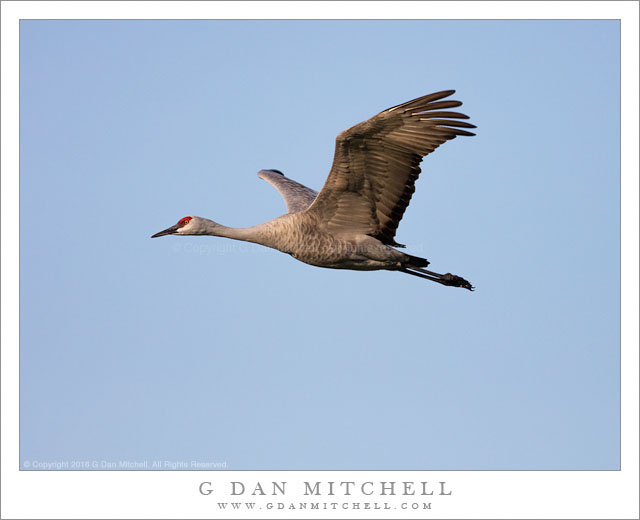
A lesser sandhill crane in flight above California’s San Joaquin Valley

Lesser Sandhill Crane. Central Valley, California. February 26, 2016. © Copyright 2016 G Dan Mitchell – all rights reserved.

A lesser sandhill crane in flight above California’s San Joaquin Valley

These beautiful birds have a big place among the Central Valley migratory birds. Although they appear in smaller numbers than the geese, at times you may see hundreds or thousands of them in one place at various locations up and down the valley. They have a striking cry that is instantly recognizable and very different from that of other Central Valley birds. With their size, their slower wing flapping, frequent coasting, and level flight from place to place they are also easy to recognize when they are airborne.

Tracking individual birds with a camera and long lens is a challenge, especially when the bird gets close enough to become large in the frame. (It takes practice to track them. The ideal is to eventually become quick and smooth, and to remain aware enough to think about the bird’s wing and head position and even about what it in the background.) On the day when I made this photograph there were many, many cranes about. I managed to position myself between two groups, and I waited there quietly for cranes to fly across my position.


G Dan Mitchell is a California photographer and visual opportunist. His book, “California’s Fall Color: A Photographer’s Guide to Autumn in the Sierra” is available from Heyday Books and Amazon.
Blog | About | Flickr | Twitter | FacebookGoogle+ | 500px.com | LinkedIn | Email


All media © Copyright G Dan Mitchell and others as indicated. Any use requires advance permission from G Dan Mitchell.
Snow Goose

Snow Goose
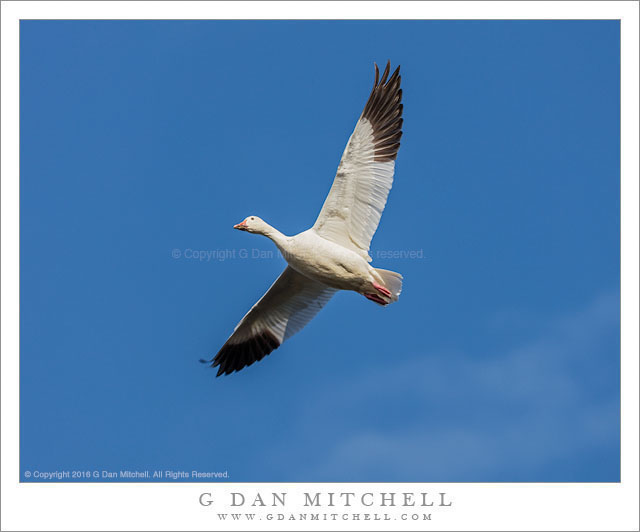
A solitary snow goose in flight against winter blue sky

Snow Goose. Central Valley, California. January 8, 2016. © Copyright 2016 G Dan Mitchell – all rights reserved.

A solitary snow goose in flight against winter blue sky

There are two common types of white geese in California, the Ross’s goose and the snow goose. Although one or the other may be more predominant in a give location, they often are found together and it can be a bit tricky to tell them apart at first. Size is one hint — the snow goose is a bit larger, and after a while this seemingly subtle difference becomes more obvious. The two birds also have differently shaped bills that are different sizes. Also on the bill is another hint — the snow goose bill has a characteristic “grin” pattern on its sides. A friend tells me that he can identify the difference by sound, too, though I can’t do that consistently at this point.

When first visiting the Central Valley bird locations, the sight of sometimes-huge flocks of white geese makes a strong impression. I can report that it continues to make an impression many visits later, especially when combined with the cacophony of thousands of the birds or the wild group take-offs that occur when they are spooked by predators or other triggers.


G Dan Mitchell is a California photographer and visual opportunist. His book, “California’s Fall Color: A Photographer’s Guide to Autumn in the Sierra” is available from Heyday Books and Amazon.
Blog | About | Flickr | Twitter | FacebookGoogle+ | 500px.com | LinkedIn | Email


All media © Copyright G Dan Mitchell and others as indicated. Any use requires advance permission from G Dan Mitchell.
Three Lesser Sandhill Cranes

Three Lesser Sandhill Cranes
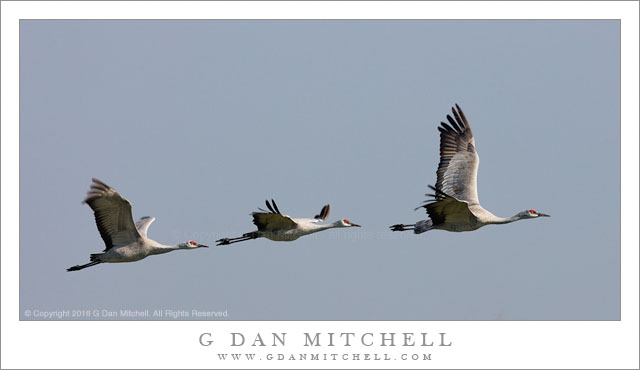
Three lesser sandhill cranes fly against blue sky above the San Joaquin Valley

Three Lesser Sandhill Cranes. Central Valley, California. February 15, 2016. © Copyright 2016 G Dan Mitchell – all rights reserved.

Three lesser sandhill cranes fly against blue sky above the San Joaquin Valley

These beautiful sandhill cranes are found up and down California’s Central Valley and beyond. Many things characterize the winter “bird-scape” in the state, but high on my list is the sound of these birds, whether directly overhead or somewhere off in the fog, invisible but often present in large numbers. They are not as numerous as the geese, but at times their numbers can become quite astounding, especially when they find a good place to feed. I think that they can be a bit awkward looking on the ground, but in flight they are transformed. Their flying pattern features slower wing motion, periods of gliding, a flat trajectory, and often wingtip-to-tail relationships with other cranes.

They aren’t always easy to photograph, though if you come (quietly!) upon a group on the ground and they don’t fly away you can often get good photographs, and you may even see the “dancing cranes” behavior. Photographing them in flight can be just a bit tricky. They seem uneasy about flying directly over humans, and birds that appear headed for your position will often divert at the last moment. Fortunately, they can be very attractive viewed from the side — perhaps more so that a straight-on view or photographed from underneath. These three were part of a larger group that was flying at low elevation between two areas of pasture-land.


G Dan Mitchell is a California photographer and visual opportunist. His book, “California’s Fall Color: A Photographer’s Guide to Autumn in the Sierra” is available from Heyday Books and Amazon.
Blog | About | Flickr | Twitter | FacebookGoogle+ | 500px.com | LinkedIn | Email


All media © Copyright G Dan Mitchell and others as indicated. Any use requires advance permission from G Dan Mitchell.
Evening Geese

Evening Geese
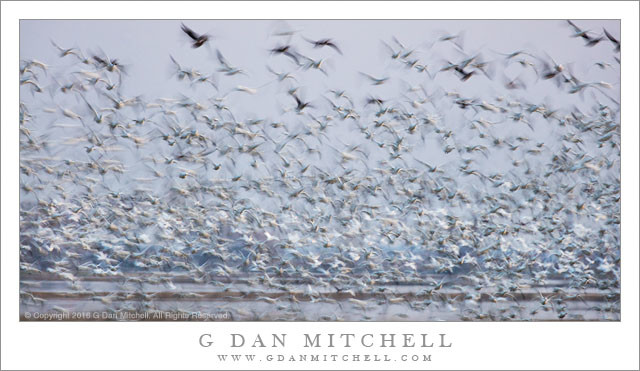
A large flock of geese takes to the air in evening light

Evening Geese. Central Valley, California. February 5, 2016. © Copyright 2016 G Dan Mitchell – all rights reserved.

A large flock of geese takes to the air in evening light

Each day among these migratory birds moves through a kind of cycle, with variations that eventually become familiar but which don’t become any less compelling or exciting. It typically starts with a pre-dawn drive and arrival at a likely spot to find them — preferably in fog! It is always thrilling to catch the first sight and sound of the birds. The day continues, likely passing from fog to hazy sunshine, as the birds tend to settle into midday routines. Sometime after lunch it is (almost always) time for a break, but the work resumes by mid-afternoon. At first things happen slowly, but as evening approaches the pace picks up – more birds coming and going, more frequent take-offs, light that evolves in beautiful ways — and before long it is sunset and then dusk.

Early morning and evening are times of daily transition for the birds, so there is often a lot of action. Although a mass take-off can occur at almost any time if something sets off the flock, they become more likely and more impressive in the evening. They also become more difficult to photograph! As light fades and the subject becomes more interesting, the photographic challenges of low light increase. Rather than giving in to the dimming light I often take a different approach and embrace the motion blur, following the general mass of birds but allowing the fine details to soften and merge.


G Dan Mitchell is a California photographer and visual opportunist. His book, “California’s Fall Color: A Photographer’s Guide to Autumn in the Sierra” is available from Heyday Books and Amazon.
Blog | About | Flickr | Twitter | FacebookGoogle+ | 500px.com | LinkedIn | Email


All media © Copyright G Dan Mitchell and others as indicated. Any use requires advance permission from G Dan Mitchell.