
Tag Archives: photography

Digital Exposure: Some Basic Rules (Morning Musings 1/10/15)

Earlier this week I read Alan Ross’s fine article about the zone system and the possibility of adapting it for use with digital photography. (“Can the Zone System Go Digital“) It is a fine summary of some very important principles of exposure, and it is one of the most straightforward and readable explanations of the basics concepts of zone system exposure I’ve seen. It also offers a useful way to apply zone system principles to shooting with digital cameras.
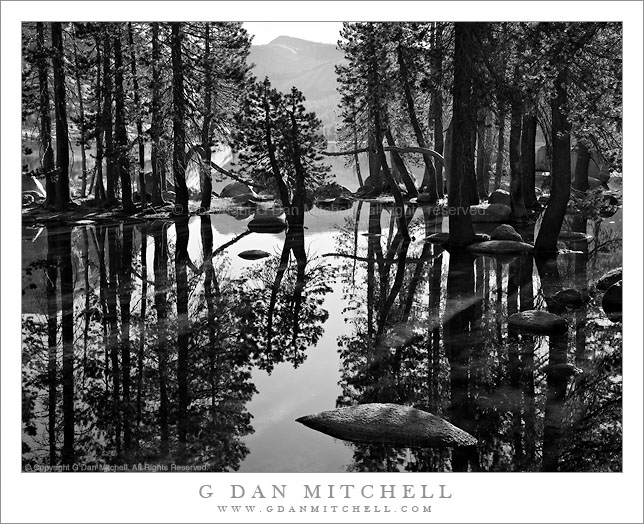
Shoreline Reflections, Tenaya Lake

I don’t use the zone system, but I do expose in ways that often have the same goals, especially when faced with subjects that have a very wide dynamic range (risking a loss of shadow and/or highlight detail) or, oddly, a very narrow dynamic range (where metering systems can try to turn everything neutral gray.) As I read his article I thought it might be fun to try to distill some of my basic principles for exposure down to a very short list. Here it is:

  • Protect the highlights! — Overexposed highlights and bright areas can completely lose detail if they are overexposed with digital photography, and these details may not be recoverable in post.
  • Watch out for dark tones that are too dark — If dark tones go too dark, they may need to be pulled back up in post, and noise, banding, and other artifacts can be the result of radical lightening of dark areas.
  • Consider the most important values in the scene, and adjust exposure to favor them — You may want to compensate for the camera’s tendency to want to make black and white tones end up gray in narrow dynamic range photographs
  • If important, subtle tonal variations are found in the shadows or in the highlights, consider offsetting exposure to protect them — You may want to underexpose just a bit to retain differences among tones in the bright areas. If there are a lot of important details in very dark shadows, you may wish to overexpose a bit.
  • Use the danged histogram — The RGB histogram display quickly tells you a lot of important things about your exposure.
  • Use the camera as the meter — Go ahead and make an exposure to test your settings. While there is a certain historical macho that says you should get it right in a single exposure, or that you should use a handheld meter, modern digital cameras can provide just as much information as external meters.
  • Don’t be afraid to bracket — Sometimes it is simply faster to make several bracketed exposures rather than to figure out one “perfect” one. That may sound like a photographic blasphemy to some… but it works!

Do you have other basic exposure rules that can be applied in a general way?


G Dan Mitchell is a California photographer and visual opportunist whose subjects include the Pacific coast, redwood forests, central California oak/grasslands, the Sierra Nevada, California deserts, urban landscapes, night photography, and more.
Blog | About | Flickr | Twitter | FacebookGoogle+ | 500px.com | LinkedIn | Email

Text, photographs, and other media are © Copyright G Dan Mitchell (or others when indicated) and are not in the public domain and may not be used on websites, blogs, or in other media without advance permission from G Dan Mitchell.
Reader Questions: Landscape Lenses

From time to time I get questions from readers, and I usually like to share the answers so that other might learn something, too.

Recently “Gregory” wrote:

I just read one of your articles on appropriate lenses to use for landscape photography. I’m a hobbyist photographer in California that has a passion for landscape photography. I sold my Canon equipment and will be purchasing some Nikon lenses and camera body. I wanted to get your input as to what the majority of landscape photographers use – prime lenses or zoom lenses? Based on my limited budget, here is what I am thinking of:

Option A — Primes: 20mm, 28mm, 50mm, 85mm
Option B — Zooms: 24-70mm, 70-200mm
Option C — Zooms: 16-35mm, 24-70mm

I don’t have the budget to purchase both a super wide zoom AND a telephoto. I’ll have to settle for one of these and then acquire an additional zoom later on. I’m thinking the primes maybe slightly sharper in the borders and lighter to carry, but what about the hassle of constantly switching lenses back and forth? Not sure I want to do this. I would appreciate any recommendations/suggestion you might have.

Before I reply here, let me share a couple of articles that I wrote about more or less this topic:

By the end of this article… I probably will not tell you which lenses to select! But perhaps I’ll help you consider factors that will assist in making a good personal decision that is right for your photography.

To a great extent, many of these decisions are personal and they come down to your own personal preferences and the ways in which you approach your subjects. Some people have reasons for preferring prime lenses, some have reasons for preferring zooms, and others have good reasons for wanting both. Some are comfortable working with a relatively narrow range of focal lengths, while other feel the need for a wider range. Some have a predilection for wide-angle lenses, while others are drawn to longer focal lengths. And this doesn’t even get into the questions about tilt/shift lenses and other variables.

I mention this for a couple of reasons. First, there are going to be people who disagree with my preferences — listen to their perspectives, too, and then use your own judgment. Second, consider your own preferences at least as much. Continue reading Reader Questions: Landscape Lenses

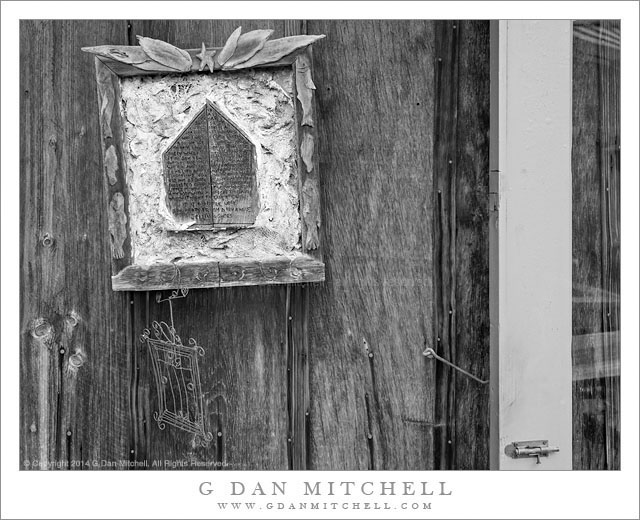
Detail, Wildcat Hill

Detail, Wildcat Hill

Detail, Wildcat Hill. Wildcat Hill, California. September 28, 2014. © Copyright 2014 G Dan Mitchell – all rights reserved.

Detail of a building at Wildcat Hill

This is the third and final (for now, anyway) photograph from my visit to the historic Wildcat Hill home of Edward Weston and other members of the Weston family, today including Kim and Gina Weston. I suppose that visiting the Weston compound is something of a photographer’s pilgrimage, given Edward Weston’s influence and the work of the other photographers in the Weston family. (I believe there now may be as many as five generations of Weston photographers.)

The place is fascinating in many ways. Given its location, today not far from a very busy tourist byway, it is especially intriguing to think about what the place must have been like many decades ago. The main building is maintained in much the way it must have been many years ago, and it is a rather humble structure. Inside are many fascinating artifacts — Weston prints, paintings, sculpture, objects from the home, the small Edward Weston darkroom, and more. Over the years the place seems to have picked up a large number of small bits and pieces of “stuff” that is found everywhere — on shelves, attached to walls, scattered around the grounds. These things make fascinating subjects for almost any photographer.


G Dan Mitchell is a California photographer and visual opportunist whose subjects include the Pacific coast, redwood forests, central California oak/grasslands, the Sierra Nevada, California deserts, urban landscapes, night photography, and more.
Blog | About | Flickr | Twitter | FacebookGoogle+ | 500px.com | LinkedIn | Email

Text, photographs, and other media are © Copyright G Dan Mitchell (or others when indicated) and are not in the public domain and may not be used on websites, blogs, or in other media without advance permission from G Dan Mitchell.

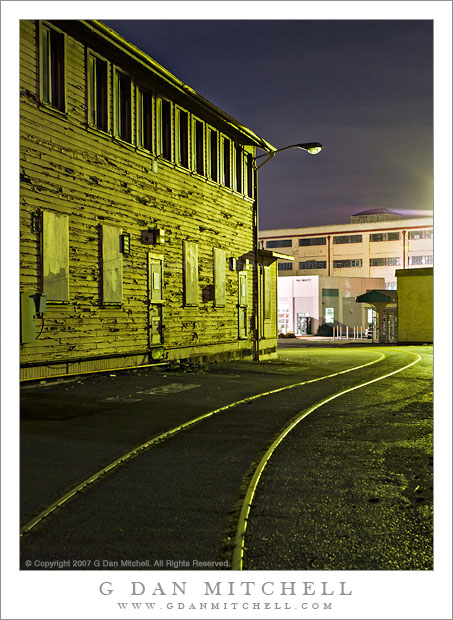
Green Building and Tracks

Green Building and Tracks

Green Building and Tracks. Mare Island Naval Ship Yard. March 3, 2007. © Copyright 2007 G Dan Mitchell – all rights reserved.

Ambient light floods the side of a building and old railroad tracks with green-tinted light, Mare Island Naval Ship Yard

A friend recently shared a photograph of a bit of curving railroad track, and I recognized it as being the same track that appears in this photograph from seven and a half years ago. I went back to look it up to share it with him, and in doing so I realized that I seem to have not shared it previously — so I’m rectifying that with this posting!

I have been photographing this location at night for over a decade now. I’m pretty certain that my first visit was back in 2003, when I happened to see an announcement of an event sponsored by The Nocturnes the San Francisco Bay Area night photography group. I had seen photographs made at night, of course, but it wasn’t anything that I had ever done, so I showed up. I was quickly hooked, especially when it comes to photographing urban and industrial areas in ambient light. This photograph is fine example of what attracts me about that light. If you were there in person, you would not really see anything quite like this — it was so dark that most of the details would be lost in shadow, the intense colors would be invisible to your eyes, and the only real details would be on the small lighted wall in the distance. But the camera can see what the eyes cannot. Here that includes not only the details in shadow areas, but also the wild colors that are produced by artificial lights.


G Dan Mitchell is a California photographer and visual opportunist whose subjects include the Pacific coast, redwood forests, central California oak/grasslands, the Sierra Nevada, California deserts, urban landscapes, night photography, and more.
Blog | About | Flickr | Twitter | FacebookGoogle+ | 500px.com | LinkedIn | Email

Text, photographs, and other media are © Copyright G Dan Mitchell (or others when indicated) and are not in the public domain and may not be used on websites, blogs, or in other media without advance permission from G Dan Mitchell.