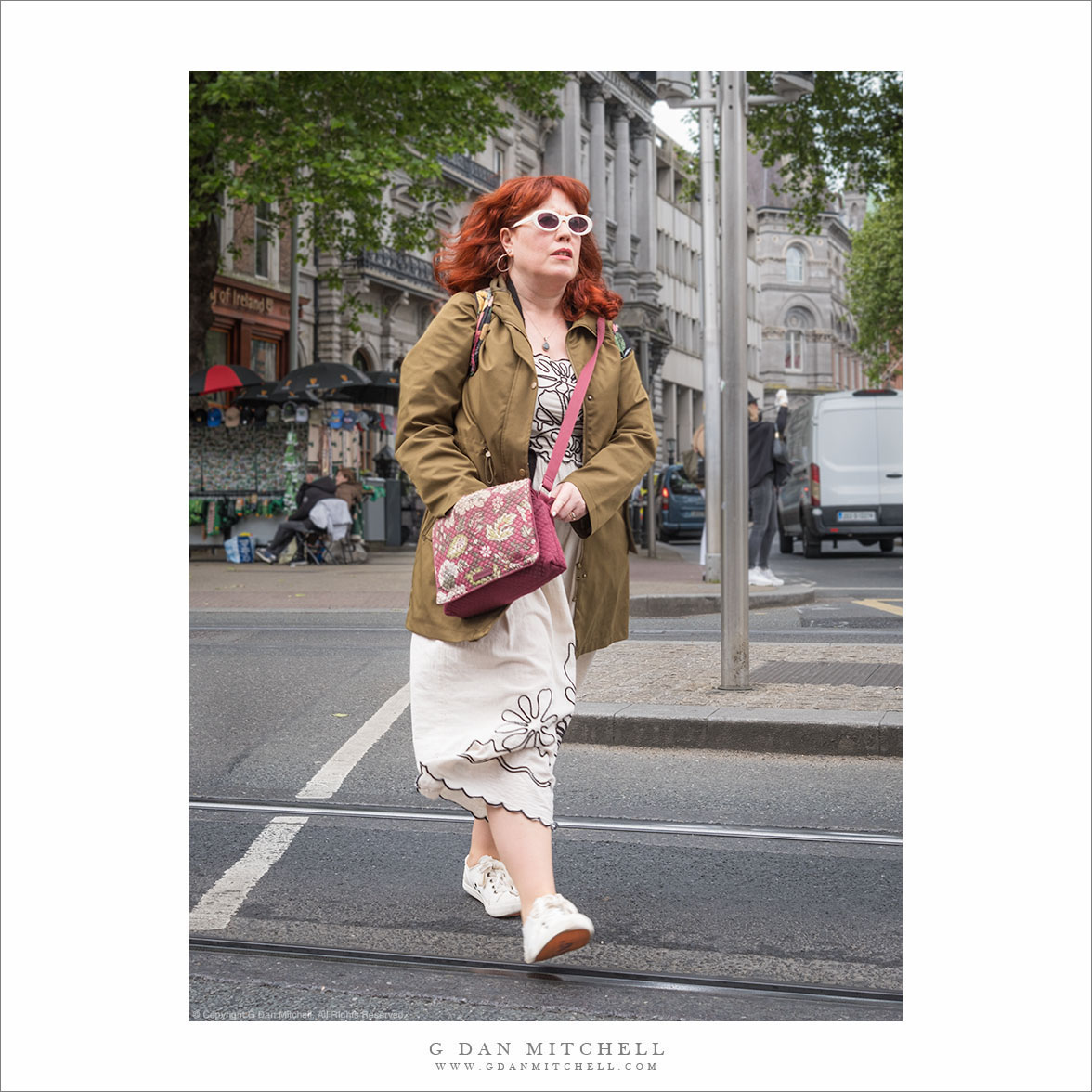
“Dublin Woman” — A Dublin woman in a hurry crosses a street.
Photographing people is not a major part of my photography, and when I do it is more often along the lines of people in their environment rather than portraits. But every so often the mood hits, and I do a series of such photos. It happened a bit during our May visit to Dublin — perhaps because it was such a busy, people-filled city. This is the first from that visit, but there will be more.
“Trolleys and Tuk Tuk” — Trolleys, tuk tuk,, and crowds near Miradouro das Portas do Sol, Lisbon.
We walk a lot when we visit cities, and on this Lisbon day we had walked to and then through portions of Alfama. This neighborhood is full of very old streets and buildings. It is built on a hill rising above the water, so many of those lanes are quite steep. Overall it was a slow and mostly quiet walk… until we emerged on this busy street!
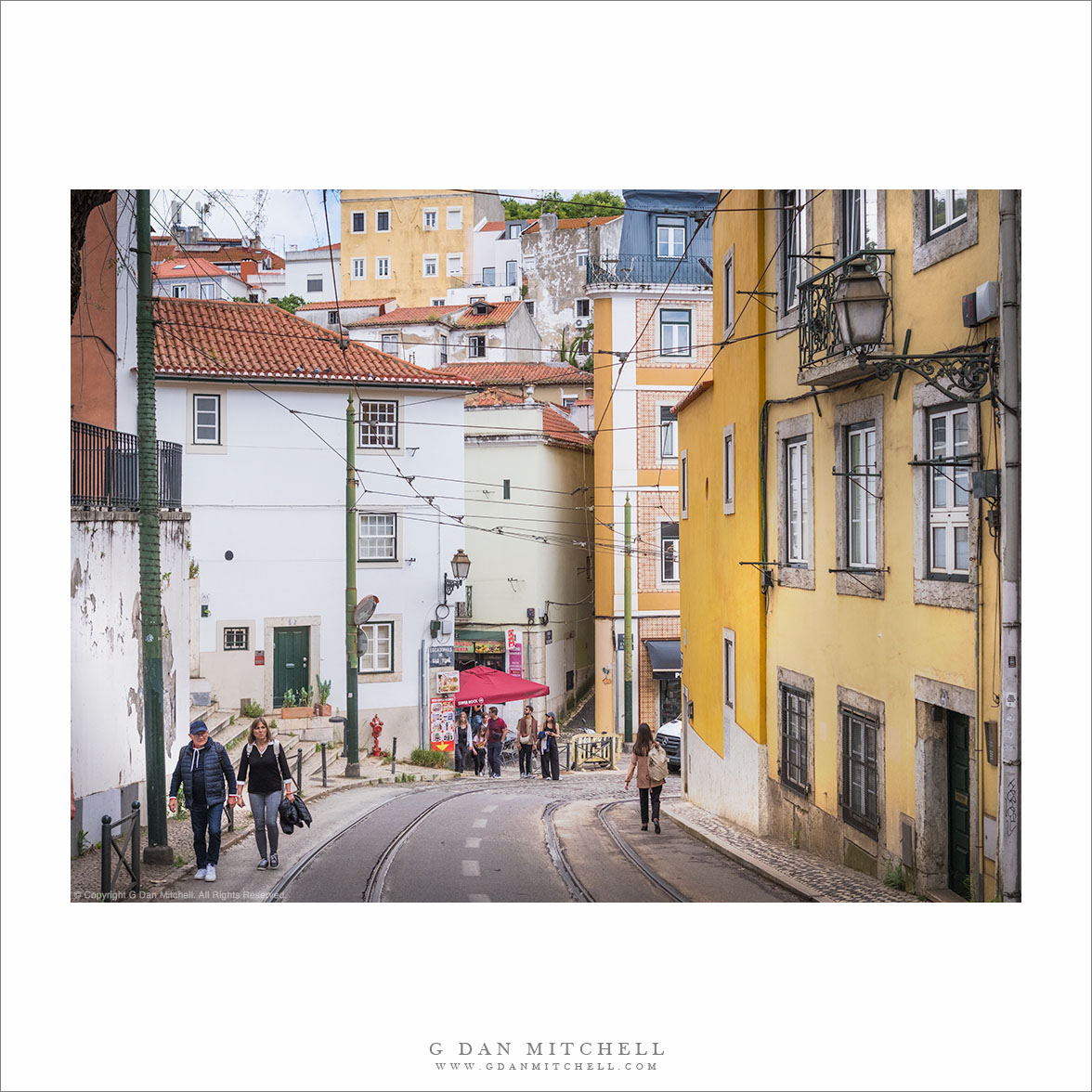
“A Lisbon Street” — A narrow, curving street in Alfama, lined with colorful buildings.
From my limited experience, this feels like a “typical” street of Lisbon’s Alfama district… except that the street is wider than many of the passageways. The lines suggest that it is two lanes wide — though I imagine that when a trolley goes up and down those tracks there isn’t a lot of room for anyone else!
There is a lot in this scene that attracted my attention. The street itself with its pairs of tracks and optimistic center dividing line is one. The stacked and tightly spaced buildings are another. And I love the saturated colors, from the nearly pure white to the many yellow buildings, and the bits of blue here and there.
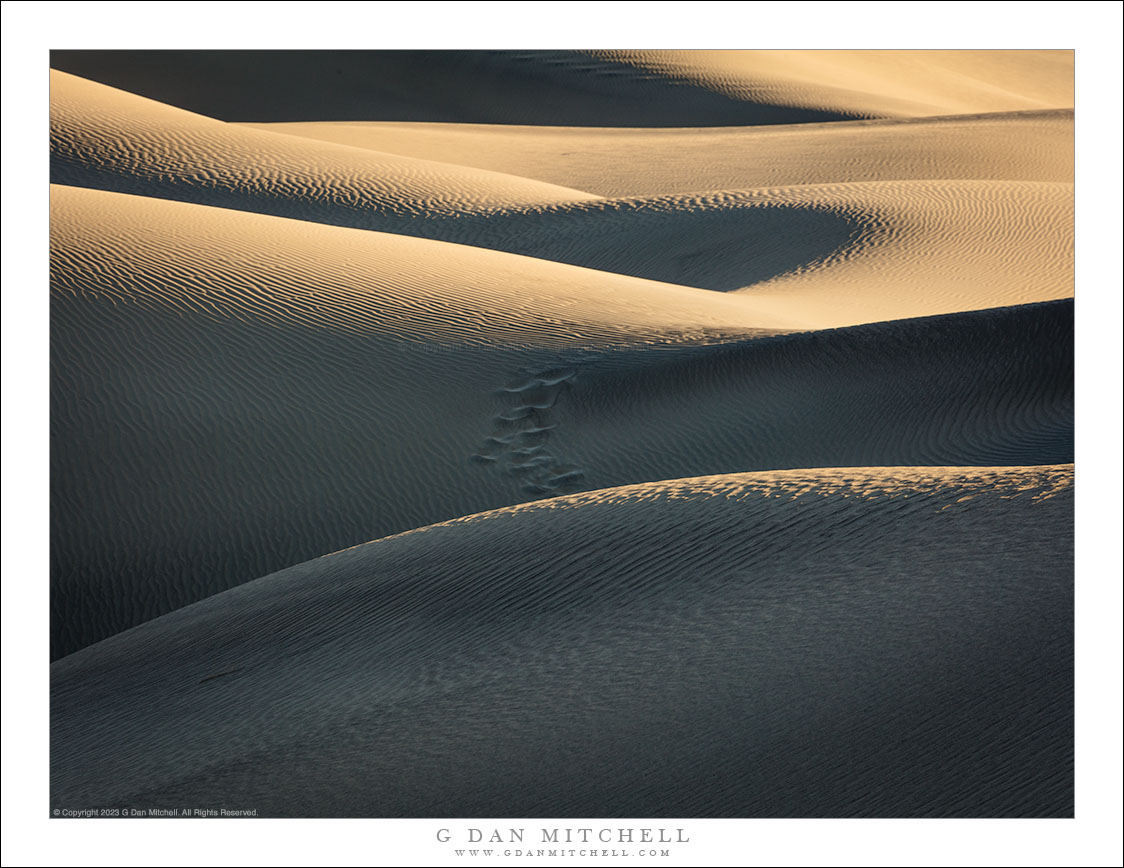
Most of our landscape photographs try to present the landscape without obvious human presence. I write “obvious” because it is hard to find any place where no human effects are present. Sometimes photographers are criticized for presenting the illusion that this isn’t so. While I think the point is important, the criticism is unwarranted and based on its own untenable notion of what wilderness is. In any case, the inclusion of a more overt human element in photographs can encourage us to think of these places in a different way.
We often strive to photograph dunes after sand storms, when footprints have been erased. But including such things can also engage us in the landscape in useful ways — if nothing else they urge viewers to imagine themselves in these places. The footprints here are somewhat subtle, but I think that we relate to the scene differently when we see a line of footprints leading into it.
G Dan Mitchell is a California photographer and visual opportunist. His book, “California’s Fall Color: A Photographer’s Guide to Autumn in the Sierra” is available from Heyday Books, Amazon, and directly from G Dan Mitchell.
Photographer and visual opportunist. Daily photos since 2005, plus articles, reviews, news, and ideas.
Manage Consent
To provide the best experiences, we use technologies like cookies to store and/or access device information. Consenting to these technologies will allow us to process data such as browsing behavior or unique IDs on this site. Not consenting or withdrawing consent, may adversely affect certain features and functions.
Functional
Always active
The technical storage or access is strictly necessary for the legitimate purpose of enabling the use of a specific service explicitly requested by the subscriber or user, or for the sole purpose of carrying out the transmission of a communication over an electronic communications network.
Preferences
The technical storage or access is necessary for the legitimate purpose of storing preferences that are not requested by the subscriber or user.
Statistics
The technical storage or access that is used exclusively for statistical purposes.The technical storage or access that is used exclusively for anonymous statistical purposes. Without a subpoena, voluntary compliance on the part of your Internet Service Provider, or additional records from a third party, information stored or retrieved for this purpose alone cannot usually be used to identify you.
Marketing
The technical storage or access is required to create user profiles to send advertising, or to track the user on a website or across several websites for similar marketing purposes.


Join the discussion — you are welcome to leave a comment or question. (Comments are moderated and may not appear immediately.)