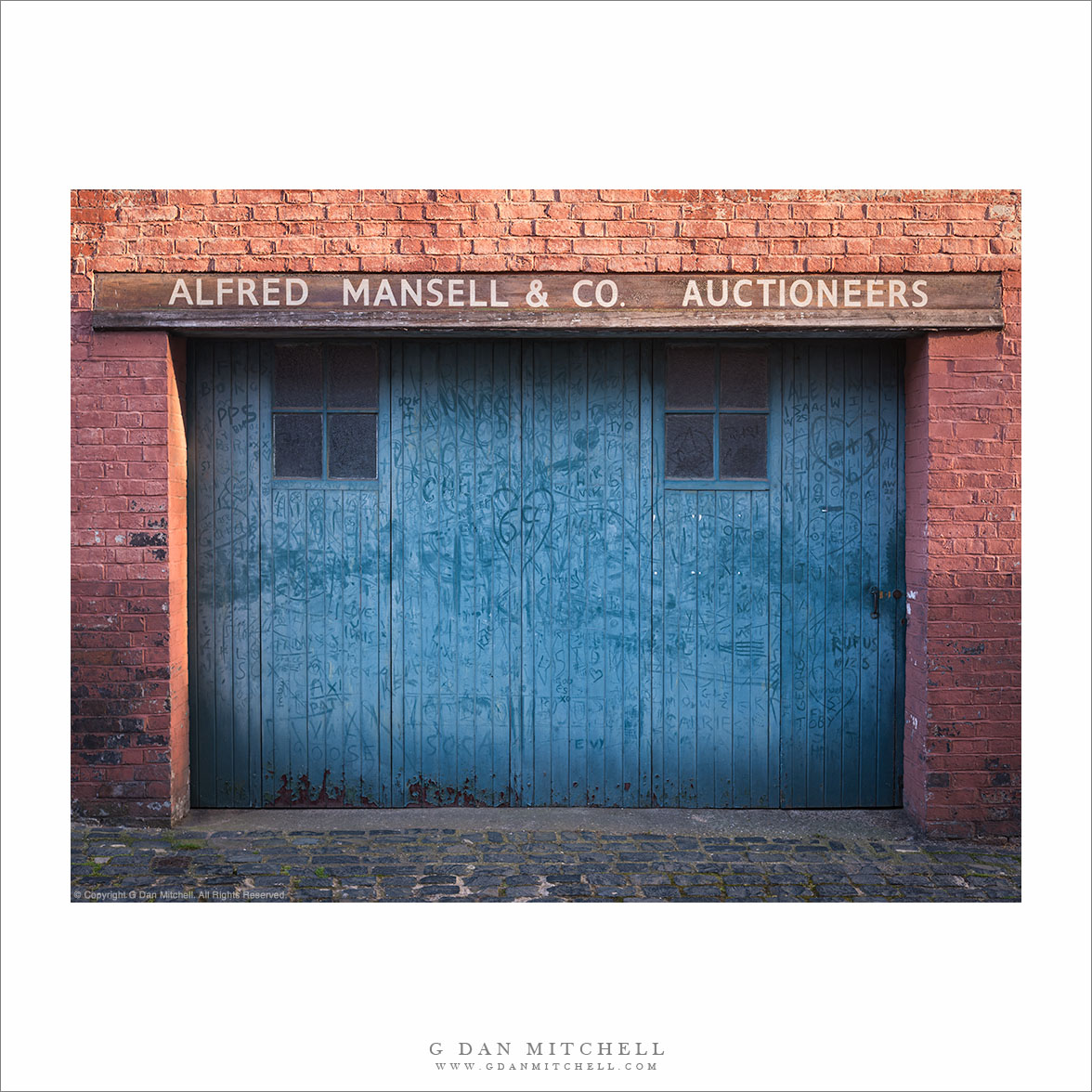
I made this photograph the English town of Shrewsbury. (More about that place below.) If a photograph is “about” something, this one is about more than one thing. To be sure, it is a record of a specific spot in a particular town, a doorway to a building with a sign for “Alfred Mansell & Co. Auctioneers.”It is perhaps a record of some history, too, given the old brick walls, the weathered doorway, and the cobblestones at the bottom of the frame. But most of all, I think it is about color, the “temperature” contrast between the warm tones of partially-sunlit bricks and the very cool blues of the doorway in shadow.
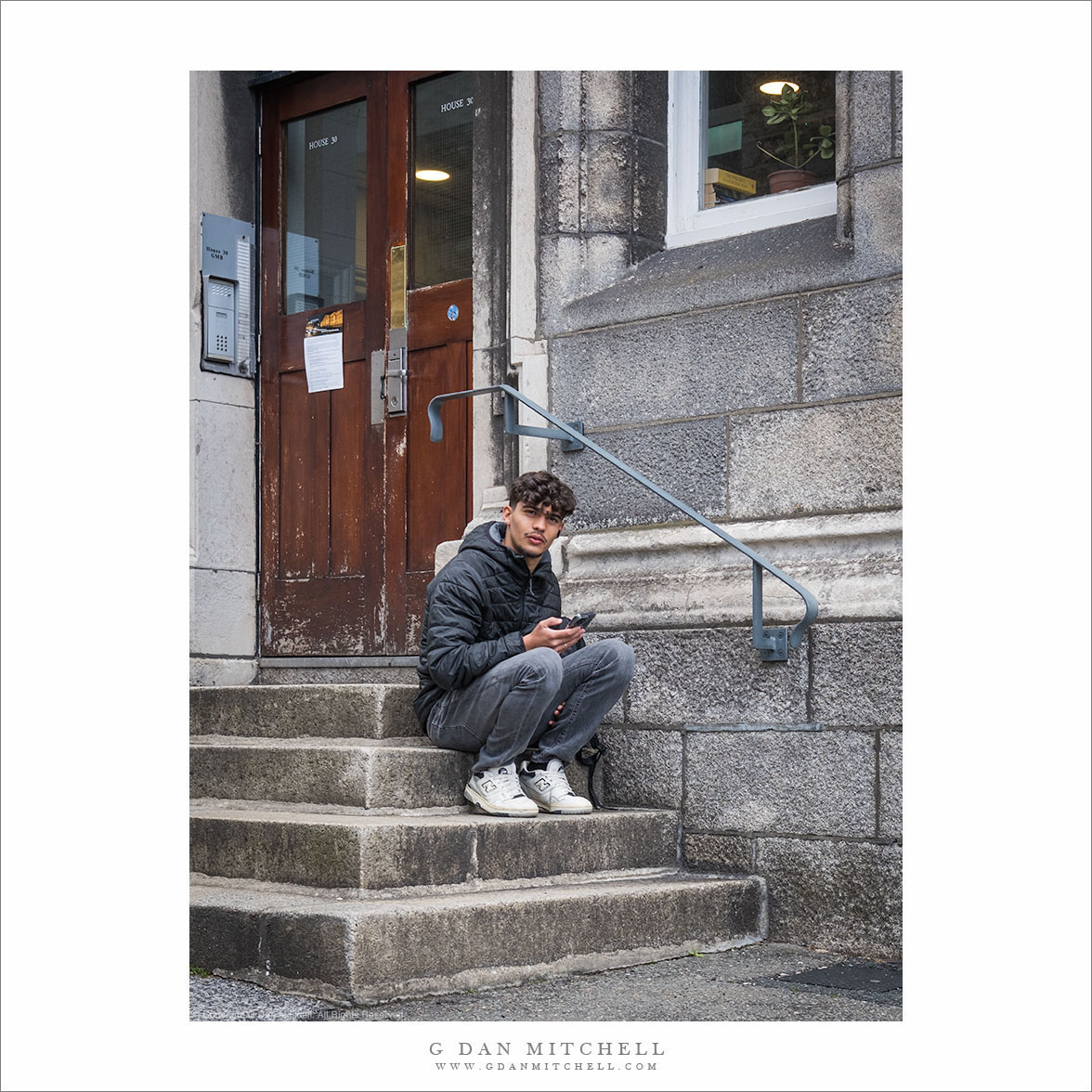
“Man on Steps, Dublin” — A man with a cell phone sits on stone steps, Dublin.
There’s a lot to see and do in Dublin, Ireland. Some cities seem rather sedate, but at least in the central area of Dublin where we spent time this past May, the streets and sidewalks were full of people — the place felt very alive. While a few day’s visit does not make me an expert — far from it — this city felt like it had a bit of an “edge,” which I think of as a good thing. All of this made it a fine place to do some photography in the streets.
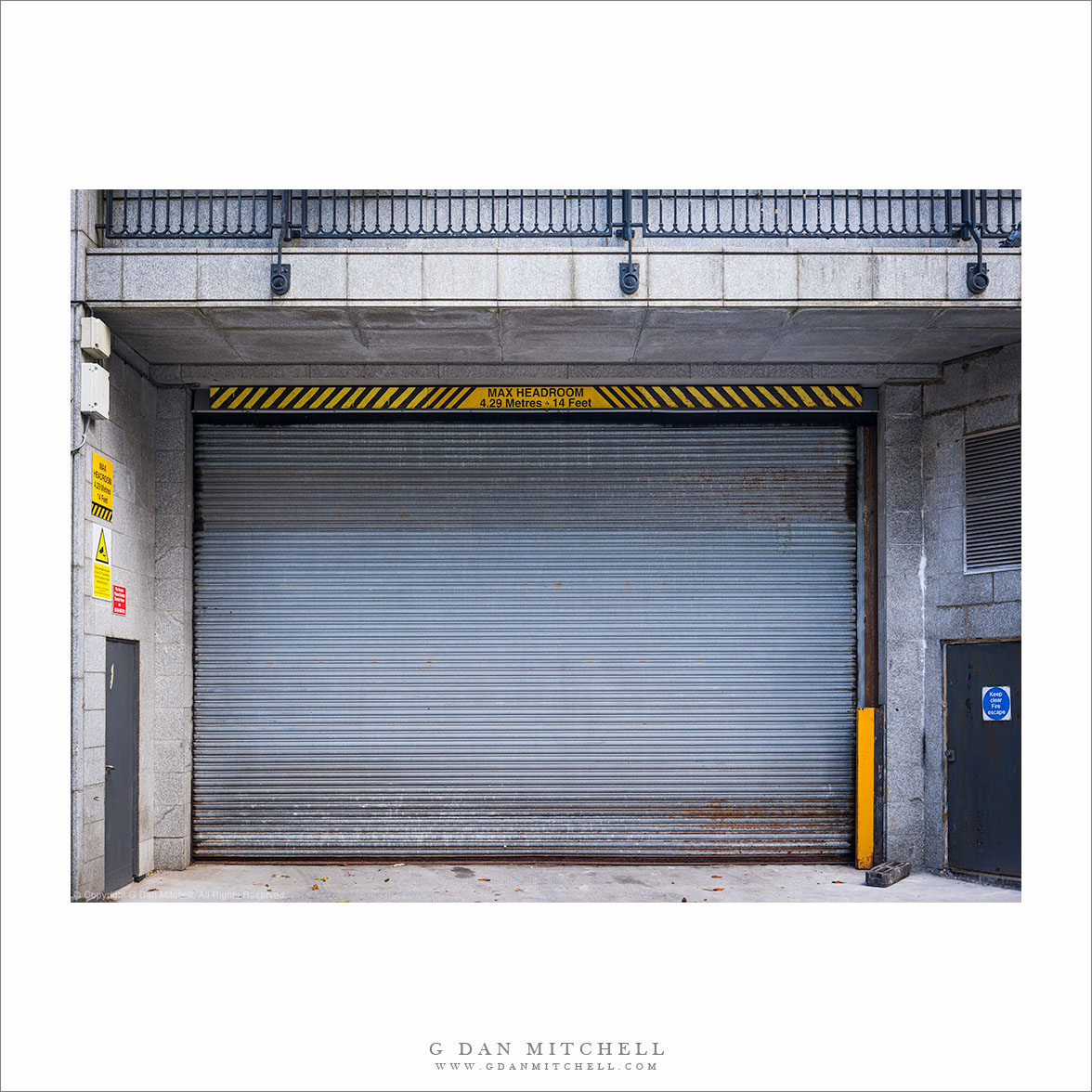
“Max Headroom 14 Feet” — A roll-up garage door in an alcove, Aberdeen.
Our May visit to Aberdeen, Scotland marked a transition on our trip. We had just completed a week-plus driving tour of Northwest Scotland, where we spent a lot of time in rural and wild areas. After returning our rental car in Inverness, we went straight to the station and boarded a train to Aberdeen, where we planned a quiet stop before heading on to Ireland. Why Aberdeen? Patty had visited the city decades ago when she went to the UK for an international orchestra festival. She wanted to return and see what she might remember of Aberdeen.
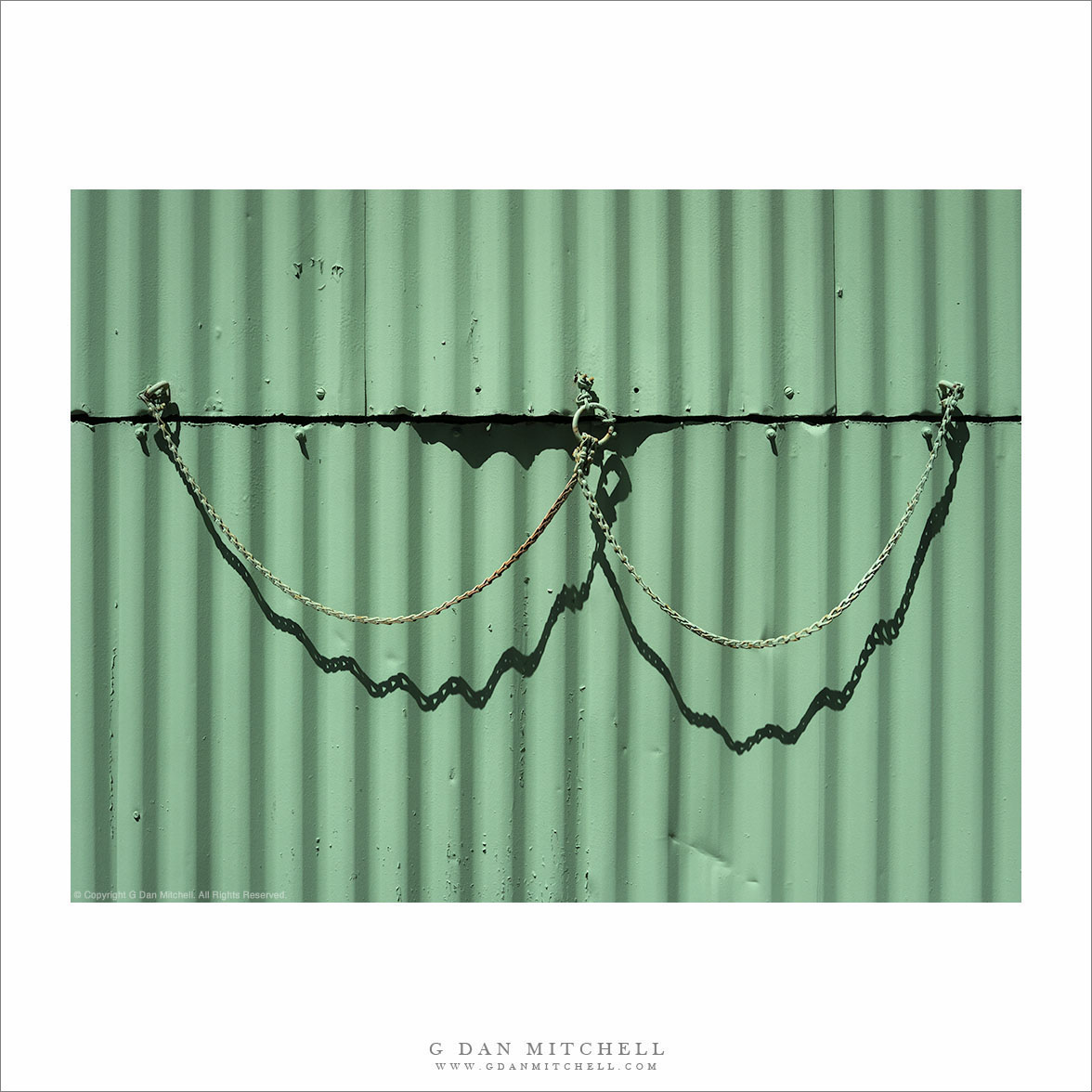
“Green Chain” — A chain casts a shadow on a corrugated metal wall.
I have admitted to a fascination with graphical elements — shapes, textures, colors, curves, and more. Finding them in the urban or natural landscape can make fairly mundane subjects interesting, at least to me. Here we see a small section of the corrugated metal wall of a very green industrial building. A couple of loops of chain hang from a gap between panels, for reasons that seem inscrutable.
Photographer and visual opportunist. Daily photos since 2005, plus articles, reviews, news, and ideas.
Manage Consent
To provide the best experiences, we use technologies like cookies to store and/or access device information. Consenting to these technologies will allow us to process data such as browsing behavior or unique IDs on this site. Not consenting or withdrawing consent, may adversely affect certain features and functions.
Functional
Always active
The technical storage or access is strictly necessary for the legitimate purpose of enabling the use of a specific service explicitly requested by the subscriber or user, or for the sole purpose of carrying out the transmission of a communication over an electronic communications network.
Preferences
The technical storage or access is necessary for the legitimate purpose of storing preferences that are not requested by the subscriber or user.
Statistics
The technical storage or access that is used exclusively for statistical purposes.The technical storage or access that is used exclusively for anonymous statistical purposes. Without a subpoena, voluntary compliance on the part of your Internet Service Provider, or additional records from a third party, information stored or retrieved for this purpose alone cannot usually be used to identify you.
Marketing
The technical storage or access is required to create user profiles to send advertising, or to track the user on a website or across several websites for similar marketing purposes.