My friend Tim Baskerville – long time San Francisco area photographer and night photograph guru of The Nocturnes – is leading photographic tours to Ireland. Tim, whose family roots go back to West Ireland, is a long time visitor to Ireland who has photographed there frequently. If this sounds interesting to you, I urge you to get in touch with Tim – and tell him I sent you!
“The Light of Ireland”
Join accomplished Photographer/Educator Tim Baskerville and Irish Guide, Olcan Masterson in Western Ireland. Olcan, a walking authority on the history of western Ireland, has spent many years exploring the hills and back roads of the area. An accomplished musician as well, he has spread traditional Irish music all over Europe and the U.S. with his flute and tin whistle. Mostly though, he is a living embodiment of Irish charm and hospitality. He will show you the spirit and soul of Ireland, as few visitors will ever experience it. You will get a view of the land and the culture that comes with living it, not merely visiting it.
Western Ireland affords us a unique opportunity in that there are so many wonderful hidden places to explore. Even if you have traveled to this area in the past, your guides will seek out new places to visit and photograph. There are spectacular monastic and megalithic ruins to seek out in your daily adventures.
The land cost includes: • Group transportation for tour events in the tour van. • Accommodations based on two people sharing a room, singles are assigned on a first come, first served basis. • Services of driver, English-speaking cultural guide (if applicable) and photographic leader, during the tour. • All breakfasts, most dinners are included. • Park entrance fees, day tours and excursions as shown in the itinerary. • Extensive pre-departure information and services.
The land cost does not include: Domestic or International air fare.
UPDATE: As of 2020 I am no longer posting annual updates concerning this subject — and I am editing older posts on the subject in light of the need to be more responsible about not encouraging the onslaught. I also no longer recommend going to the Valley to see it. Unfortunately, too much exposure (yes, I played a part in it, unfortunately) has led to absurd crowds, traffic jams, littering, destruction of areas in the Valley where too many people go to see it… and the park has increasingly — and appropriately — cracked down. Parking options have been eliminated, at least one viewing location has been closed. Good news! The rest of Yosemite Valley is still there and often exceptionally beautiful at this time of year.
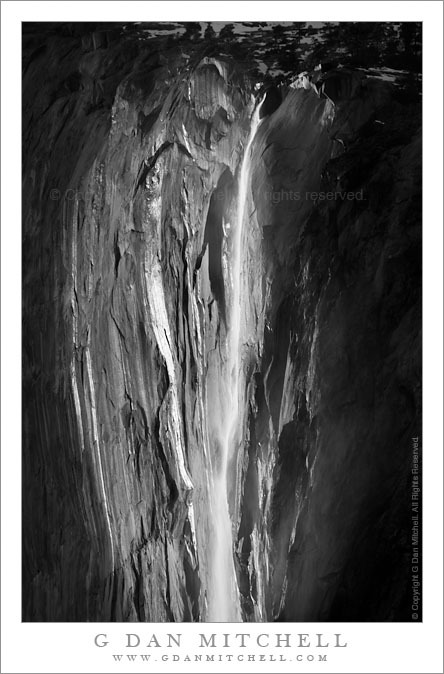
The silver strand of Horsetail Fall and water reflecting on surrounding cliffs in late afternoon light, Yosemite Valley, California.
Although it seems like it would be extremely difficult to make a truly original photograph of Horsetail Fall at this point, I won’t completely rule out the possibility, and recently I have seen a few interesting and imaginative photographs of the phenomenon.
The necessary conditions are fairly specific, and even when the basics are in place there is no guarantee that the show will occur on a given evening. To be honest, the odds are distinctly against you, and you are more likely to see something that doesn’t match your expectations.
There must be flowing water in the creek near the east end of the face of El Capitan that feeds the fall. This is not a sure thing in mid-winter. There must be sufficient snow above El Capitan and the temperatures must be warm enough to melt it, or there must have been a recent warm storm that brought some rain to higher elevations.
The setting sun must align just right with a gap in the mountains to the west of El Capitan so that the setting sun (miraculously) casts its last beams right on the face of El Capitan where the fall is located. Roughly speaking this occurs during the second half of February, right around February 20 or so.
You must be in a position such that the fall is back-lit by the sunset light beam. In addition, your position must provide a clear view of the fall – not necessarily a simple thing given the forest cover in the Valley. These areas are now subject to terrible crowding that has damaged areas of the park, and the park service is wisely reducing or eliminating access.
Although photographs make it seem like a huge, overpowering spectacle, it is actually very small. It takes place high on a distant cliff face, and to photograph it you’ll need a very long lens.
Finally, the skies to the west of Yosemite must be clear so that the golden hour sunset light is not blocked. Many tell stories of clouds that made it obvious that the show would not happen or, even more frustrating, developing light that was killed at the last minute when the sun dropped behind clouds to the west, which are quite common.
Any post about the February Horsetail Fall occurrence must include a few other important points:
The event has become so popular in recent years that the experience has been significantly compromised. You will not have an experience of relative solitude such as Galen Rowell likely had when he made the iconic photograph of the subject decades ago. Instead you will likely find yourself among hundreds or thousands (you read that right) of other photographers lined up with lenses pointed the same direction.
This, of course, implies that parking and finding “your spot” may both be challenges. As a result of traffic jams, illegal parking, overwhelming crowds, gross littering, and damage to meadow, forest, and river… the park service is wisely putting several access limits in place, even closing one of the favorite areas as of 2020.
If Horsetail isn’t an option, you are are still in one of the most beautiful and compelling places on the face of the planet for making photographs! Speaking of which, while the crowds are focused on Horsetail, you might consider photographing other things away from the crowds…
The annual Yosemite Renaissance art show typically opens at about this time each February and features the work of photographers and other artists working in Yosemite. The show is in the Yosemite Museum Gallery and the 2013 edition runs from February 22 through May 5, with the opening reception at 5:30-7:30 on February 22. (You can view my work in the show this year.) In addition, there is always something interesting to see at the nearby Ansel Adams Gallery – this year an exhibit of Michael Frye’s photographs opens on February 16.
NOTE: The 2017 edition of the exhibit, Yosemite Renaissance 32, opens with a free public reception at 5:30 PM on Friday, February 24. One of my photographs is in the exhibit again this year. See you there!
G Dan Mitchell is a California photographer and visual opportunist whose subjects include the Pacific coast, redwood forests, central California oak/grasslands, the Sierra Nevada, California deserts, urban landscapes, night photography, and more.
G Dan Mitchell is a California photographer whose subjects include the Pacific coast, redwood forests, central California oak/grasslands, the Sierra Nevada, California deserts, urban landscapes, night photography, and more. Blog | About | Flickr | Twitter | Facebook | Google+ | 500px.com | LinkedIn | Email
I just read the stunning and deeply disturbing story of the theft (not “merely” the all-to-common defacing) of a number of petroglyphs from a California location. (See “Petroglyph Thefts Near Bishop Stun Federal Authorities, Paiutes”) Apparently a group of depraved individuals hauled rock-cutting equipment to the site and sawed out the rocks holding several examples of native rock art, defacing and destroying other examples in the process. Anyone who has visited the better known examples of rock art is aware that a certain pathetic sub-group of the human race finds itself unable to resist the temptation to add their own “art” or deface that which is already there, but this incident represents a new low.
Defaced Petroglyph Site
Photographers, those who operate photography workshops, and those of us who write about photography need to take this as an opportunity to think very carefully about how much information we should share about fragile places and things and about where and how we do our sharing. A few years ago I wrote about an occasion on which some friends and fellow photographers called me out on this (“Disclosing Photo Locations: How Much Information is Too Much?”), causing me to re-think how and what I write about my photographs and the places where I make them.
Here is the problem, more or less. “Back in the day,” we might well share what we knew about certain places and subjects without much care at all. While we certainly would not blabber about fragile places in front of people who we thought might disrespect or even damage them, we had no qualms about sharing information with trusted friends. And, in fact, the dangers of that kind of sharing in the pre-web world were not really all that great. The word-of-mouth sharing reached very small number of people, and it was unlikely (though not quite impossible) that the information would eventually get to “the bad guys.” We could even argue that we were serving a greater good by sharing this knowledge with others who should know, and whose voices might contribute to the protection of these places and subjects.
However the web has changed everything. Anything that you or I post today becomes cataloged, is searchable, is readily shared and re-shared, becomes linked to other pieces of information about the same subjects… and can be seen by millions of people you don’t know, among them many whom you would not trust and some that you would never share this stuff with. That’s the new reality. Among the people who may see our work and read our descriptions online are thoughtless barbarians who stand on top of fragile arches, who climb on tufa towers, who inscribe their own “art” into ancient sites, who drive all over the landscape, who remove “sailing rocks” from their playa homes, who leave trash in the landscape, who create trails across wilderness landscapes, who harm wildlife, who party in sacred and quiet places, and more.
As photographers who share our work and write about it and even take other people to these places, we have a responsibility to our subjects to do everything we can to protect them, even if this means restricting what we say, what we share, and where we share it.
Using photographs of rock art as an example, I think that responsible photographers should adopt the following policies:
When posting a photograph, if location information is not important to understanding the photograph, don’t share such information at all.
When some location context is actually important – and sometimes it is – anonymize it as much as possible. Perhaps the name of the 200-mile-square geographical region is sufficient. Perhaps the word “canyon” can be used without naming the canyon.
When making photographs of such things, avoid the inclusion of surrounding or background elements that will help the cretins figure out the location. I know this is hard, given the photographic potential that you’ll need to forego – but a your discretion serves a greater good, and you can figure out an effective alternative way to shoot these subjects. (For my part, I enjoy the challenge of trying to work out an effective composition that doesn’t give things away.)
If you realize that you have been too open about information, edit your text, remove unnecessary or risky references, or withdraw certain photographs. (There used to be an extensive guide to photographing in Death Valley on this web site – it was removed for such reasons.)
When writing about photographs of such subjects, always include some reference to their fragility, their significance, the power of experiencing them, and the responsibility of protecting them.
Recognize that everything you share, no matter the online forum in which you share it, will eventually reach a much wider audience – and think about how much you want the lowest-common-denominator types in that audience to know.
Exercise caution even when you share directly with those you know. Share only with those who you trust to share your love for and concern about these places, and only with those who will refrain from sharing more widely. Perhaps sharing with “online friends” is a bit to liberal – maybe you want to restrict this to people you really know and work with. Even with direct, personal sharing… be conservative.
As tremendously tempting as it is – for financial as well as self-aggrandizement reasons – don’t take your workshops to these places. I’m afraid it isn’t enough to think you have told your students how fragile these places are. Once they leave they will share their photos, they will talk about your workshop, they will give directions, they will brag about the cool thing you showed them… and they’ll do it in that linked, searchable, uncontrollable world of the web.
Speak about these issues more openly – with other photographers, online, in your workshops, and so forth.
Our work to photograph these subjects and the photographs that result from this work should be evidence of our recognition of the importance of these places and of protecting them – and not something that will contribute to endangering them.
Update: A few months later the petroglyphs were recovered. Final outcome in the case is not known as of this writing.
Photographer and visual opportunist. Daily photos since 2005, plus articles, reviews, news, and ideas.
Manage Consent
To provide the best experiences, we use technologies like cookies to store and/or access device information. Consenting to these technologies will allow us to process data such as browsing behavior or unique IDs on this site. Not consenting or withdrawing consent, may adversely affect certain features and functions.
Functional
Always active
The technical storage or access is strictly necessary for the legitimate purpose of enabling the use of a specific service explicitly requested by the subscriber or user, or for the sole purpose of carrying out the transmission of a communication over an electronic communications network.
Preferences
The technical storage or access is necessary for the legitimate purpose of storing preferences that are not requested by the subscriber or user.
Statistics
The technical storage or access that is used exclusively for statistical purposes.The technical storage or access that is used exclusively for anonymous statistical purposes. Without a subpoena, voluntary compliance on the part of your Internet Service Provider, or additional records from a third party, information stored or retrieved for this purpose alone cannot usually be used to identify you.
Marketing
The technical storage or access is required to create user profiles to send advertising, or to track the user on a website or across several websites for similar marketing purposes.