Tag Archives: photography

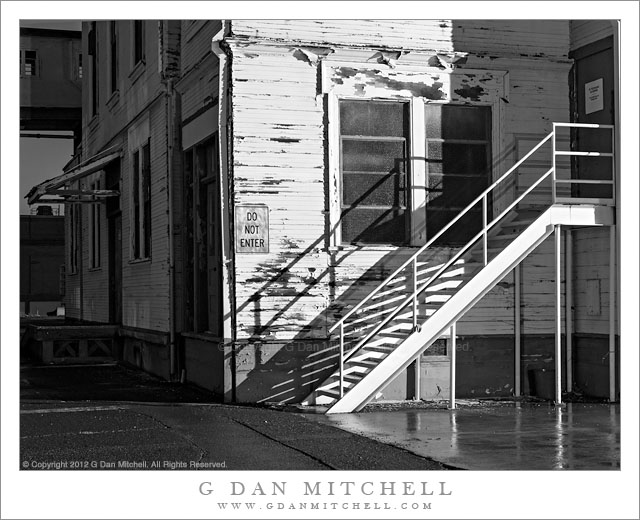
Stairway, Rain

Stairway, Rain - Black and white photograph of a stairway and a portion of a front wall of a building on a rainy evening at the historic Mare Island Naval Ship Yard, Vallejo, California
Black and white photograph of a stairway and a portion of a front wall of a building on a rainy evening at the historic Mare Island Naval Ship Yard, Vallejo, California

Stairway, Rain. Mare Island Naval Ship Yard, Vallejo, California. November 17, 2012. © Copyright 2012 G Dan Mitchell – all rights reserved.

Black and white photograph of a stairway and a portion of a front wall of Building 45 on a rainy evening at the historic Mare Island Naval Ship Yard, Vallejo, California

I interrupt the almost-steady stream of landscape photographs from the American Southwest (of which there are many more to come) to share a photograph of night photography at the historic Mare Island Naval Ship Yard near Vallejo, California. Depending upon where you see/read this, you may not know that I have been photographing this place at night for a half-dozen years or more, joining a large number of other night photographers who continue to be fascinated by the place. The San Francisco Bay Area group known as The Nocturnes has been instrumental in uncovering the photographic potential of this wonderful location and in ensuring its respectful treatment by photographers, and I was there with them again this week. I’m certain that many people who drive past and see “Mare Island” signs have no idea of how long this place has existed (well back into the 1800s) nor of its historic importance (the first US west coast major ship yard) or some of its “issues,” including the transition from the military to civilian uses and all of the things that this entails.

The whole area, but especially that around the “historic core,” is quite an amazing photographic resource, especially for those who have worked to “see” it at night. There are a number of obvious, impressive, and iconic features – the gantry structures, the power plant, many old buildings, dry docks, and more – yet return visits begin to reveal smaller and subtler features that you could miss on a single visit. There was one wrinkle in this week’s shoot – RAIN! When we assembled there before sunset – for photograph sharing and talk – we knew that a weather front was headed our way, but we hoped that it might hold off long enough to let us complete some shooting first. I wasn’t so sure. (The weather radar app showed a front very close to us!) As soon as it was dark enough, I quickly went to work at this building that I had seen earlier in the day when I arrived. It was already beginning to sprinkle when I got there, and soon the rain increased to the point where I had to work under an umbrella as I completed some relatively long exposures. (For real fun, try juggling camera, lenses, bags, tripod, and an umbrella… in increasing wind… and rain… while trying to attach camera to said tripod and compose and focus!) I had time to make five or six photographs at this location before I had to seek shelter along with my Nocturnes colleagues on the front porch of one of the old officers’ mansions.

G Dan Mitchell is a California photographer whose subjects include the Pacific coast, redwood forests, central California oak/grasslands, the Sierra Nevada, California deserts, urban landscapes, night photography, and more.
Blog | About | Flickr | Twitter | FacebookGoogle+ | 500px.com | LinkedIn | Email

Text, photographs, and other media are © Copyright G Dan Mitchell (or others when indicated) and are not in the public domain and may not be used on websites, blogs, or in other media without advance permission from G Dan Mitchell.
Some Thoughts on Aperture and DOF and Related Issues

(This post is slightly adapted from something I recently posted in a photography forum in which hyperfocal distance, “DOF calculation” software, and related issues were under discussion.)

Shooting as a way to learn to understand how things like depth of field or “hyperfocal distance” work is a great idea – it is perhaps the best way to understand these concepts. I firmly believe that it is better than relying on tools such as software DOF (“depth of field”) calculators or tables. Fortunately, it is easy to do some basic experiments related to aperture and DOF and the so-called hyperfocal distance.

(The term hyperfocal distance can be interpreted in a couple of ways. In photography, this is often thought of as the distance at which you might focus in order to place objects at different distances in focus. If there is an object that is 15 feet from the camera and there are important subjects at infinity, the hyperfocal distance lies beyond the object that is 15 feet away and closer than the far away objects that might be in focus with the lens set to “infinity.”)

To find out about the effect of aperture on DOF, try the following:

  1. Put the camera on a tripod and compose some reasonable test image that includes subjects at various distances from the camera position, with a primary subject somewhere between the closest and the furthest.
  2. Focus on your primary subject within the scene.
  3. Shoot a series of images at apertures ranging from the largest to perhaps f/16 – shoot at f/1.4, f/2, f/2.8, etc. You might want to go as far as f/22 on full frame.*
  4. If you want to be a bit more methodical, you can use your DOF tables/software to “calculate” your hyperfocal distance, focus there, and repeat the process – but, frankly, I wouldn’t bother.
  5. Spend some time – likely well under an hour – looking over the results on your computer. If possible, make a few small prints to confirm the relevance (or not) of what you observe on the screen.

Another great way to understand the effect of aperture on the depth of field in your shot is to shoot in live view mode on your DSLR. Here you can press the DOF preview button, zoom in the live view display to 5x or 10x magnification, and pan around the magnified image on the rear display to see a very good approximation of the effect of your aperture choice on elements of the scene at various distances from the camera.

SIMPLIFICATION: A SECRET

Let me share a little secret. From reading some photography forum posts, you might get the idea that lots of photographers are going around making careful and technical calculations of precise hyperfocal distance and DOF and all the rest and then making exactingly accurate choices about aperture for each shot. In general, it doesn’t work that way in the real world, where photographers often tend to select aperture in basically three ways:

  1. In a shot where the subject doesn’t have a lot of depth and DOF isn’t really an issue, we tend to shoot at some default aperture that we believe is more or less optimal for overall resolution, corner resolution, and perhaps vignetting. On full frame, this might frequently be roughly f/8, though there are reasons to vary from that a bit sometimes.
  2. When working a subject on which we want very large DOF, we tend to go straight to the smallest aperture that we feel will produce large DOF and very good resolution. For me, this is typically f/16 on full frame, it might be no smaller than f/11 on cropped sensor cameras. There are situations in which I might use a smaller aperture, but they are very rare and will involve acceptance of some tradeoffs.
  3. When faced with a shot in which we want very narrow DOF, we tend to open up as much as we think we can, perhaps tending toward the largest aperture on the lens we are using. There are some additional factors to consider here, but I’ll leave them out for now in the spirit of simplifying.

So, a simple generalized approach:

  • Shoot at some middle-of-the-road aperture when DOF isn’t a major concern.
  • Shoot at the smallest acceptable aperture when you want large DOF – f/16 on full-frame or f/8-f/11 on crop.
  • Open way up when you want to minimize DOF.

This approach works in a wide range of real-world photographic situations, and it is especially useful to begin with it when you have to work quickly. There will be situations in which these are simply starting points, and you’ll need to make some modifications – for example, in very low light you might not be able to use that very small aperture if you are shooting hand-held, or your largest aperture might produce DOF that is too narrow for some subjects, and so on. But starting with this simple basic concept, using live view DOF preview when appropriate, and learning from experience will likely move you a lot further along on the road towards understanding and making effective use of aperture/DOF than trying to rely on some DOF calculator. (Depite their appearance of accuracy, these calculators depend on a bunch of assumptions that may not match up with your photography.)

* You can stop down further on cameras with larger sensors before you run into issues with diffraction blur, a softening of the overall image that occurs with the smallest apertures. To generalize, while you can stop down to roughly f/16 on a full frame and still produce very sharp images, you might want to avoid such a small aperture on your cropped sensor DSLR, perhaps avoiding anything smaller than about f/11… and you might want to be a bit cautious about using f/11.

© Copyright 2012 G Dan Mitchell – all rights reserved.

G Dan Mitchell is a California photographer whose subjects include the Pacific coast, redwood forests, central California oak/grasslands, the Sierra Nevada, California deserts, urban landscapes, night photography, and more.
Blog | About | Flickr | Twitter | FacebookGoogle+ | 500px.com | LinkedIn | Email

Text, photographs, and other media are © Copyright G Dan Mitchell (or others when indicated) and are not in the public domain and may not be used on websites, blogs, or in other media without advance permission from G Dan Mitchell.

Almost Time for Eastern Sierra Aspen Color

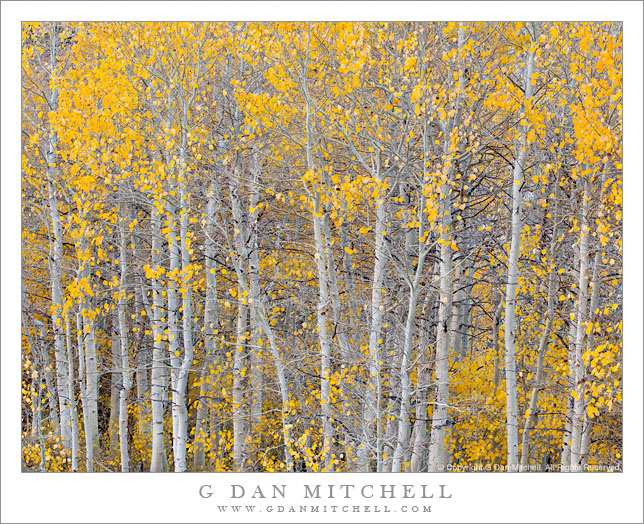
Aspen Thicket, Bishop Creek - Bright yellow autumn leaves festoon a dense aspen thicket along Bishop Creek near South Lake, California.
Aspen Thicket, Bishop Creek – Bright yellow autumn leaves festoon a dense aspen thicket along Bishop Creek near South Lake, California.

Earlier today I posted my first photos of fall color from the 2012 season, so it seems like a good time to re-share my overview of photographing the Eastern Sierra aspen color, “Sierra Nevada Fall Color – Coming Sooner Than You Think!” The article gives a general outline of where you might look for aspen color in areas from about Carson Pass south to just below Bishop, and also goes into some ideas, both technical and aesthetic, about how you might photograph this subject. I first posted the article three years ago, and I’ve updated it each year since then.

The “coming sooner than you think” part of the article’s title seems especially appropriate this year. Although one can never be absolutely certain how the color change will play out or when it will start and end, there are signs that things may be a bit different this year. The main thing is that some color seems to have appeared a bit earlier than usual. I found some interesting color (though distinctly short of peak color) on a three-day backpacking trip into McGee Canyon on September 14-16 this year – and that seems significantly earlier than I normally expect. I have also heard some second- and third-hand reports of a bit of interesting color already developing in a few other aspen areas.

(9/25/12 update: Various sources who have been in the Sierra since I wrote the original post or who are there now are generally reporting that the color transition has indeed begun a bit ahead of schedule this season. While the progress of aspen color can never be precisely predicted, I’d plan on erring on the side of arriving a bit early this year – in fact, that’s precisely what I plan to do!)

G Dan Mitchell is a California photographer whose subjects include the Pacific coast, redwood forests, central California oak/grasslands, the Sierra Nevada, California deserts, urban landscapes, night photography, and more.
Blog | About | Flickr | Twitter | FacebookGoogle+ | 500px.com | LinkedIn | Email

Website and Affiliate News

Every so often it seems like time to do a bit of updating around the blog, and I’m embarking on a bit of that work here at the end of the summer season. Some of the changes are minor or even invisible, but you may notice others as you look around the blog – now and during upcoming weeks. One change has been to move some affiliate links to where you can find them a bit more easily in the right sidebar of the blog.

B&H Photo is the well known vendor of photography, video, audio, and many other products – with an impressive storefront in New York City and a great online store that carries just about anything photographic that you might need or want.

Craft And Vision eBooks

Craft & Vision has pioneered the creation and sales of excellent and inexpensive eBooks on a wide range of photographic topics, and written by a group of experienced photographers.

ThinkTank Photo

ThinkTank Photo produces and sells a range of very high quality and innovative photographic bags and related gear. My primary gear bag is their Airport Acceleration bag.

I personally purchase and use products from each of these vendors. I’m grateful when you make purchases through these links since they help support the blog and you get the same prices on great gear. If you find the information at this blog useful, consider making your purchases through these links. Thanks!

© Copyright 2012 G Dan Mitchell – all rights reserved.

G Dan Mitchell is a California photographer whose subjects include the Pacific coast, redwood forests, central California oak/grasslands, the Sierra Nevada, California deserts, urban landscapes, night photography, and more.
Blog | About | Flickr | Twitter | FacebookGoogle+ | 500px.com | LinkedIn | Email

Text, photographs, and other media are © Copyright G Dan Mitchell (or others when indicated) and are not in the public domain and may not be used on websites, blogs, or in other media without advance permission from G Dan Mitchell.