
Tag Archives: photography

Photographic Myths and Platitudes – Primes Make You a Better Photographer

(This is another in my series of occasional posts based on my replies to questions about photography that come up from time to time. This question was under discussion in an online photography forum, where the discussion began with a new photographer asking whether the acquisition of certain equipment would make him a better photographer. Those with experience in photography know the answer to this question, but it comes up, explicitly or implicitly, all the time, so I think it is worth another look here. The following text is a slightly edited and expanded version of my original answer. This is also part of my “Photographic Myths and Platitudes” series of posts. )

For the moment I’ll leave the full-frame question aside * – not that there isn’t a lot to say about it in the context of your desire to become a better photographer – and just respond to the following:

“My goal here is to become a better photographer. I feel zooms make me lazy, and that primes would make me think more about my photography.”

Sorry to say, but that is nonsense, plain and simple.

This notion that somehow primes are more “serious” than zooms comes up from time to time, and certain folks who post about photography (though not so often people who actually do a ton of photography) encourage this odd and unfounded line of thinking. I’ve speculated about where it comes from at times, and some of the following come to mind:

  • There is a certain mindset among some folks who desire to be viewed as artists that holds that being “different” is the most important characteristic of artists. (It isn’t, by the way.) And by doing something different, like using only primes, they may feel that they have established their different-ness from a world in which most others use zooms most often.
  • There is another notion that modern is not as good as “classic,” and therefore sticking to older equipment types is better. While there can be a risk of being too infatuated with new stuff just because it is new (perhaps the opposite form of gear obsession from the extreme of automatically dismissing the new) it just doesn’t make sense to automatically assume that, for example, because Henri Cartier-Bresson shot with primes that  you should, too. (HCB, by the way, did not choose the gear he used because it was “classic” – he chose the newly developed and quite modern small 35mm film cameras for a variety of reasons relating to his specific needs.)
  • There is also an odd notion that assigns an almost moral imperative to doing things the hard way, and that then presumes that those who do things in a more efficient or practical way must not be as serious as artists. Therefore, if shooting with zooms is “too easy,” shooting with primes must be better. This is often paired with the derisive advice to “zoom with your feet” or a claim that “zooms will make [you] lazy.” (Artists typically have no interest in making their work harder; they are generally far more concerned with making it better, and will use any tools or methods that accomplish the latter goal.)
  • Finally, there is the unfortunate notion, not unique to photography, that being “better” is largely the result of having the best or the “right” equipment – e.g., if I use this sort of camera or this sort of lens I will be more of an artist than if I use that camera/lens. The seed of truth in this – photography does require equipment – is too often built up into a false notion that photography is largely or even primarily about what gear you use.

The “zooms will make you lazy” business completely baffles me. Yes, folks doing point and shoot photography often may use a zoom that way, just zooming to get the shoot of their kids or the waterfall that most fills the frame, without bothering to move from their current position. But that fact that casual amateurs can use a zoom lens on their point and shoot cameras that way does not mean that the use of a zoom always means that this is the way one shoots. Continue reading Photographic Myths and Platitudes – Primes Make You a Better Photographer
Getting Skunked at Point Reyes

Yesterday I got sort of “skunked”* at Point Reyes National Seashore – yet, again. ;-)

I get to shoot there from time to time – a beautiful and interesting place that is not so far from me that I can’t drive there and back in a day. I find it fascinating in many ways, but also a bit difficult to get my brain around how to photograph it. While I can show up in the high Sierra – that region from the lodgepole forests well up above timberline – and almost immediately find a wealth of subjects, at Point Reyes I have to search and look a lot!

There are, I think, several reasons for this. Frankly, a place like Point Reyes, as spectacular as it can be in the right places and at the right times, often does not call attention to itself in the same ways that some more dramatic landscapes do. Much of the park is covered with a low, dense forest, and other places are largely bucolic and grass-covered hillsides. I love the beaches and the estuaries and inlets, but they tend to offer peaceful quiet more than stunning features.

A part of it is the need to know where, when, and how to look. A few weeks ago I hiked on a long trail past the of the estuary areas, on a day that was mostly foggy. At first, it was difficult for me to see any photographs in this particular landscape, even though I like the fog and enjoyed being there. Liking a place and seeing how to make photographs of it can be quite different things. However, on that afternoon and evening I did get the sense of this landscape enough to make a few photographs that I believe “work.” They are not necessarily the photographs I thought that I would make, but instead photographs that I found as I spent more time just looking and getting the sense of the place.

I also have to get lucky and/or change my expectations at Point Reyes. The weather there is, as is often the case on the Pacific coast, quite variable. Yesterday, on one side of main ridge along Tomales Bay the sun was out. But I could see that further north there were wisps of fog, and I started developing some ideas about photographs that might include sun and perhaps a bit of fog. But when I crossed the ridge to go to Limantour the fog line was just inland from the coast and those ideas were not possible. I did make some photographs – and I think I’m going to like at least a few of them – but I also spent a lot of time walking and looking and not photographing, just enjoying the foggy atmosphere (which, when the wind came up, reminded me of the coming winter) and the sounds.

* For those who might not know, “skunked” is an American English idiom that essentially means “defeated or frustrated,” though in a manner that might be a bit self-deprecating and perhaps humorous.

© Copyright 2012 G Dan Mitchell – all rights reserved.


G Dan Mitchell is a California photographer and visual opportunist. His book, “California’s Fall Color: A Photographer’s Guide to Autumn in the Sierra” (Heyday Books) is available directly from him.

G Dan Mitchell: Blog | Bluesky | Mastodon | Substack Notes | Flickr | Email


All media © Copyright G Dan Mitchell and others as indicated. Any use requires advance permission from G Dan Mitchell.

Photographing Icons – Or Not

Yesterday I shared elsewhere a photograph that someone had posted featuring a line-up of scores of photographers, arrayed tripod-to-tripod, ready to photograph one of those iconic views that we all know so well. I suspect that we have all been to such places and either found the experience of seeing and photographing them to be powerful… or we might have been repulsed by the crowds of people all apparently trying to “capture” the same thing, among them perhaps a number of folks who might be trying to almost literally recreate versions of the scene that they had seen elsewhere.

The point of the share (seen here and here) was not complimentary. My reaction to the photograph was to wonder, even more than usual, why people would want to make photographs that way. I phrased it as, more or less, “yet another reason to avoid photographing icons.”

However, a person wrote to me after I posted and pointed out, with a bit of anger and with some justification I think, that complaining about and putting down those who want to photograph a beautiful place might seem a bit pretentious and self-righteous.

She has a point.

While there is something a bit troubling about seeing dozens of people lined up to make the very same photograph, some of us might be a bit too quick to jump to overly negative conclusions. Perhaps there is a way to cast this as a positive lesson, rather than ridicule. So let me engage in a bit of reflection and honesty. Continue reading Photographing Icons – Or Not

A Photograph Exposed: Photography and Luck

(“A Photograph Exposed” is a series exploring some of my photographs in greater detail.)

I have never been shy about admitting the role that luck plays in producing effective photographs, especially photographs of the natural world. Vision and knowledge and experience and planning and all the rest are important, but we kid ourselves if we imagine that we are in control of our subjects to any great degree. The topic came up in a recent discussion, so I thought I’d share an edited version of my response here.

I can tell you with certainty that luck plays at least some role in many, if not the majority, of my landscape photographs. It is not the only thing, and preparation of all sorts is critical, but in the end almost every photograph depends on conditions and circumstances that are largely beyond my control. I’ve written quite often at my blog about the sudden unanticipated appearance of magical light or atmosphere, snap decisions to be here instead of there, showing up in a place to find the key element that I could not have predicted, and random decisions that led (or not!) to special photographs.

The following photograph is one of my favorite illustrations, though I could use scores of others to make the same point.

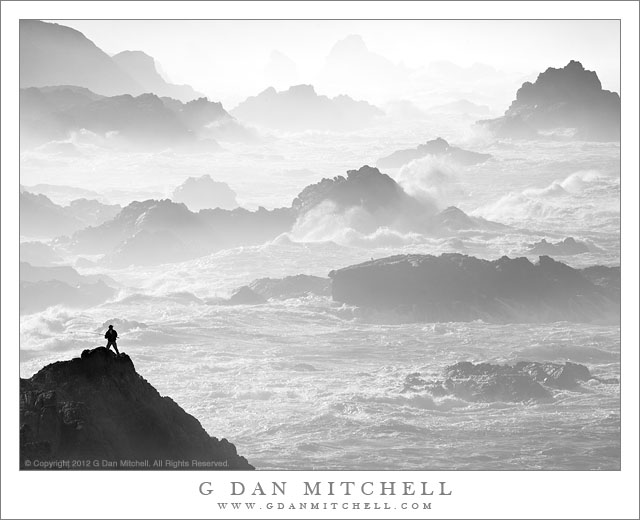
Fisherman, Winter Surf - Big Sur fisherman casts into the roiling winter Pacific Ocean surf.
Fisherman, Winter Surf

(To make the story even wilder, I ended up with three images of this scene, and I still have a hard time selecting a favorite.)

So, how did this photograph come about? It sure looks like it must have taken some planning to get that individual fisherman posed in front of the stupendous winter surf, right? Or else some serious Photoshop trickery ? No, on both counts.

One morning I decided to photograph at Point Lobos along the Central California coast – a bit less than an hour and a half from where I live. Why Point Lobos on that day? It is hard to say for sure since even though I knew that high surf was possible, I could have gone to many other coastal locations to find it. It is a place I photograph often, but so are at least a score of other locations within the same radius of my home. So, for no clear reason that I can articulate, other than it is one of the places I like to shoot, I headed that direction.

I got there  too early, and the park was still closed. I pulled up to the entrance, joining the short line of cars waiting for the gate to open, and figured I’d wait. As I sat there, I realized that I might as well drive around and see what else I could find while waiting. So I started the car, made a u-turn, and returned to highway 1, the Pacific Coast Highway. Should I go left (north) or right (south)? No idea. Oh, what the heck, I guess I’ll go south. (Less traffic to worry about when turning right onto the highway…)

Continue reading A Photograph Exposed: Photography and Luck