For those of us who chase aspen color in the Sierra Nevada every fall, speculating about the potential of the upcoming aspen season is an annual obsession. Will the season start early or late? Will the colors be spectacular or less so? How will the past season’s weather affect it? What are the early signs telling us? When will the peak arrive and when will the show be over?
I’ve been playing this game — with enthusiasm! — for some years now. A few years back I think I finally figured out that I cannot really tell what will happen until it actually happens. As often as not, my “predictions” turn out to be less than perfect and/or immediate conditions (arrival of an early storm, wind, rain, etc.) throw me a curve. The real game is in being flexible and quick to respond to evolving conditions, and to have enough experience with the subject that you have some intuitions about what to do when you encounter the conditions on the scene.
Early Autumn Snow, Eastern Sierra
Yet, I still can’t help but look at Sierra conditions here in September and try to extrapolate forward a bit. As I make my guesses — and frankly, guesses is what they are — about the upcoming Sierra aspen season, a few things are on my mind: Continue reading Sierra Fall Color Speculation (Morning Musings 9/14/14)→
Thoughts about seasonal light in the Range of Light…
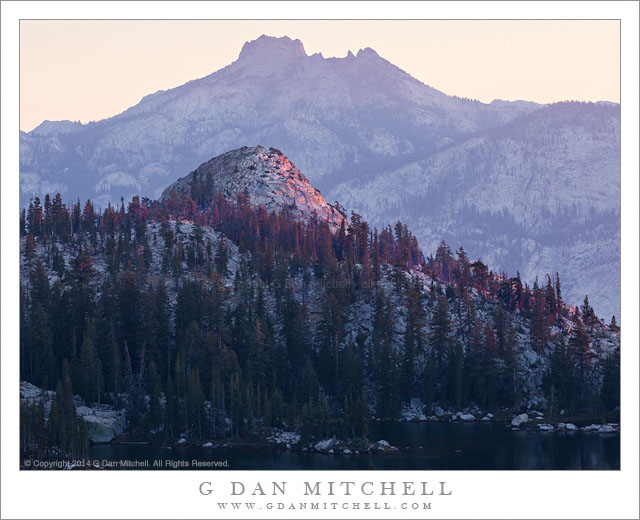
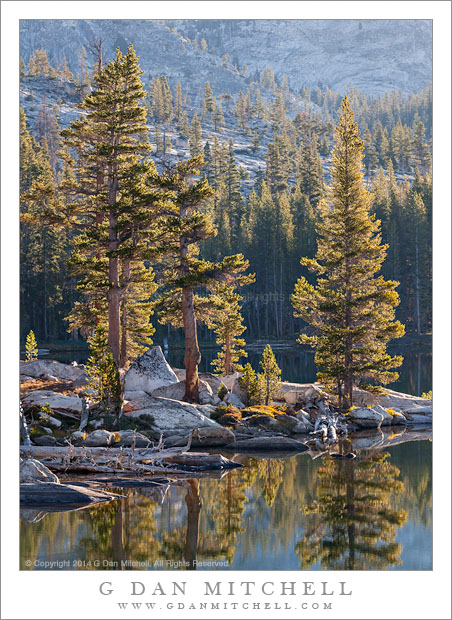
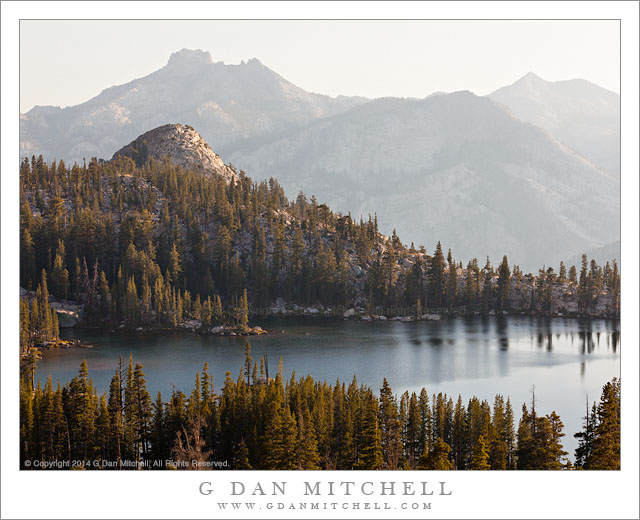
Sunset, Lower McCabe Lake
It is no secret that I can find something to love about every season in the Sierra Nevada — the storms and snow of winter, the wildly flowing water and new growth of spring, and the lazy days of summer that bring easy access to the high country. But if I had to pick one perfect day in the Sierra high country it would be in fall.
This ideal day would come some time between the middle of September and the middle of October, when it becomes increasingly clear that summer really is ending and that winter really is on its way. This is not a wild season — no giant winter storms, no raging rivers and waterfalls, no spectacular growth and colorful fields of wildflowers. It is a quieter time. The crowds are almost all gone, and the people you do meet there are more likely to be those with a deeper relationship with this range.
The light is beautiful — perhaps as beautiful as it gets — and perhaps even more precious because it doesn’t last as long on these shortening days of the late season. The sun is lower in the sky and less intense, and there is often a muted, golden quality to the light, amplified by the golden colors of dry meadows, the beginning of fall colors, and softened by seasonal haze. And it is all the more sweet because we know that winter is just around the corner and that these days will end very soon.
G Dan Mitchell is a California photographer and visual opportunist whose subjects include the Pacific coast, redwood forests, central California oak/grasslands, the Sierra Nevada, California deserts, urban landscapes, night photography, and more. Blog | About | Flickr | Twitter | Facebook | Google+ | 500px.com | LinkedIn | Email
For various reasons — projects I’m working on, clear signs of the changing seasons, photographs I’ve recently seen — I have been getting into that autumn frame of mind that comes at about this time every year. With that in mind, today’s “morning musings” post is about finding and photographing fall color in the Sierra Nevada. Rather than re-writing the whole thing, I’ll start by pointing you to an extensive guide that I wrote a few years ago and have updated every year since that time — if you are thinking of chasing aspen color this fall you may want to take a look: “Sierra Nevada Fall Color — Coming Sooner Than You Think”
If things evolve on a relatively typical schedule, eastern Sierra aspen color is perhaps about six weeks away. I have been photographing this subject for a while now, and it is one of my favorites. I intend to be out there again this fall.
Aspen Color, North Lake
One popular game at this time of year is to predict/guess when the colors will arrive and how good they will be. I’m fully aware that I’ve been wrong quite a few times, and my increasing knowledge of this subject has perhaps only made me more aware of how unpredictable this can be. However, this year I have to wonder about the effects on the trees from our three-year California drought, which has reached an extreme level all across the state this year. I don’t know what the results will be, but I’m considering some possibilities:
During the last two years it seemed to me that I was seeing the onset of color move a bit earlier in the season. I have to wonder if we may see stressed trees go into fall mode a bit on the early side this year.
Some people say that they are seeing a few aspen groves turning brownish-yellow already and looking like they are drying out.
Also during the last few dry years we have seen some anomalous early season storms, and I wonder if that pattern will continue. This can affect the season in various ways if it happens. On the negative side, leaves can blow down early. On the positive side, snow and aspens can make a beautiful pair.
As always, to the extent possible, I like to remain flexible about when and where I’ll photograph the aspens, and I watch the evolving conditions to see what this season may bring. How about you? What are your fall color plans?
G Dan Mitchell is a California photographer and visual opportunist whose subjects include the Pacific coast, redwood forests, central California oak/grasslands, the Sierra Nevada, California deserts, urban landscapes, night photography, and more. Blog | About | Flickr | Twitter | Facebook | Google+ | 500px.com | LinkedIn | Email
Trees on a snowy bench in front of the granite face of Half Dome
With this photograph I continue on the theme of Yosemite Valley winter photographs I made back in the late winter, while there for the opening of an exhibit in the Valley. The opening was just one evening, but that meant that we had most of three days to photograph. It had been anything but a snowy winter in the Sierra, but we were fortunate to arrive not long after one of the few snowstorms, and the Valley walls and pinnacles had a thin coating of new snow.
While out in a meadow photographing other subjects I looked up and saw that some of that snow was still plastered to the vertical face of Half Dome and to the row of trees standing precariously on the ledge running down from right to left at the base of the main cliff. Such places in the Valley are very interesting to me — spots that everyone can see but which remain virtually inaccessible to all but some climbers… and to photographers with long lenses who look closely. And, yes, I’m aware of the obvious precedent when I use the term “monolith” in the title of the photograph.
G Dan Mitchell is a California photographer and visual opportunist whose subjects include the Pacific coast, redwood forests, central California oak/grasslands, the Sierra Nevada, California deserts, urban landscapes, night photography, and more. Blog | About | Flickr | Twitter | Facebook | Google+ | 500px.com | LinkedIn | Email