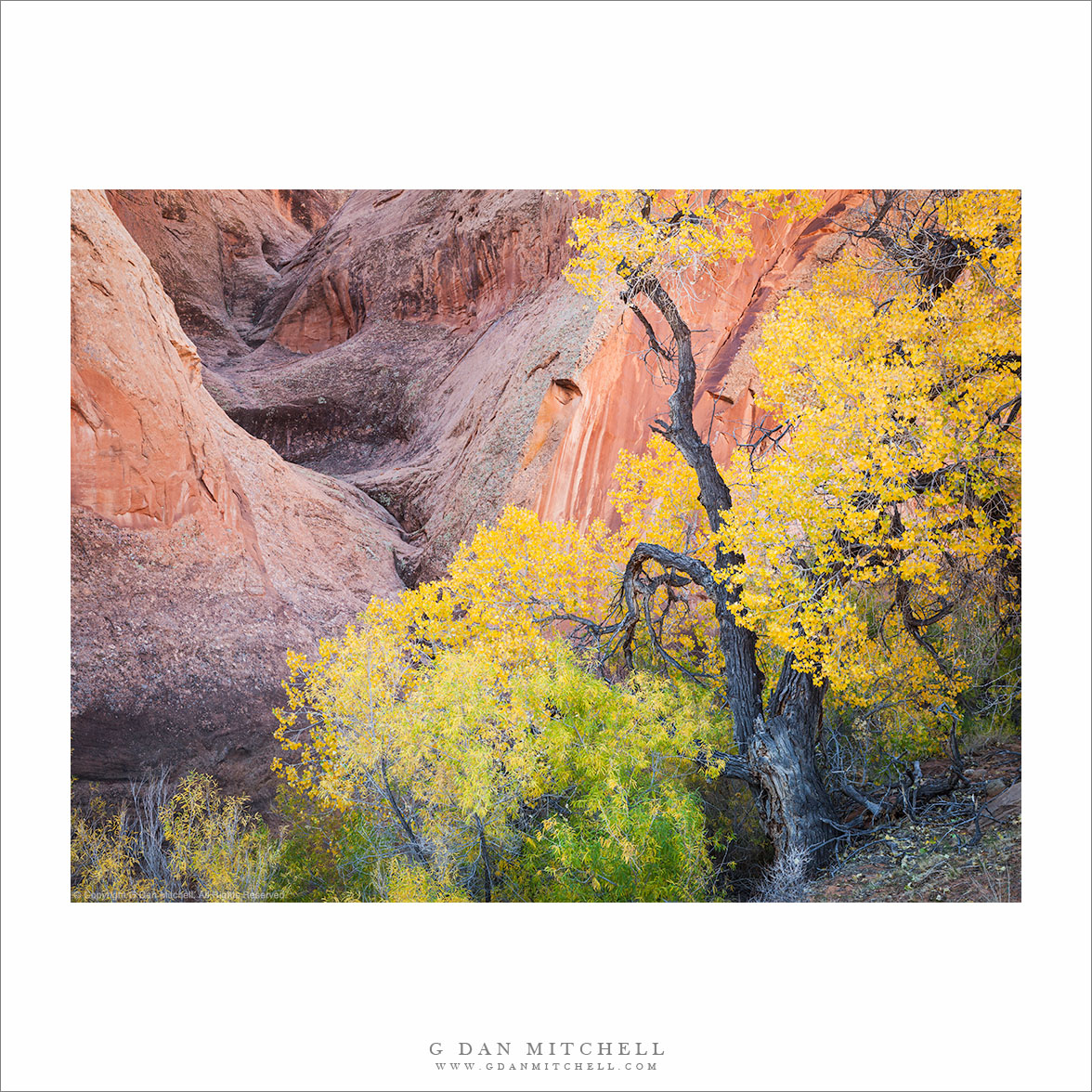
“Large Cottonwood Tree, Side Canyon” — A large cottonwood tree with fall colors in front of sandstone walls and a side canyon
During a bit of hard drive housekeeping this week I found a folder full of files from a Utah visit in 2012. Because I have a hard drive that is about to fill, I’ve been looking for unused and unneeded files that invariably get left behind after work on various projects — you know, the files that I “just might want to keep around, just in case.” I think that the batch in this folder were transferred from my laptop, and they are most likely files that I worked on quickly in the field and planned to update on my desktop computer later. My first thought was that I’d just delete the folder, but then I looked more closely and found several files that I want to keep.
This is one of the keepers. Although I hadn’t thought if it for quite a while, I now recall this little canyon junction quite distinctly, a place were a smaller side canyon dropped down into the larger canyon through which we walked. Scale is hard to judge against this landscape, but the old cottonwood is very large, especially for one in the base of a narrow canyon. This photograph reminds me of something else, too — I need to get back to these canyons!
Leave a comment or question using the form. (If you are reading this on the home page, click the article title to see the full article and the comment form.
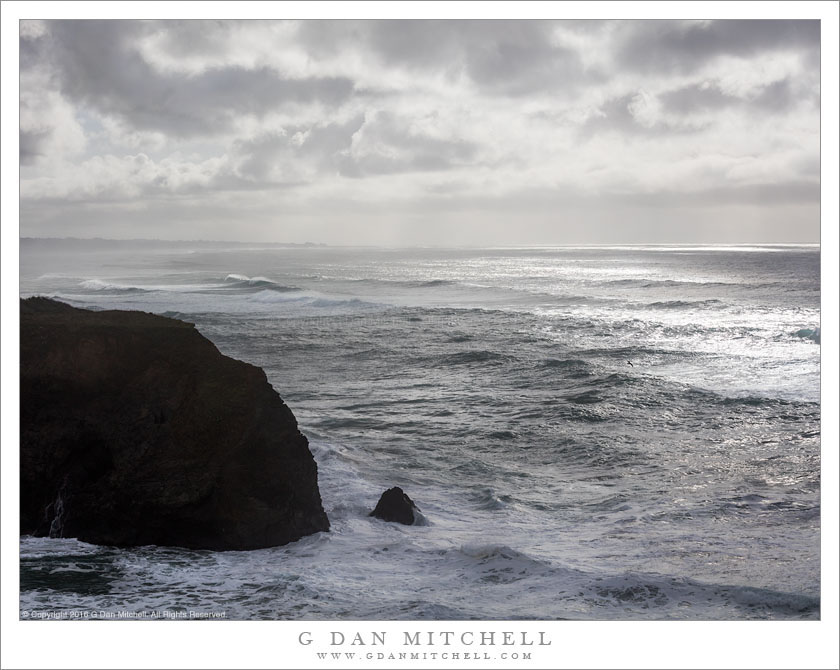
An autumn storm clears along the Northern California cost above Fort Bragg
On this November day, the light along the Pacific coast north of Fort Bragg, California was mostly spectacular and in a constant state of change. In rained, occasionally hard and more than once taking us by surprise, there was fog, the sun appeared, clouds were dark one moment and luminously bright the next.
We paused at this overlook, where the meeting of land and water is less steep. The nearly level coastal bluffs run along the water at the base of low coastal mountains, and the underwater slope is also apparently not very steep, judging from the distance from the shoreline that the waves begin to rise and break. The atmosphere was semi-opaque, filled with a combination of fog and light rain, and the glow of light on clouds was diffused and soft. To the west, sun broke through the clouds and lit the water brilliantly in patterns that curved toward the horizon. The waves broke against the seaward side of the huge sea stack — more of an island, really — that stood in front of us just off from the shoreline.
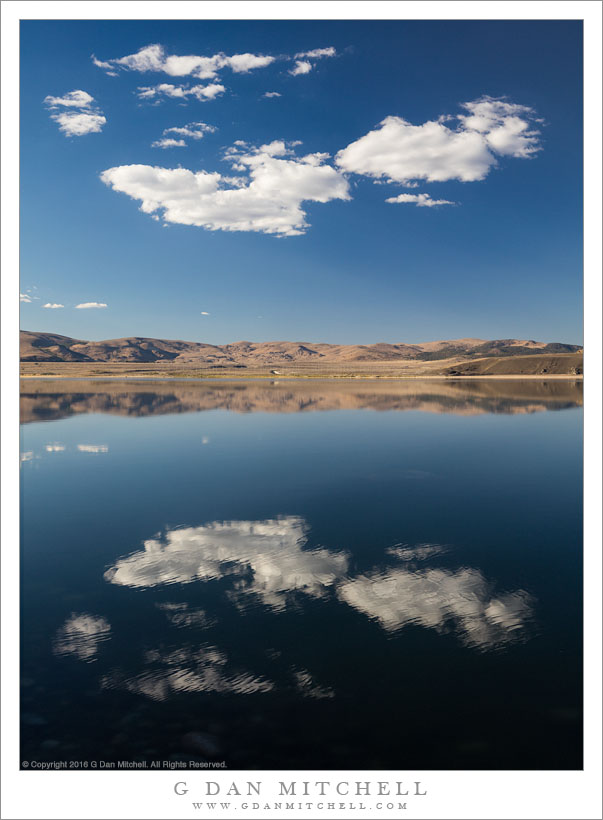
A few scattered clouds are reflected in the surface of Mono Lake on a windless day
As I have returned to Mono Lake over the years, my orientation to the place has changed. (I guess that is a sort of general theme with me, now that I think of it — repeated visits to a familiar place over long periods of time are rewarded with a continually evolving knowledge of the place.) First it is just a very big lake. They one usually discovers tufa towers, followed perhaps by birds. My concept of the place has now come to center on quiet immensity, with open sky above, perhaps interrupted by the sounds of birds.
Mono Lake is often a windy place, but at times, especially early in the day, the winds can die down or even stop, and the stillness becomes palpable. On this day I traveled out to a shoreline area I had not visited before, and one that is not particularly popular or well-known. I parked and walked down a slope towards the water, where I found its surface almost still and reflecting the shapes of a few clouds to the north.
G Dan Mitchell is a California photographer and visual opportunist whose subjects include the Pacific coast, redwood forests, central California oak/grasslands, the Sierra Nevada, California deserts, urban landscapes, night photography, and more. Blog | About | Flickr | Twitter | Facebook | Google+ | 500px.com | LinkedIn | Email


 G Dan Mitchell is a California photographer and visual opportunist. His book, “California’s Fall Color: A Photographer’s Guide to Autumn in the Sierra” is available from Heyday Books and Amazon.