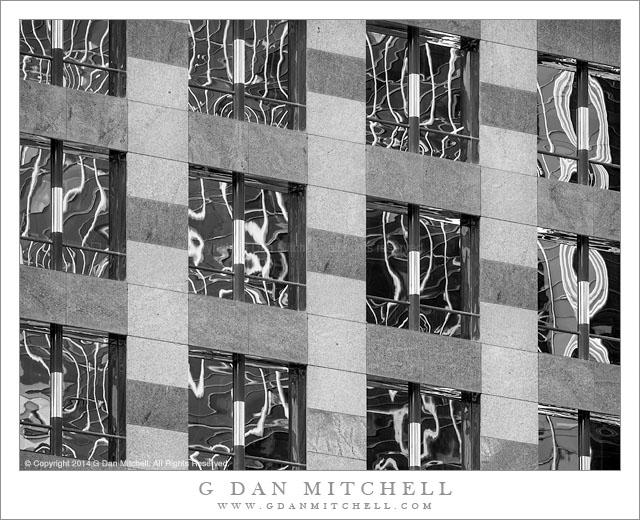
Exterior surface of a Chicago building, including distorted window reflections
This is another small bit of Chicago urban landscape, this time a detail of a downtown building that contrasts the very regular and geometric shapes of textures of the vertical and horizontal features against the wildly random and distorted patterns in the windows.
Brilliantly colorful autumn cottonwood foliage winds down a Utah red rock canyon
After four days of photography and camping in the far reaches of the Grand Staircase-Escalante National Monument, I came out to civilization and spent a night at Boulder Mountain Lodge. (Not my usual thing, but I had an appointment to meet someone there — and it was quite a fine visit!) Arriving a bit early, I decided to head out on a nearby road just to see what I could see.
I knew this road a bit from traveling it in the past — I was looking forward to red rock cliffs and some cottonwood color. But I was not prepared for the intensity of the autumn cottonwoods in this little canyon. The effect was a combination of arriving at the peak moment of color for these trees, and the fact that the light was slightly softened by some high clouds. The result was one of those colorful scenes that you imagine but rarely actually find, with the tree winding down the canyon and around the far bend.
This is another of my architectural detail photographs from our summer 2014 visit to Chicago. We decided to cross the continent the old-fashioned, slow way — we took the train from the San Francisco Bay Area to New York City. The first leg was on the venerable California Zephyr to Chicago, and we decided to take a few extra days in Chicago before boarding the Lakeshore Limited (also apparently known as the Late Shore Limited…) to Manhattan. We stayed right in downtown Chicago, just a few blocks from Millennium Park, so there was plenty to see and do. One morning we took the architectural tour up the river, something that I had not done before.
I enjoy Chicago. Part of it appeals to my long-ago midwestern roots, I think. But it is also a cosmopolitan big city with a quality all its own. While the buildings are as huge as those of any other big city, the urban center sprawls in a way that is quite different from, say, New York City or from our familiar San Francisco. It seems like views of the architecture are a bit more opened and varied, and much more light seems to get down to street level. I’ve long been fascinated by close-in photographs of building details, especially when they include windows like these. When I look at them initially I see a big, sturdy building. But looking more closely I see that most of what I’m looking at is not-the-building, but instead is a series of reflections and reflections of reflections in the windows, and the whole structure starts to take on a more insubstantial quality.
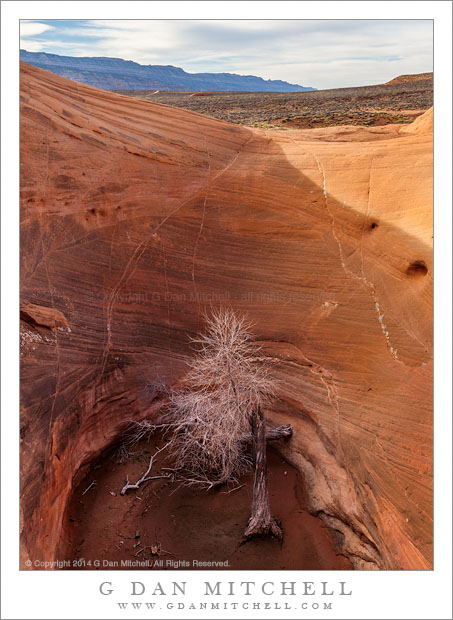
Dead trees lie at the bottom of a deep sandstone pothole, Grand Staircase-Escalante National Monument
There are multiple ways to react to the remarkable sandstone potholes from this terrain of rounded sandstone hills and gentle slabs. First of all, they are remarkable structures. They are simply “holes” in the sandstone — but surprisingly large holes. They are many feet across and perhaps 15-20 feet deep. They have no outlet, and you can imagine that with the right water source they would make rather gigantic swimming holes. Their source is not immediately apparent, though I understand that they are created over a long period of time by the forces of wind and water on the relatively soft sandstone.
They are beautiful, too. Their smooth, curving shapes have an almost sensuous quality, made stronger by the warm colors of the sandstone rock. Surprisingly, plants and even trees grow at the bottom of many of them. But these potholes may also be traps — there is no way out of their depths except for those creatures that can fly. In the middle or relatively smooth expanses of sandstone, these pits appear suddenly, and the angles at their edges quickly increase to vertical, making them potentially dangerous. The pothole in this photograph seems to me to have a bit less of the rock garden quality and a bit more of the ominous quality, with two dead cottonwood trees and broken branches littering the bottom of the pit.
Photographer and visual opportunist. Daily photos since 2005, plus articles, reviews, news, and ideas.
Manage Consent
To provide the best experiences, we use technologies like cookies to store and/or access device information. Consenting to these technologies will allow us to process data such as browsing behavior or unique IDs on this site. Not consenting or withdrawing consent, may adversely affect certain features and functions.
Functional
Always active
The technical storage or access is strictly necessary for the legitimate purpose of enabling the use of a specific service explicitly requested by the subscriber or user, or for the sole purpose of carrying out the transmission of a communication over an electronic communications network.
Preferences
The technical storage or access is necessary for the legitimate purpose of storing preferences that are not requested by the subscriber or user.
Statistics
The technical storage or access that is used exclusively for statistical purposes.The technical storage or access that is used exclusively for anonymous statistical purposes. Without a subpoena, voluntary compliance on the part of your Internet Service Provider, or additional records from a third party, information stored or retrieved for this purpose alone cannot usually be used to identify you.
Marketing
The technical storage or access is required to create user profiles to send advertising, or to track the user on a website or across several websites for similar marketing purposes.

 G Dan Mitchell is a California photographer and visual opportunist. His book, “California’s Fall Color: A Photographer’s Guide to Autumn in the Sierra” is available from Heyday Books and Amazon.