
California Nature Photography Blog

I can’t believe I neglected to mention this earlier, but John Wall asked me to be one of a group of California photographers contributing to the California Nature Photography blog. When John asked, I said “yes” immediately – partly because I’ve seen his work and like it and partly because he came up with a really fine idea for this blog. Wander on over and take a look, and while you are there subscribe to the blog’s RSS feed – you’ll find the link way at the bottom of the home page there.

I have a few posts planned in the near term, with likely photography subjects including Point Lobos, Death Valley, and possibly Muir Woods. I’m certain to post on “my” Sierra Nevada before long now that spring is here and summer is not far behind. I offered my first post there last week, a little piece on California’s “impossibly green” season. I had intended to post earlier… but with all the other interesting posts I decided to wait for a brief lull in the action!
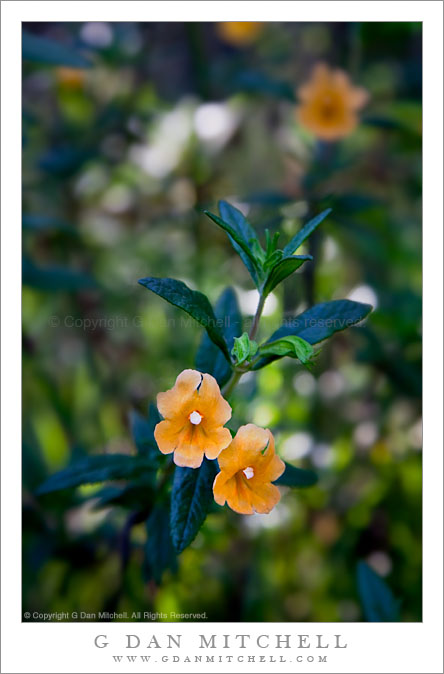
Sticky Monkeyflower

Sticky Monkeyflower

Sticky Monkeyflower. Almaden Quicksilver Park, California. April 18, 2009. © Copyright G Dan Mitchell – all rights reserved.

Spring sticky monkey flower blooms at Almaden Quicksilver Park, Santa Clara County, California.

This is a very common springtime flower in the hills of central California – it is one of the first flowers that I recall learning to recognize when I was a kid. (Something about that name must have caught my attention.) These were photographed along one of my favorite trails at the Almaden Quicksilver Park in the south San Jose area of Santa Clara County.

This photograph is not in the public domain. It may not be used on websites, blogs, or in any other media without explicit advance permission from G Dan Mitchell.

keywords: sticky, monkey, flower, Mimulus aurantiacus, Diplacus aurantiacus, bush, island, blossom, wildflower, plant, foliage, leaf, green, orange, bokeh, almaden, quicksilver, santa clara, county, park, mines, california, usa, san jose, spring, nature, stock

Yosemite Spring Conditions Update

While most photographers in California reserve a part of their consciousness year-round for thoughts of Yosemite (Valley and high country), at about this time of year many think about that location even more. This is the time when the waterfalls really begin to flow and often start to peak as the snow melts at higher elevations, and it is also the beginning of the annual “Great Greening” as plants start to come back to life. In particular, lots of us anticipate the return of the dogwood blossoms.

I’ve been hearing news, and I’ll pass a bit of it along here. Continue reading Yosemite Spring Conditions Update

Wherever We Are Headed, We Certainly Are Not There Yet

Contrary to those who feel that with the introduction of multiple reasonably-priced 20+MP full frame DSLR camera there isn’t much room left for advancement and change, I think that the camera market is still truly dynamic.

One assumption that many make is that the high photosite density full-frame DSLR cameras will “take over” the part of the photographic world previously occupied by medium format (MF) film cameras. Several observations seem to support this notion. The resolution available from carefully used high end DSLRs with the best lenses certainly can compete with that of medium format film, and the arguable advantages of the larger format in terms of image quality would not be enough to convince many to give up the conveniences and lens choices of the best DSLR systems. Even those who might prefer to shoot medium format digital back systems – and I count myself as among those who are interested – are often not in a position to be able to afford the stratospheric cost of the best medium format systems, despite the fact that they compete with large format for image quality.

Some have argued that the costs of the high end systems cannot possibly come down. Some argue (falsely, I believe) that the high costs can not drop because, unlike the costs of computer memory, they are determined by factors that are not subject to scaling. Some argue that the market will never be big enough. However, these folks made the same arguments about the very types of cameras that are now becoming available in the DSLR market – the 20MP and higher full frame sensor camera. Not long ago these cameras cost roughly $8000 and were available from only one manufacturer. They now cost a third of this and are available from at least three vendors.

If you think this cannot happen in the medium format market, perhaps you need to watch a bit more closely. Recently Mamiya introduced a basic medium format digital system (admittedly not one defining the high end of this market segment) at a cost of around $14,000 if memory serves. This week Phase One announced 40 MP medium format backs at cost in roughly the upper teens ($15,000 or thereabouts) range. There are certainly higher priced backs available, but it was only a year or two ago that the 35MP MF backs were the high end – and cost perhaps two or three times this much.

It seems to me that these developments are moving toward bringing MF digital systems to a price point where some who might now get a high-end DSLR system may be able to instead think about going MF.

(Note added later: I just want to acknowledge that I do understand that there are reasons besides pixel dimensions – e.g. number of photosites/MP – to choose MF, and that I also understand that there are reasons other than cost to choose a DSLR. :-)