
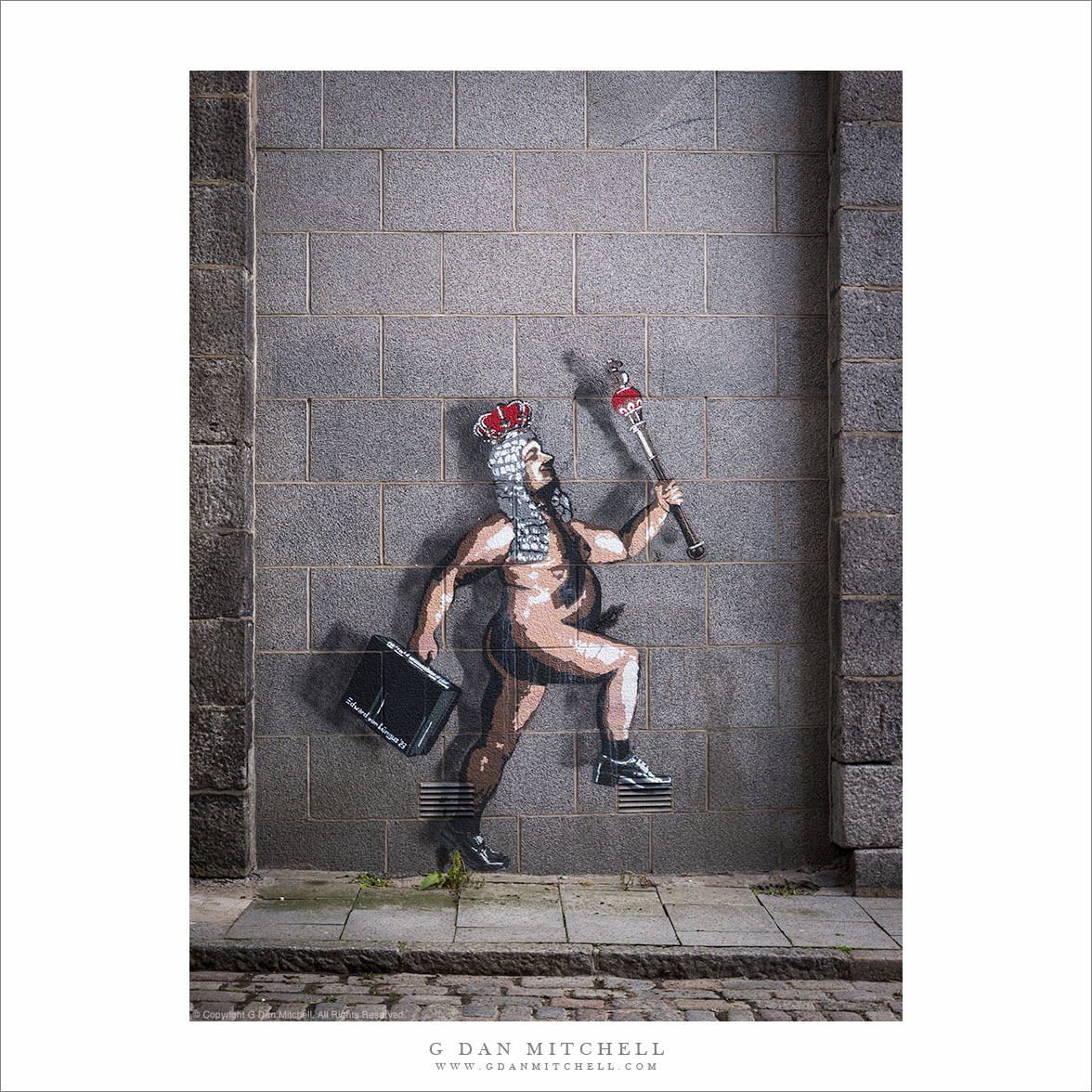
I photographed this version of “The Naked Emperor” in Aberdeen, Scotland, but I understand that the figure is found in many European cities. The artist signs his work, “Edward von Lõngus,”which I understand is a pseudonym meant to hide his real identity, in the Banksy tradition. I made the photograph along a very old, narrow street in an area of Aberdeen where there is a lot of other street art.
I’m often a bit uneasy about making photographs of street art and graffiti, but sometimes the work is not just the imagery itself, but where and how it appears. Seeing this in a book would be a very different experience than seeing it on a concrete wall on this dark, narrow street — and my intention is to try to convey some of that context in the photograph. When you look at the strutting naked emperor, you are, of course, free to make your own associations.
COMMENT OR QUESTION? Scroll down to the comment form.
G Dan Mitchell is a California photographer and visual opportunist. His book, “California’s Fall Color: A Photographer’s Guide to Autumn in the Sierra” (Heyday Books) is available directly from him. Blog | Bluesky | Mastodon | Substack Notes | Flickr | Email
All media © Copyright G Dan Mitchell and others.
Thanks for sharing that.
Naturally, as a sometime street photographer, I’m attracted by street art itself — for its colors, it forms, its subjects, and its messages. But, as I wrote, I’ve often been a bit uneasy about just photographing someone else’s appealing work and putting it forward as my own.
So I’ve tended to approach the subject it three way. One is to essentially make the back ground of photographs of people. (You can see one of my favorite examples here, a photo from Paris: https://gdanmitchell.com/2016/08/12/je-suis-bleu/). Another is to select out abstract components from within something larger. (Here is an example from Lisbon: https://gdanmitchell.com/2025/07/12/alfama-street-art/) The third way is to place the piece in its surroundings, as you see in the photo from Aberdeen.
Take care,
Dan
I like your point about photographing not just the artwork, but also its surroundings. The narrow street and concrete wall become part of the story, giving the piece a completely different feel than it would have in a gallery or a book.