All posts by G Dan Mitchell

G Dan Mitchell, photographer and visual opportunist focusing on the Pacific coast, the Sierra Nevada, redwood forests, California oak/grasslands, California deserts, urban landscapes, night photography and more. Posting daily photographs since 2005, along with articles, reviews, news, and ideas.

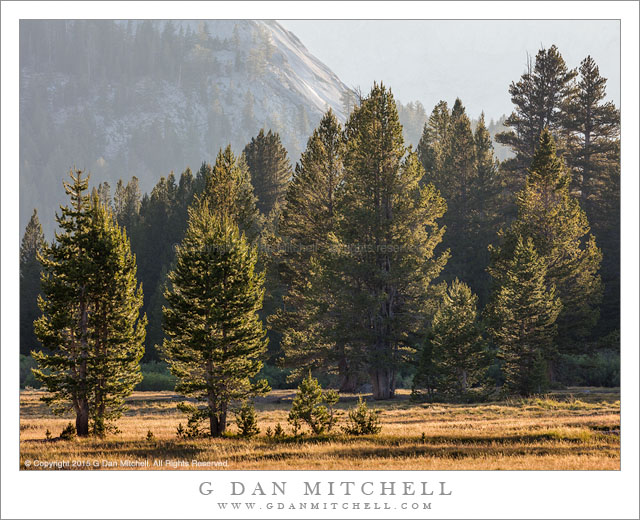
Glaciated Ridge and Trees, Morning

Glaciated Ridge and Trees, Morning
Trees growing on rocky, glaciated granite terrain in morning light

Glaciated Ridge and Trees, Morning. Yosemite National Park, California. July 13, 2015. © Copyright 2015 G Dan Mitchell – all rights reserved.

Trees growing on rocky, glaciated granite terrain in morning light

Among folks who know me a bit, it is not a surprise to hear that this is my favorite kind of Sierra light — early morning light coming across hazy ridges and granite and striking sparse trees from behind, creating a glow among their branches. I can’t explain why it draws me, but it does, and I think it always has. Perhaps I saw something, now forgotten, during one of my first visits to the Sierra, or possibly I saw a photograph (possibly in one of my father’s books) many years ago and it made an impression.

This scene is obviously not a Yosemite icon (though one is nearby), but the nature of the view is iconic Yosemite for me. A handful of things seem characteristic of the Yosemite high country, and one of them is the sight of granite domes, usually with broken rock, and widely separated trees somehow eking out a livelihood on what appears to be bare rock. Undoubtedly, more square miles of the park are covered by forest, but we can find forest almost anywhere — these trees thriving on bare granite are more rare and more a special characteristic of this place.


G Dan Mitchell is a California photographer and visual opportunist. His book, “California’s Fall Color: A Photographer’s Guide to Autumn in the Sierra” is available from Heyday Books and Amazon.
Blog | About | Flickr | Twitter | FacebookGoogle+ | 500px.com | LinkedIn | Email


All media © Copyright G Dan Mitchell and others as indicated. Any use requires advance permission from G Dan Mitchell.
Photographic Myths and Platitudes — That Sensor Noise is Awful!

Let’s say you are looking for a new camera. You want to make a smart decision, especially since you are sinking your hard-earned money into the purchase. You sure don’t want to make a mistake and end up with deficient gear. So you do the smart thing — you do some research. You look around on the web, find some articles, and you discover that there is a lot of contradictory information. Some tell you that Product X is wonderful, while others are adamant that Product X is pathetic and that Product Y is far superior. The Product X fans point out that Product Y is deficient in other critical ways by comparison to Product X.

You have some unanswered questions.

I keep hearing that Camera X has terrible noise compared to Camera Y. In fact, I found some photographs that demonstrate how bad this noise is. Why in the world would anyone get Camera X?!

Both sides provide “evidence.” Photographers love evidence, especially evidence of a failure to achieve divine technological perfection, and double-especially when the failure is demonstrated in a brand they don’t own. They get a little testy though, when the “evidence” makes their product look weak! (For a fun detour, look up the term confirmation bias on the web. Also, this is an important time for a reminder that photography is about photographs, not about cameras.)

I want to construct a little story for you based on “evidence.” We’ll start with evidence that makes a particular product (one that I rely on) look particularly bad. But before we start, you need to promise to read the whole thing. I’ll try to make it worthwhile.

OK, I promise to read it all, and with an open mind.

Good. Here we go.

Lots of people are concerned with the related issues of dynamic range (the camera’s ability to record image data from both light and dark sources in a single photograph) and noise (non-image artifacts that are, in a rough sense, sort of like “grain” on film).

I’ll begin with an example of noise in a photograph I made using the the new and very expensive Canon EOS 5Ds R, a 50.6MP full frame DSLR that Canon released recently.

045DsRPushedAbsurdly100PercentCrop
Example #1

Man, that is awful! That 5Ds R obviously produces terrible noise. It is so bad that the photograph is unusable, at least for anything other than an article demonstrating how bad it is! And the color is pathetically bad, too!

Yes. That image looks absolutely horrible!

Astute, critical thinkers are already wondering what went wrong here. Let me explain. Continue reading Photographic Myths and Platitudes — That Sensor Noise is Awful!

DSLR & Mirrorless: Flexibility and Adaptability

(Note: This is one of those occasional posts adapted from something I originally wrote elsewhere. This one came from an online discussion of the relative merits of DSLRs and mirrorless cameras and their abilities to work with various lenses and photographic subjects. I have edited the original slightly for its re-use here.)

With all of the recent (justifiable!) interest in new mirrorless camera developments from Sony, there are factors that may persuade some photographers to go slow on giving up DSLRs for mirrorless. (It may also convince them to do what I did — I augmented my DSLR system with a second mirrorless system.) As good as mirrorless cameras are becoming, in particular the full frame Sony A7r and newer A7rII, they have their pluses and minuses when it comes to real-world photography. They can do some things quite well – there are advantages in some cases to the electronic viewfinders, Sony sensors provide state-of-the-art dynamic range, the bodies are compact, and more. They do some things less well — native lenses are few, other lenses require adapters, the autofocus systems are slower than DSLRs, there are still latency issues with the viewfinders, and so on.)

In this context, I recently realized that one of the nice things about the new Canon EF 100-400mm f/4.5-5.6L IS II Lens and the newer Canon bodies (like my 5Ds R, which is very similar to the 5Ds)  is that they now autofocus (AF) quite well at f/8. The 100-400 len’s maximum f/5.6 aperture at the long end is no longer a barrier to getting 560mm out of the lens by adding the TC.

I’ve only tried the combination on one occasion so far, when the opportunity to photograph wildlife came up on a recent photography venture along the California coast. I put the 100-400 version II and the Canon 1.4x TC on my 5DsR and photographed two wildlife subjects, elephant seals lounging on a beach and pelicans doing everything from flying past to landing to sitting still. (For those who want more information than I can provide here, I wrote about the initial results in a another article.)

While I do not recommend that people whose primary photographic focus is birds in flight rush out and get a 5Ds or 5Ds R, a 100-400 v2, and a 1.4x TC as their primary setup, it does work decently and in some cases extremely well.  Most importantly, it means that my primary landscape photography setup and can also work very effectively with non-landscape subjects, including wildlife — a task that will severely challenge the best current mirrorless options.

The Landing
“The Landing” — A brown pelican joins the flock on a rock along the Pacific coast of California

The combination focuses well and provides good resolution, even with moving subjects — though, obviously, not as well as using something like a 1Dx with a 300mm f/2.8 prime. It is good enough that I can track birds in flight and catch sharp photographs of them in motion.

Continue reading DSLR & Mirrorless: Flexibility and Adaptability

Children in Striped Hoodies

Children in Striped Hoodies
Two children in striped hoodies walk along a San Francisco street at night

Children in Striped Hoodies. San Francisco, California. July 25, 2015. © Copyright 2015 G Dan Mitchell – all rights reserved.

Two children in striped hoodies walk along a San Francisco street at night

This is yet another photograph that I don’t actually recall making! Sometimes when shooting street I think I work so quickly and spontaneously that I simple capture an image and move on to the next one without imbedding the specific experience in my memory. This almost certainly was one of those very quickly made photographs, and I only made two exposures of these subjects before moving on to something else.

There is a lot in this photograph, some of which I was likely considering in the moment when I made the photograph and some of which may have been more or less a happy accident. I’m pretty certain that I was attracted to the fact that the two kids were both wearing hoodies with horizontal stripes — perhaps someone’s mother or father had just gone shopping for the two of them? A wonderful bonus was the child on the right (big sister?) putting her arm gently on the shoulder of the other child — her younger brother? Then there are the other bits of color — the blue form on the left (which houses an automated carnival-like figure) and the wildly painted lamp-post on the right. And, yes, there is something a bit disconcerting about seeing two young children alone on the nighttime streets of a big city — at least to this photographer who brought up three such young children.


G Dan Mitchell is a California photographer and visual opportunist. His book, “California’s Fall Color: A Photographer’s Guide to Autumn in the Sierra” is available from Heyday Books and Amazon.
Blog | About | Flickr | Twitter | FacebookGoogle+ | 500px.com | LinkedIn | Email


All media © Copyright G Dan Mitchell and others as indicated. Any use requires advance permission from G Dan Mitchell.