All posts by G Dan Mitchell

G Dan Mitchell, photographer and visual opportunist focusing on the Pacific coast, the Sierra Nevada, redwood forests, California oak/grasslands, California deserts, urban landscapes, night photography and more. Posting daily photographs since 2005, along with articles, reviews, news, and ideas.

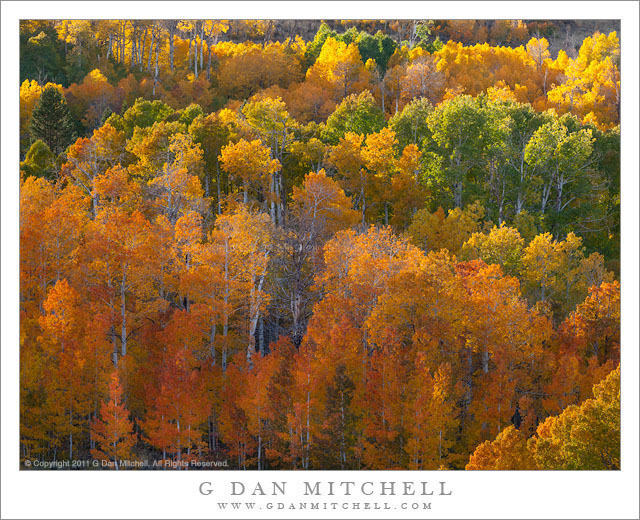
The Aspen Palette

The Aspen Palette
The Aspen Palette

The Aspen Palette. Sierra Nevada, California. October 16, 2011. © Copyright 2011 G Dan Mitchell – all rights reserved.

Colorful eastern Sierra autumn aspen groves along US 395.

This is another photograph from a few years back that I rediscovered while reviewing many, many photographs for a project that I’m working on. I made the photograph in mid-October along highway 395 in the eastern Sierra, where the autumn colors had finally worked their way down from the higher regions toward the valleys. This large grove of aspens is a fall favorite of mine. The sub-grove extend mostly from left to right across the scene, and the genetically related trees of each group seem to change colors at different times and to end up with different coloration — and when my timing is just right and the season cooperates, almost the entire palette of possible aspen colors can appear here at once. In this photograph we have brilliant reds at the bottom of the frame, blending through orange toward yellow/gold, with a few still-green trees and even a few that have lost most of their leaves.

As I worked on this photograph recently I realized that I made it at a time that seemed much different in California. The two preceding winters had brought record levels of precipitation, the high country had opened late with snow remaining much later than usual, and there was water everywhere. This October visit to the eastern Sierra came near the end of the second wet summer, and it looked like we were about to be in for another wet winter, with early season storms. Then the tap was shut off, and we experienced three years are terrible drought. These trees and others in the range are now under a great deal of stress, and the past autumn was a bit of a strange one. And now, in the fourth year, the Sierra is still experiencing far below normal snowfall and far above-normal temperatures.


G Dan Mitchell is a California photographer and visual opportunist whose subjects include the Pacific coast, redwood forests, central California oak/grasslands, the Sierra Nevada, California deserts, urban landscapes, night photography, and more.
Blog | About | Flickr | Twitter | Facebook | Google+ | 500px.com | LinkedIn | Email

Text, photographs, and other media are © Copyright G Dan Mitchell (or others when indicated) and are not in the public domain and may not be used on websites, blogs, or in other media without advance permission from G Dan Mitchell.

Fading Autumn Color

Fading Autumn Color
Fading Autumn Color

Fading Autumn Color. Eastern Sierra Nevada, California. October 11, 1013. © Copyright 2013 G Dan Mitchell – all rights reserved.

Eastern Sierra aspen trees near Conway Summit transition from full color to bare trunks

As I’ve worked on a project recently, I have been going through virtually almost all of my photographs of Sierra Nevada fall color, and along the way I have rediscovered photographs that I had forgotten or, in some cases, never really looked at seriously before. I know many photographers who have this same experience of wondering why they missed certain images when they made them, and then only “found” them much later when revisiting their archives. (I have some theories about how and why this happens, but I’ll save them for another time.)

There are some bands of aspens running up a narrow valley in this area of the eastern Sierra. I had seen them many times before but either they were not in the right condition, in poor light (their location makes light challenging), or I was unable to stop. On this particular visit I managed to find a place from which to view them, and the trees were at that wonderful stage when some leaves are in peak color but others have fallen, and the beautiful white trunks become more visible.


G Dan Mitchell is a California photographer and visual opportunist whose subjects include the Pacific coast, redwood forests, central California oak/grasslands, the Sierra Nevada, California deserts, urban landscapes, night photography, and more.
Blog | About | Flickr | Twitter | Facebook | Google+ | 500px.com | LinkedIn | Email

Text, photographs, and other media are © Copyright G Dan Mitchell (or others when indicated) and are not in the public domain and may not be used on websites, blogs, or in other media without advance permission from G Dan Mitchell.

Great Blue Heron

Great Blue Heron
Great Blue Heron

Great Blue Heron. San Joaquin Valley, California. January 25. 2015. © Copyright 2015 G Dan Mitchell – all rights reserved.

A great blue heron in flight above the San Joaquin Valley

The great blue heron is a big and spectacular bird that I sometimes find in the San Joaquin Valley in the winter. It is often along — though occasionally paired up with an egret — and I find them in fields, grassy areas, and occasionally near ditches and creeks. The heron is an impressively big bird, slightly larger than the great white egrets that are often found in similar locations.

In some ways they are not so hard to photograph, though getting close enough to fill the frame with one of them isn’t easy. Often when photographing in an area where I can usually find them, they will seem to be not overly distracted as I come up to a reasonable distance, trying to avoid upsetting the bird. Then, almost invariably, I sense that the bird is nervous about my presence, so I go no closer — and before long it typically takes to the air. (Most often I photograph them from inside a vehicle.) Their flight is beautiful, as they spread their large wings and once in the air glide gracefully. The other sort of opportunity to photograph them is when one simply happens to fly past, which is what this one did. As it crossed in front of me I managed to squeeze of more than a half-dozen photographs of the bird against the foggy Central Valley sky.


G Dan Mitchell is a California photographer and visual opportunist whose subjects include the Pacific coast, redwood forests, central California oak/grasslands, the Sierra Nevada, California deserts, urban landscapes, night photography, and more.
Blog | About | Flickr | Twitter | Facebook | Google+ | 500px.com | LinkedIn | Email

Text, photographs, and other media are © Copyright G Dan Mitchell (or others when indicated) and are not in the public domain and may not be used on websites, blogs, or in other media without advance permission from G Dan Mitchell.

New Canon 5DS R DSLR: A Printing Test

(Updated: May 2015)

In February 2015 Canon announced the new EOS 5DS DSLR bodies in two versions: the EOS 5DS and the EOS 5DS R The “R” model does not apply anti-alias filtering (AA-filtering) to the image. This is said to have the potential to optimize image sharpness in some cases, though it increases the risk of aliasing/moire artifacts in photographs that include fine patterns such as fabric, screens, and similar. Both versions of the camera have 50.6MP sensors, which more than double the number of photo sites compared to previous Canon 21MP and 22MP full frame sensors.

A big question for people considering this camera is how much potential for image improvement will come from the higher-MP sensors. My feeling is that the improvement should be meaningful for photographers who already push the upper boundaries of potential print size from full-frame image files, but that the increase in MP will not likely mean much to photographers who don’t do this. Since I’m in the former category — and therefore quite interested in the new bodies — I wondered how this might play out in an actual print. (Prints, after all, are where the rubber meets the road with high MP cameras.)

I did not have access to raw files from the new camera at the time of this test, however Canon had made full resolution jpg files available online. (RAW files were not available at the time I conducted the test, but they are not necessary for creating a high quality print, as long as extensive post processing is not used.) I downloaded “Image 2” from the link, which appears to be a straight-from-camera jpg image made with the Canon EF 16-35mm f/4 L IS lens at f/11, 1/500 second, at ISO 200. The image is an aerial photograph of a dense downtown area, with many buildings and other details, including some that should reveal moire artifacts if they are going to be an issue.

My entire workflow with the image was as follows:

  1. Open the Canon jpg file in Photoshop CC.
  2. Resize to 30″ x 45″ at 300 ppi
  3. Select a letter-size section of this resized image and crop it out of the full image. Since I am interested in detail reproduction and how the non-AA-filtering body handles potential moire, I took a section that included the radiating spokes of a ferris wheel against the linear forms of buildings.
  4. Apply my customary output sharpening for prints.
  5. Keeping the resolution of the 30″ x 45″ image, I printed the small section on 8.5″ x 11″ Epson Ultrapremium Lustre paper using my Epson 7900 printer.

The results?

If I handed most people the letter-sized printed extract they would probably think, “Not a bad print — not great, but fine.” But they would not likely notice that they were looking at a tiny fraction of an original 30″ x 45″ print. Skillful photographers and printers who looked closely would be able to see some things suggesting this… but once they heard that it was from a 30″ x 45″ inch print, I’m positive that they would join me in being very impressed. Detail is excellent, especially so for such a gigantic print size. I see no obvious examples of moire artifacts, and I’ve looked closely. I do not not see any smearing of colors, and I can see no noise whatsoever in the print of this detailed image. (I cannot say whether or how much noise would be available in an image of a subject with continuous or smooth gradient tones.)

Since this looked so good, I decided to take things to further and repeat the process — but this time resize to 60″ x 90″ at 300 ppi. For those who don’t know, that would be a very, very big print — four times the print area of the 30″ x 45″ print. Again I selected a letter-size subsection of the final huge image and printed it.

The results?

At this huge size I can certainly see that the image is softer — though whether that is a result of using a 16-35mm ultra wide lens or from the resizing or a combination of the two is open for debate. If you looked at the letter sized print and did not know that it was a crop from an image 5 feet tall and 7.5 feet wide, you would think it was soft. If you made the full print (which I’m not equipped to do!) you would be very impressed. I still see no aliasing/moire artifacts. I do see some slight color smearing in a few areas where there is a sharply delineated edge to a colorful area.

Bottom line: I’m confident that photographers using full frame images to make very large prints are going to like the results from this camera a great deal. I am certainly going to get one — in fact, I have pre-ordered a 5DS R from B&H. (You can do the same using the following links — the cost to you is the same, but you’ll help support this website and article like this one. Thanks in advance!)

Notes:

  • Update 5/15/15: Since I first posted this article much more information about the cameras has become available, including reports and raw files from parties using late-beta versions of the camera. I have had a chance to look at some raw files and they seem quite good to me in every way that matters to my photography.
  • Update: The cameras are now available for pre-order (as of 3/23/15), and I posted an article with more information more about the cameras.
  • The original version of this article incorrectly stated that Canon’s example file was made with the new EF 11-24mm f/4L USM lens. The article has been edited to correct this error.
  • As a side note, the level of detail in the sample image speaks very well for the resolving power of the Canon EF 16-35mm f/4 L IS lens.

5Ds and 5Ds R Articles:


G Dan Mitchell is a California photographer and visual opportunist whose subjects include the Pacific coast, redwood forests, central California oak/grasslands, the Sierra Nevada, California deserts, urban landscapes, night photography, and more.
Blog | About | Flickr | Twitter | Facebook | Google+ | 500px.com | LinkedIn | Email

Text, photographs, and other media are © Copyright G Dan Mitchell (or others when indicated) and are not in the public domain and may not be used on websites, blogs, or in other media without advance permission from G Dan Mitchell.