Category Archives: Commentary

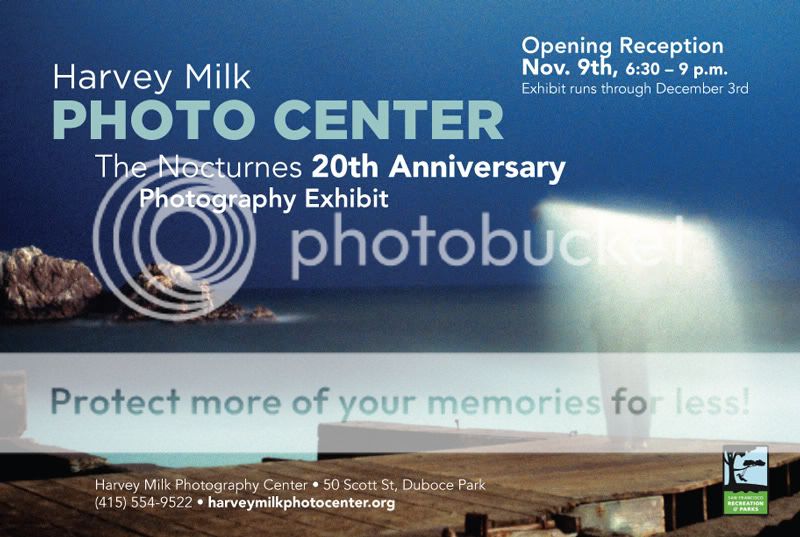
The Nocturnes 20th Anniversary Photography Exhibit

The Nocturnes 20th Anniversary Photography Exhibit
Opening Reception: November 9, 2011, 6:30 – 9 p.m.
Free

Exhibit runs through December 3rd.

Harvey Milk Photo Center
50 Scott Street, Duboce Park
San Francisco, California 94117
(415) 554-9522

“In 1991, ten pioneering Bay Area photographers displayed their work as “The Nocturnes” in a curated show on night photography. Twenty years later, The Nocturnes are still having “full moon gatherings”, educating new photographers, and enjoying the camaraderie of like-minded artists that realize that some of the best photos are taken after the sun sets. This curated exhibit is a retrospective on the work of some of the most well-known night photographers as well as those just getting started.” (From the event web site.)

I’m pleased to say that two of my prints will be included in this show. If you are a San Francisco Bay Area night photographer, a fan of night (and other) photography, or happen to be visiting the area, I invite you to drop in and see some wonderful night photography by a diverse and talented group of photographers. Maybe I’ll see you at the opening reception on November 9!

Aspen Update 10/17/11

I’m back from my second trip to the eastern Sierra in as many weeks, and I’d like to share a bit of what I observed.

A week ago I visited and/or photographed several areas including Bishop Creek, Rock Creek, McGee Creek, a few areas around Mammoth Lakes, and Lee Vining Canyon. I also got reports from others who were there at the same time, and their reports tended to be in line with what I saw that week, namely that the trees that had been turning were interrupted by the early winter-like storm, dropping leaves or turning brown/black, and that lower elevation trees were mostly still green. At that time my hunch was that not much more was going to happen up high, but that the many green trees would provide color over the following couple of weeks.

This week I visited the portion of Bishop Creek in the South Lake drainage, areas on and near Glacier Lodge Road, the north section of the June Lakes loop near Parker Lake, Lee Vining Canyon, and Conway Summit. This visit confirmed some of my expectations from the previous week but also offered some surprises.

  • The thought that the loss of higher elevation leaves might mean that they were done for the season turned out to be not quite correct. This week I saw a surprising amount of color up high. In many places along the eastern escarpment I saw groves of brightly color trees marching right up many ridges.
  • Although I did not return to North Lake, I even heard reports that it had improved. (Though the person sharing the report pointed out that this would likely not be an exceptional year there.)
  • The color of the middle and lower level trees seems to be progressing very quickly. I was expecting middle elevation trees to turn by this week, but I was surprised by how low the color extended. If forced to make a prediction, I might guess that the season is going to run its course a bit faster than usual this year. (Stable weather this week – especially if the winds are light – might sustain things a bit longer.)

I feel like every aspen season has its own “personality” – whether it starts gradually or suddenly, early or a bit later, whether it is interrupted by weather events, and how long it lasts. The personality of this year’s eastern Sierra aspen season seems to include the storm that interrupted the early color up high, followed by a very rapid development of color about a week later.

I need to offer a few disclaimers. First, I only visited a small percentage of the places where aspen color may be found in a typical season. Second, while I can make some guesses about how things will evolve going forward, no one really knows. Third, if you are going to head out there to photograph the aspens this season, I urge you to check others sources of information on the conditions before you go.

Night Photography Article at SFGate

Updates:

  1. I can’t believe I neglected to include the link to the article! See “Photographers Find Light in the Dead of Night“
  2. After I posted the link to this article earlier today I got word that two of my prints have been selected for inclusion in the show. Hope to see some of you Bay Area photographers at the reception!

San Francisco’s SFGate web site has an article on night photography and especially on the history of the medium in the San Francisco Bay Area:

“Before this eccentric genre emerged here in the 1970s, only a handful of shutterbugs shot in the dark. At the turn of the 20th century, Alfred Stieglitz conjured images of an evanescent New York. In the 1920s and ’30s, Brassaï captured lustrous scenes of Paris a la nuit. And O. Winston Link glorified American modes of transportation against the backdrop of night in the 1950s.

But night photography didn’t become a codified style until a group of Northern Californian photographers (including Richard Misrach, Arthur Ollman and Jerry Burchard) started tackling nighttime as a major theme in their work.”

The Bay Area has been fortunate to be a bit of a hot spot for night photographers who have “gone over to the dark side,” and this continues. The Nocturnes, the Bay Area night photography group, is celebrating its 20th year with a series of exhibitions this year, including a recent show at the Mare Island Naval Shipyard (which is, in many ways, ground zero for area night photographers) and an upcoming event:

The Nocturnes 20th Anniversary Photography Exhibit: Reception 6:30 p.m. Nov. 9. Through Dec. 3. Free. Harvey Milk Photo Center, 50 Scott St., San Francisco. (415) 554-9522. harveymilkphotocenter.org.


Sierra Nevada Aspen Hunting and the Weather

Something to think about for photographers headed to the eastern Sierra to photograph aspen color next week: The seven-day Yosemite to Kings Canyon weather forecast is calling for snow (!) on Wednesday and Thursday, and things don’t look like they’ll totally clear out on Friday. This has some ramifications:

  • Those of us who get to the eastern Sierra by way of one of the trans-Sierra passes may encounter difficulties if the forecast pans out. I would not be at all surprised to see a temporary closure of Tioga Pass Road (highway 120) though Yosemite, and other passes to the north could be affected. This makes for a very long drive for those of us in the SF Bay area!
  • A storm can affect the aspen color display. A cold snap can, or so many of us believe, encourage the colors to change. But wind can also bring down many of the leaves in a hurry. (I once arrived before dawn at North Lake to see – just barely – incredible color conditions in the grove the runs up the hillside on the far side of the lake. Moments later a snow squall blew in, and as the wind began to blow I retreated to my car for a half hour. When it passed, half of the leaves had blown down!
  • On the plus side, an early winter storm can bring some opportunities and advantages as well. Overcast and rainy/snowy weather can intensify the colors and create some very compelling and moody scenes. New snow adds something special to the scene, whether only on the higher peaks above or down among the trees.

It could get interesting, so check those weather forecasts and the road conditions on the mountain highways. Fall in the Sierra is a time of change in many ways. Pacific winter-type weather systems start to move through, and they can range from very mild to virtually full-blown winter storms. While most of them pass quickly, some can last for a few days and close passes. It would be very unusual for such an early October storm to actually mark the beginning of the winter road closures, but mid-October storms have done so in the past.

More: