
A forum discussion in which I recently participated (it involved an ethical question related to providing GPS coordinates for a photography destination) has me thinking today about how much information to reveal about photography subjects and locations and the factors that we might want to consider as we share such things. With that in mind, here is a link to something I posted on this topic after a conversation with a photographer friend who is a retired Yosemite ranger.
Category Archives: Commentary
Ending Soon: The Nocturnes 20th Anniversary Night Photography Show
As they say, all good things must come to an end, and the 20th Anniversary Nocturnes Night Photography Exhibit in San Francisco ends this weekend. I believe that the exhibit will close on Saturday afternoon at 2:00 p.m. If you are in the San Francisco Bay Area and have yet to see this extensive collection of night photography, go now! (I’ll be there during the final hour or so on Saturday.)
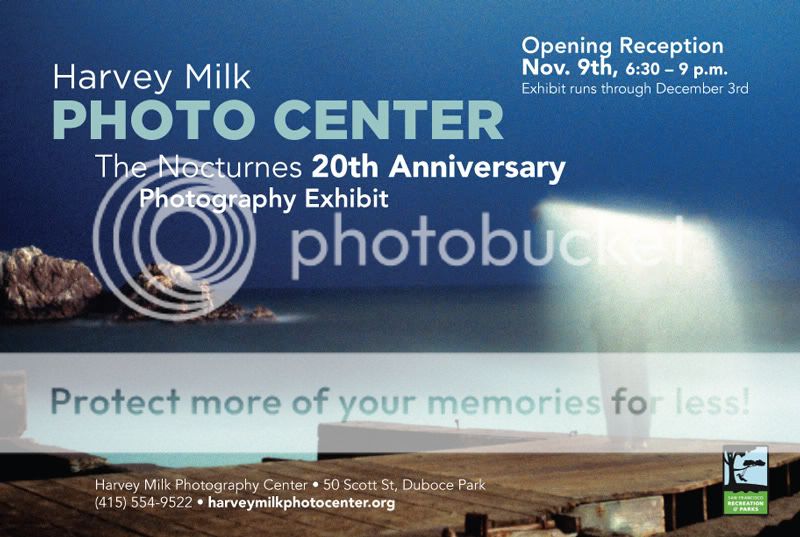
The Nocturnes 20th Anniversary Photography Exhibit
Opening Reception: November 9, 2011, 6:30 – 9 p.m.
Free
Exhibit runs through December 3rd.
Harvey Milk Photo Center
50 Scott Street, Duboce Park
San Francisco, California 94117
(415) 554-9522
“In 1991, ten pioneering Bay Area photographers displayed their work as “The Nocturnes” in a curated show on night photography. Twenty years later, The Nocturnes are still having “full moon gatherings”, educating new photographers, and enjoying the camaraderie of like-minded artists that realize that some of the best photos are taken after the sun sets. This curated exhibit is a retrospective on the work of some of the most well-known night photographers as well as those just getting started.” (From the event web site.)
I’m pleased to say that two of my prints are included in this show. If you are a San Francisco Bay Area night photographer, a fan of night (and other) photography, or happen to be visiting the area, I invite you to drop in and see some wonderful night photography by a diverse and talented group of photographers.
Interested in Purchasing a Print?
Since the question comes up frequently and because it is Small Business Saturday, let me answer the question: “Do you sell prints of your photographs?”
Yes, I do. Virtually every photograph that appears at this web site is available as a print. I’ve been told they make nice gifts! :-) There is more information about print sales (and licensing) at the Sales page on this web site. Please contact me if you have additional questions or would like to order a print for the holidays. Thanks!
What a Photograph Is and What It Ain’t
Every so often I post something lengthy in some photography forum or another, and sometimes I want to get as much mileage out of it as a can… so I share it here. Recently there was a discussion about exposure blending and HDR and related stuff in one such forum and people were trying to decide whether HDR is a good, bad, useful, or indifferent thing. I posted a few times in that thread, but here is the final thing I added.
A poster read and quoted the following:
With our knowledge of post-processing techniques, are we involuntarily pre-disposed to see what could have been rather than what is? Does that limit our ability to appreciate the “what is”?
And then responded this way:
It definitely didn’t seem to limit Ansel’s appreciation of what is. You can see quotes throughout all of his books for many varying scenes on how beautiful it was. But then he will also say that he envisioned the final print as ‘stronger’ and did what was necessary to achieve his vision of the scene. Unless you aren’t talking about a live scene but rather a photo – a ‘plain’ photo that tried to capture ‘what is’. I don’t photograph to try and recreate what is. I would find that a waste of time and boring and leaving little in the way of artistic interpretation of the scene. I try to create a photograph using whatever tools necessary to achieve my vision of a given scene and hopefully with a somewhat unique outcome. But I will never limit myself to trying to replicate ‘reality’ as my eye saw it. I still appreciate what is, just not in my photos.
After that I offered up:
This brings up an interesting subject and one that seems to afflict landscape photography discussions more than it does discussions of other types of photography, namely this notion that a photograph “captures” what is “real” and that this can and should be its goal – and, by extension, anything that “manipulates” that “real” thing is somehow wrong and should be called out.
There is very little support anywhere for that idea, at least in the pure form that some seem to think it might have. Virtually every landscape photographer has said or will tell you today and shows through his or her own work that the idea of a photograph as an objective record of “what was there” is both impossible and undesirable. “Recording” the objective, physical nature of the subject – whatever the heck that even is – is almost completely missing the point.
First, it is impossible.
If we assume that the landscape that we see when in its actual presence at the time of the exposure is an objective and real thing, it is obvious that the camera cannot accurately capture that thing. There is a whole list of reasons for this to be the case, and it could include the following and more:
- The reality of the place is a continuum of light and seasons and atmosphere and more, yet the photograph only “captures” a tiny slice of the continuum that defines that subject.
- The camera cannot record all of the elements that define the nature of that subject – not the movement of air, the smell, the warmth of the sun, the exertion required (or not) to be there, and much more.
- The camera cannot “see” the scene the same way that our visual system does – which is the primary subject of this thread. I’ll just point out that bright clouds don’t blow out and shadows are not blocked and leaves don’t blur in the wind when we use our visual system to view them directly.
- The photographer’s most basic choices “edit” and transform the reality of the scene in important ways: where to place the camera, when to click the shutter, what to include/exclude from the scene, focal length, whether aperture choices make everything in focus or are selective, what the shutter speed does to moving elements of the scene, and much more.
- Other things that would make this list too long for this thread… ;-)
Second, even if it were possible it would be undesirable.
Let’s use Adams as an example. What moves many about his photographs is not the extent to which they are objectively “real” – fundamentally, they are not real. (The last time I checked, the world was not black and white.) What sets his work apart is the way that he used the tools at hand to interpret (not literally reproduce) the subjects of his photographs and the resulting personality and point of view that are expressed in his work. In other words, the literal subjects were, arguably, primarily a means for Adams to share his point of view and his passions through his photographs. In the end, the photographs tell us more about Adams than they tell us about his subjects. (I used Adams here because he is most likely to be known to all reading the thread, but virtually any other “landscape” photographer’s work would serve as well.)
To loop back to the thread, virtually all serious landscape (and other) photographers understand that it is an essentially unquestioned truth that photographs do not and cannot “accurately” portray the real subject, that they inherently (and aren’t we glad!) express a point of view, and that the notion of a pure “unmanipulated” “capture” is a strange and impossible concept. (Yet, for reasons that I won’t explore here, it seems to persist…)
This means that things are complicated. There is no “right” mode of expression, no “right” or wrong techniques, and no “right” type or amount of modification of a photograph in post. It is all relative and subjective. Some who like to imagine that a world of absolutes would simplify things find this difficult to understand and accept. Wouldn’t it be simpler if we could just declare that HDR or exposure blending or adding saturation or using curves or cloning out a spot were “wrong” because they were manipulations of the original “truth” of the scene and dismiss them as being objectively wrong or even dishonest, unethical, or immoral? But we can’t, if for no other reason than once you start down that absolutist road you would have to exclude most or arguably even all photography.
In the end it is about judgment and taste and the power of the photographer’s personal expression – and not simply an accounting of which techniques were used. Perhaps the least important thing about a photograph is how it was made.