
Category Archives: Photographs: Nature

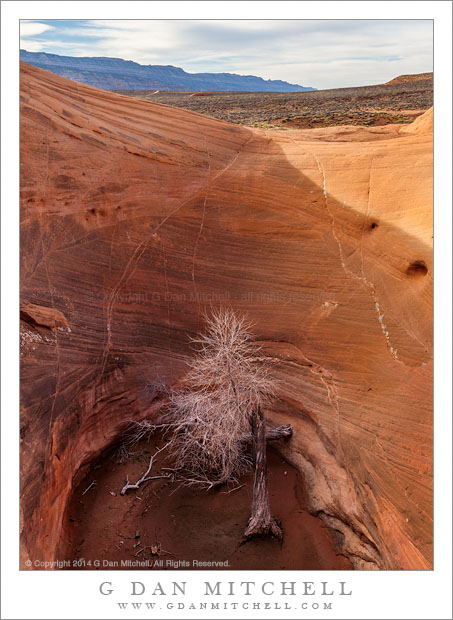
Dead Trees, Sandstone Pothole

Dead Trees, Sandstone Pothole
Dead trees lie at the bottom of a deep sandstone pothole, Grand Staircase-Escalante National Monument

Dead Trees, Sandstone Pothole. Grand Staircase-Escalante National Monument, Utah. October 23. 2014. © Copyright 2014 G Dan Mitchell – all rights reserved.

Dead trees lie at the bottom of a deep sandstone pothole, Grand Staircase-Escalante National Monument

There are multiple ways to react to the remarkable sandstone potholes from this terrain of rounded sandstone hills and gentle slabs. First of all, they are remarkable structures. They are simply “holes” in the sandstone — but surprisingly large holes. They are many feet across and perhaps 15-20 feet deep. They have no outlet, and you can imagine that with the right water source they would make rather gigantic swimming holes. Their source is not immediately apparent, though I understand that they are created over a long period of time by the forces of wind and water on the relatively soft sandstone.

They are beautiful, too. Their smooth, curving shapes have an almost sensuous quality, made stronger by the warm colors of the sandstone rock. Surprisingly, plants and even trees grow at the bottom of many of them. But these potholes may also be traps — there is no way out of their depths except for those creatures that can fly. In the middle or relatively smooth expanses of sandstone, these pits appear suddenly, and the angles at their edges quickly increase to vertical, making them potentially dangerous. The pothole in this photograph seems to me to have a bit less of the rock garden quality and a bit more of the ominous quality, with two dead cottonwood trees and broken branches littering the bottom of the pit.


G Dan Mitchell is a California photographer and visual opportunist. Blog | About | Flickr | Twitter | FacebookGoogle+ | 500px.com | LinkedIn | Email


All media © Copyright G Dan Mitchell and others as indicated. Any use requires advance permission from G Dan Mitchell.

Dahlia

Dahlia
Dahlia blossom

Dahlia. Fort Bragg Botanical Gardens. Fort Bragg, California. July 5, 2015. © Copyright 2015 G Dan Mitchell – all rights reserved.

A dahlia blossom.

I’m not usually the flower photographer around here — that title goes to my wife, Patty, whose passion is seeing and photographing the very small world of flowers. But every so often I give it a try. We spent some time one morning at the beautiful botanical gardens in Fort Bragg, where I made a few photographs including this one of a dark-colored dahlia blossom

We were in Northern California for a few days earlier this week, centered in the Mendocino area but traveling from there to places as far away as Humboldt Redwood State Park and even up to Ferndale, California. Overall it was not a tremendously successful trip for photography, at least not for me. (It was, however, a very successful trip for eating…) Photography in this area is perhaps more condition-dependent than in some other places where I photograph, and the conditions were difficult this time. No matter. Even when I don’t come back with a lot of photographs, I do come back with more knowledge of the place that I can can use the next time I’m there.


G Dan Mitchell is a California photographer and visual opportunist. Blog | About | Flickr | Twitter | FacebookGoogle+ | 500px.com | LinkedIn | Email


All media © Copyright G Dan Mitchell and others as indicated. Any use requires advance permission from G Dan Mitchell.
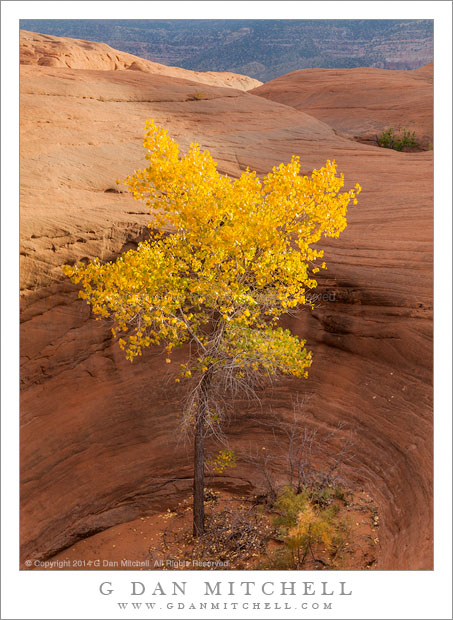
Cottonwood Tree, Sandstone Pothole

Cottonwood Tree, Sandstone Pothole
A cottonwood tree with fall foliage stands in the bottom of a sandstone pothole.

Cottonwood Tree, Sandstone Pothole. Grand Staircase-Escalante National Monument, Utah. October 23, 2014. © Copyright 2014 G Dan Mitchell – all rights reserved.

A cottonwood tree with fall foliage stands in the bottom of a sandstone pothole.

Coming upon one of the large and deep sandstone potholes is a strange experience. There is something almost spooky about them. At first there is no obvious explanation for how such a thing could come to be. (It involves water and wind and long periods of time.) There is something strangely attractive about them and you want to get closer and closer to the edge. But this is a very dangerous proposition. The incline of the rock increases quickly and then quickly becomes vertical. It is a long ways down — perhaps as much as twenty feet. And anyone falling into such a pothole would not only be injured by the fall but would find it virtually impossible to get out without help. (There are stories of people finding dead animals that had fallen in and died there.)

There is positive magic about these formations, too, especially when a beautiful cottonwood tree grows within one of them, creating a kind of magical garden cut off from the rest of the world. We came to this area late in the day, climbed up onto VAST sandstone slabs, picked a route across the terrain, and arrived at a place where there were several of the potholes, many of which were home to cottonwood trees full of autumn foliage.


G Dan Mitchell is a California photographer and visual opportunist. Blog | About | Flickr | Twitter | FacebookGoogle+ | 500px.com | LinkedIn | Email


All media © Copyright G Dan Mitchell and others as indicated. Any use requires advance permission from G Dan Mitchell.
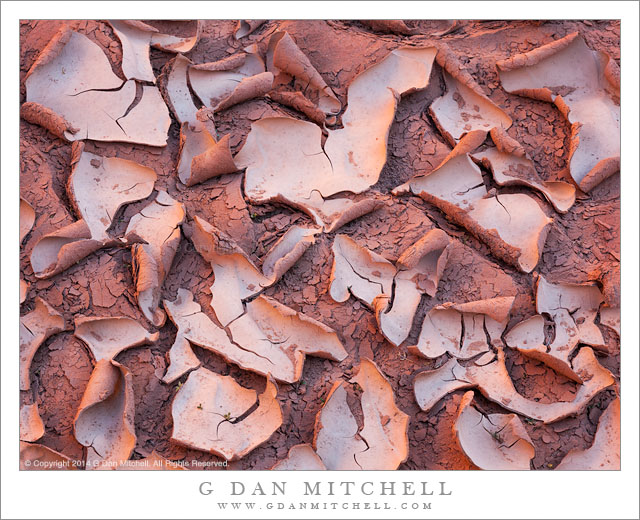
Dry Mud and Sand

Dry Mud and Sand
Dry, cracked mud on top of red sand under reflected canyon light, Grand Staircase-Escalante National Monument

Dry Mud and Sand. Grand Staircase-Escalante National Monument, Utah. October 25, 2014. © Copyright 2014 G Dan Mitchell – all rights reserved.

Dry, cracked mud on top of red sand under reflected canyon light, Grand Staircase-Escalante National Monument

I almost titled this photograph, “Another Photograph of Mud.” But I have resisted that temptation, and once again used a simple more or less objective title. But, indeed, this is almost a photographic type when it comes to the Southwest, and one that is awfully difficult to pass up. These formations come about when silt-laden water rushes down desert canyons, washes, and streams, leaving behind a layer of very wet silt. The layer may be thin, as it was in this case, or it may be quite thick. In one narrow canyon last year I slipped into such silt-mud and it almost seemed like there was not bottom!

I’m not sure quite what explains our fascination with these formations. Is it because they are among the most transient features of the physical landscape, disappearing and then reforming every time it rains? Is it the patterns themselves, which can have a wonderful geometric quality and, at the same time, embody a randomness? Is it the combination of the colors of the material, which can range from white through black with many colors in between, and the reflected canyon light? Possibly it is all of these things and more.


G Dan Mitchell is a California photographer and visual opportunist. Blog | About | Flickr | Twitter | FacebookGoogle+ | 500px.com | LinkedIn | Email


All media © Copyright G Dan Mitchell and others as indicated. Any use requires advance permission from G Dan Mitchell.