“Waterfall And Pond, Japanese Garden” — Waterfall, pond, and trees in a quiet Japanese Garden, Portland, Oregon.
Some years back we used to get to visit Portland, Oregon somewhat regularly when we had family in the area. (Our youngest son lived there for a few years.) Portland is a rather unique place, especially in the central core. I won’t try to explain except to point out that there is a rather unique fusion of cultures in the area. We like the place, though it has been a few years now since our last visit.
Portland seems to me to be a city off gardens. Two wonderful Asian gardens are in the area — the Chinese Garden in an urban setting close to the downtown area, and the Japanese Garden set in more rustic surroundings in the hills. We spent a day in the latter garden, and this photograph of a lush scene of water and vegetation is one of several photographs I made there during this visit.
Leave a comment or question using the form. (If you are reading this on the home page, click the article title to see the full article and the comment form.
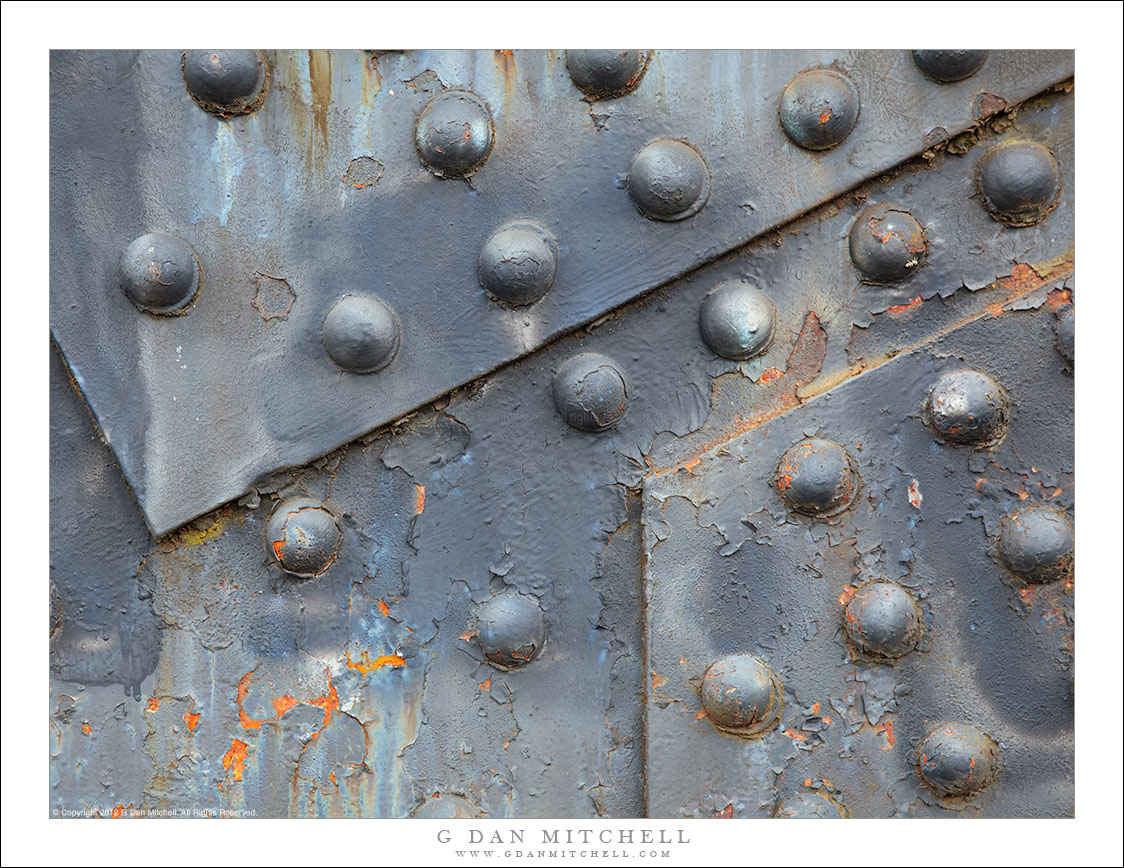
“Detail, Steel Bridge ” — Structural detail of the Steel Bridge, Portland, Oregon
This might be the most unimaginatively named steel bridge in the United States — as far as I can tell it is actually called “Steel Bridge.” Which it is. The bridge crosses the Willamette River in Portland, Oregon, where its double-deck structure (with a center section that can be raised) carries trains, cars, pedestrians, bicycles, and rapid transit across the water. When we visited we joined the pedestrians, which gave me a chance to look at the structure close up.
Old distressed and weathered structures like this intrigue me, and I know I’m not the only photographer who has this interest. Sometimes I imagine the contrast between some engineer crafting very careful and precise design drawings of the structure and its smaller elements, producing materials that reflect the conceptual perfection of such structures… and the real-world reality the creeps in over the long life of such structures. The latter is visible here in the multiple layers of paint, now marked by stain patterns and split open to reveal rust.
Leave a comment or question using the form. (If you are reading this on the home page, click the article title to see the full article and the comment form.
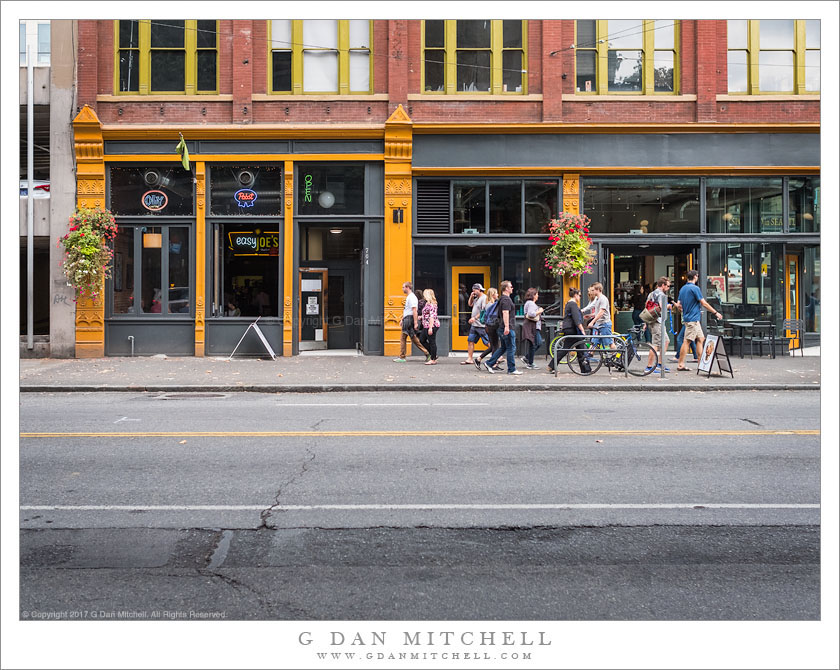
Today I’m going to insert one more street photograph into what has largely been a recent stream of natural world photographs. (I suppose that focus should not be a surprise during the fall season!) Back in September I was in the Seattle area of several days, mostly on non-photographic business, but I managed to get out and spend some time photographing, too. One day I made it to the North Cascades for a bit of landscape photography, and on another I sneaked out for a few hours of street photography.
I actually have no idea what Easy Joe’s is (or who Easy Joe is or was), but since the text appears in the scene I am going with it. For some reason, this photograph feels like Seattle to me — something about the architecture, perhaps, or the light or possibly I just recognize the downtown location. It also presented a sort of urban geometry that I enjoy, with tons of vertical and horizontal forms, but broken up by the passage of a compact group of pedestrians.
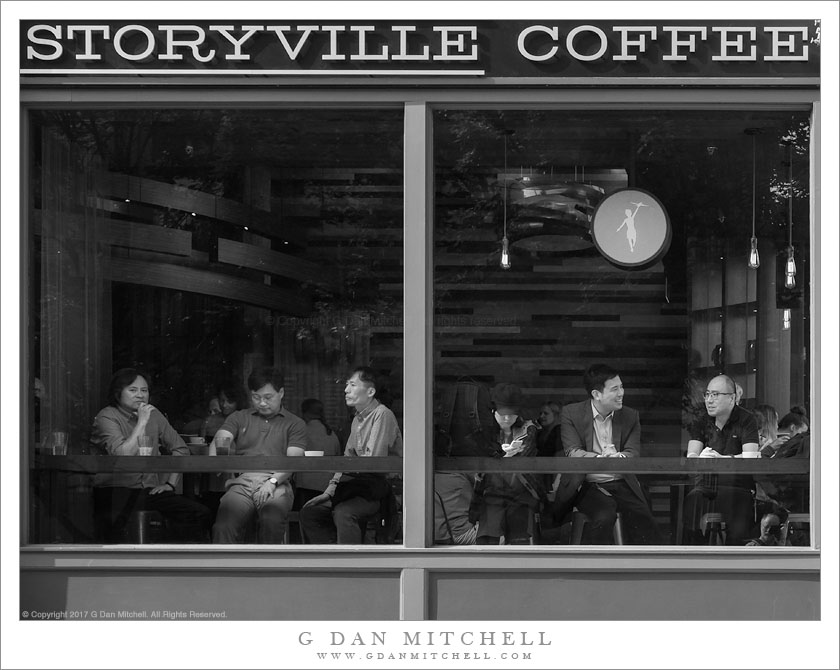
Patrons sitting at the window of a Seattle coffee shop
As you may have noticed — at least if this isn’t the first time you have seen one of my posts — I like to photograph a rather wide range of subjects. Some know me as a “landscape” or “nature” photographer, but my subjects include many other things: night photography, street photography, urban landscapes, musicians, and more. One line of thinking holds that this is not a good thing — that it dilutes one’s photographic identity and fails to produce a recognizable style. Yet, it turns out that I’m not alone, and lots of other photographers are fascinated by multiple subjects. (Last weekend I ran into a couple of fine photographers and friends high in the Yosemite Sierra, people who have a reputation for photographing the natural world. When I met them they were just finishing up photography of peeling paint on an empty building…) Once they have been typecast, they tend to accept that — since being recognized for a type of photography is a good thing — but they occasionally admit to being frustrated when their other work isn’t understood.
So this is from my “other photography” — the work I do when I spend time in urban environments. It is hard for me to explain the fascination of “street photography” to those who don’t get it, but I’ll try. First, I think we can regard this world as a kind of “urban landscape” — and some of the same attractions of light and texture and color and form are found here. Second, it can be an incredibly dynamic “landscape.” When things are going well, I often feel that I’m in the midst of a continuous flow of people and compositions and their collisions and that there is almost too much to see. The trick is often (though not always) to stay tuned in and to be read to see and photograph quickly. Third, the human layer is something found much less in landscape photography, and it fascinates me. Here I just happened to spot one of the little vignettes that are everywhere in the city — an interest group of people in different poses and likely with different attitudes.
Photographer and visual opportunist. Daily photos since 2005, plus articles, reviews, news, and ideas.
Manage Consent
To provide the best experiences, we use technologies like cookies to store and/or access device information. Consenting to these technologies will allow us to process data such as browsing behavior or unique IDs on this site. Not consenting or withdrawing consent, may adversely affect certain features and functions.
Functional
Always active
The technical storage or access is strictly necessary for the legitimate purpose of enabling the use of a specific service explicitly requested by the subscriber or user, or for the sole purpose of carrying out the transmission of a communication over an electronic communications network.
Preferences
The technical storage or access is necessary for the legitimate purpose of storing preferences that are not requested by the subscriber or user.
Statistics
The technical storage or access that is used exclusively for statistical purposes.The technical storage or access that is used exclusively for anonymous statistical purposes. Without a subpoena, voluntary compliance on the part of your Internet Service Provider, or additional records from a third party, information stored or retrieved for this purpose alone cannot usually be used to identify you.
Marketing
The technical storage or access is required to create user profiles to send advertising, or to track the user on a website or across several websites for similar marketing purposes.