About Tripods (Morning Musings 11/4/14)

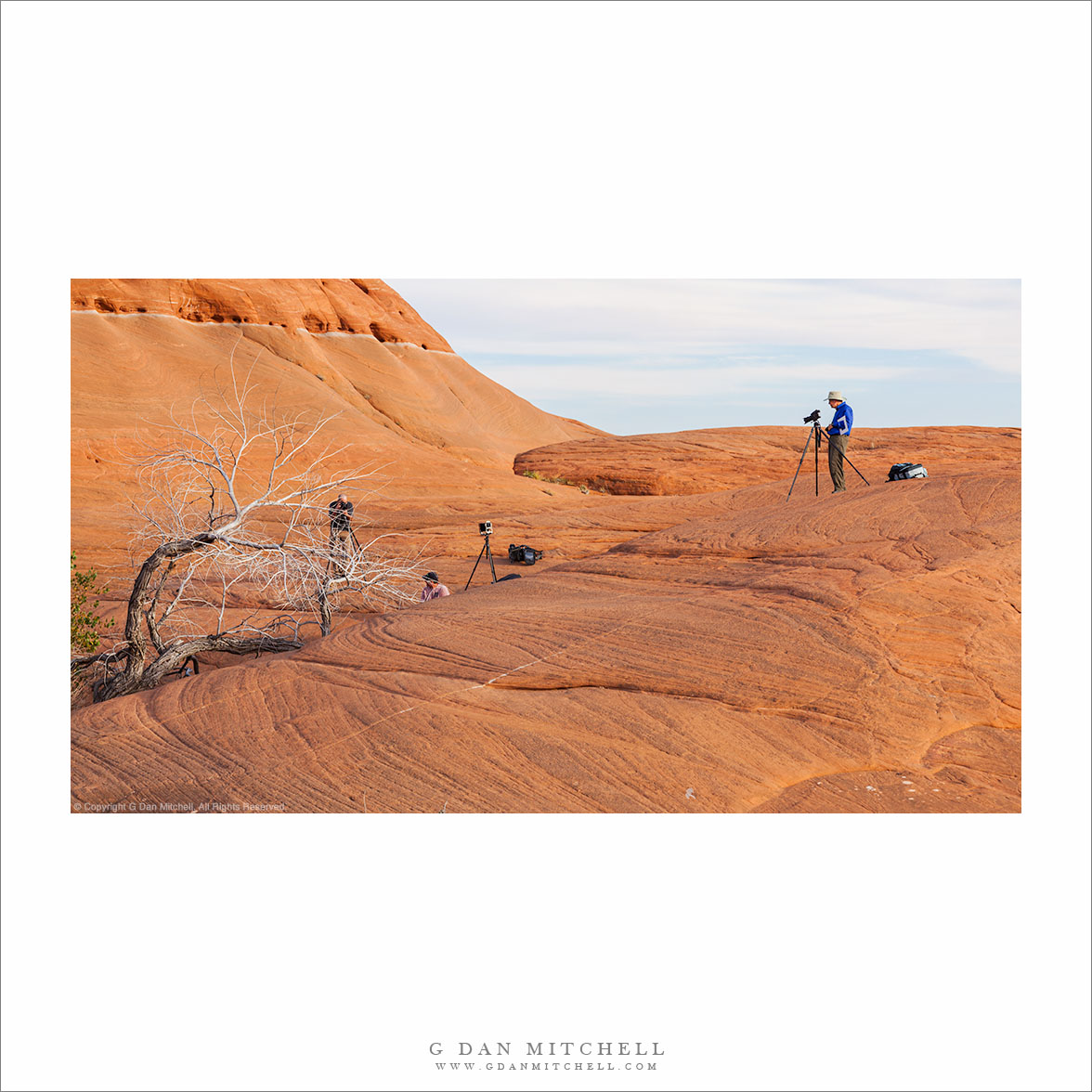
Working the Red Rock Landscape
“Working the Red Rock Landscape” — Photographers at work in Utah’s red rock country

Morning Musings are back! Today I have a few general thoughts about tripods — not aimed at those who are already confirmed tripod users, but rather at those who find it hard to bother using them.

To start, let’s admit that one does not always need a tripod. For certain types of photography in which quick response is required and being too obviously a photographer can interfere with photographs, it is usually better to not use one. There are exceptions to every rule, but you are unlikely to use a tripod for most street photography, for personal and family photography at home and on vacations, for certain kinds of portrait work, casual travel photography, and so on.

Let’s also agree that using a tripod is a burden, especially at first when you haven’t accepted the extra trouble and when you haven’t developed instincts that make tripod use a lot more automatic. I’ll readily admit to being less than thrilled on about the 50th time that I must remove my tripod from the car or pack, extend and lock the legs, level the thing, attach the camera, and only then make a photograph… after which I have to reverse the process: remove the camera, collapse the tripod legs, stow the thing once again. The slightly put-upon feeling diminishes as you get used to it, but it never goes away entirely. (The good news here is that the process of setting up and using the tripod does eventually become much quicker and much more automatic.)
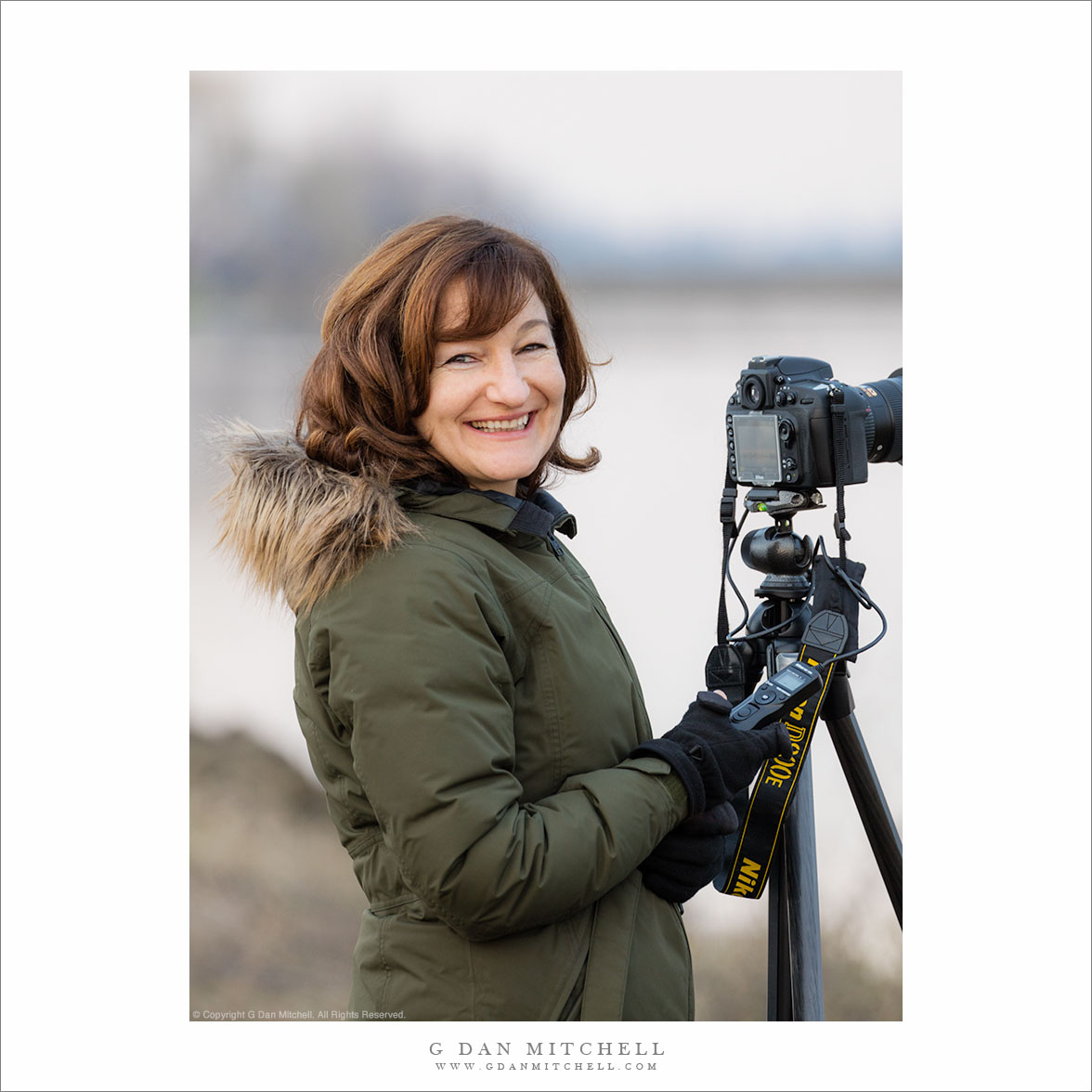
Photographer Franka M. Gabler
“Photographer Franka M. Gabler” — Franka M. Gabler in the field photographing in the San Joaquin Valley

So, why use it then? There are more reasons than you might imagine.

Stability is an obvious advantage of the tripod. While you can, with care and practice, often hold a camera quite steadily and produce very sharp images when shooting handheld, you simply cannot eliminate all of the blur that comes when you hold the camera in your hands. And if you do happen to have very steady hands, you still will make mistakes that produce blur — working a bit too fast you may introduce a bit of camera vibration in some shots and you will reduce the number of successful results. A good tripod used correctly can virtually eliminate camera motion and vibration. This is especially important when doing types of photography that intrinsically require longer shutter speeds. This obviously includes night photography. Low light, low ISO, long lenses, and small apertures often require landscape photographers to use rather long shutter speeds.
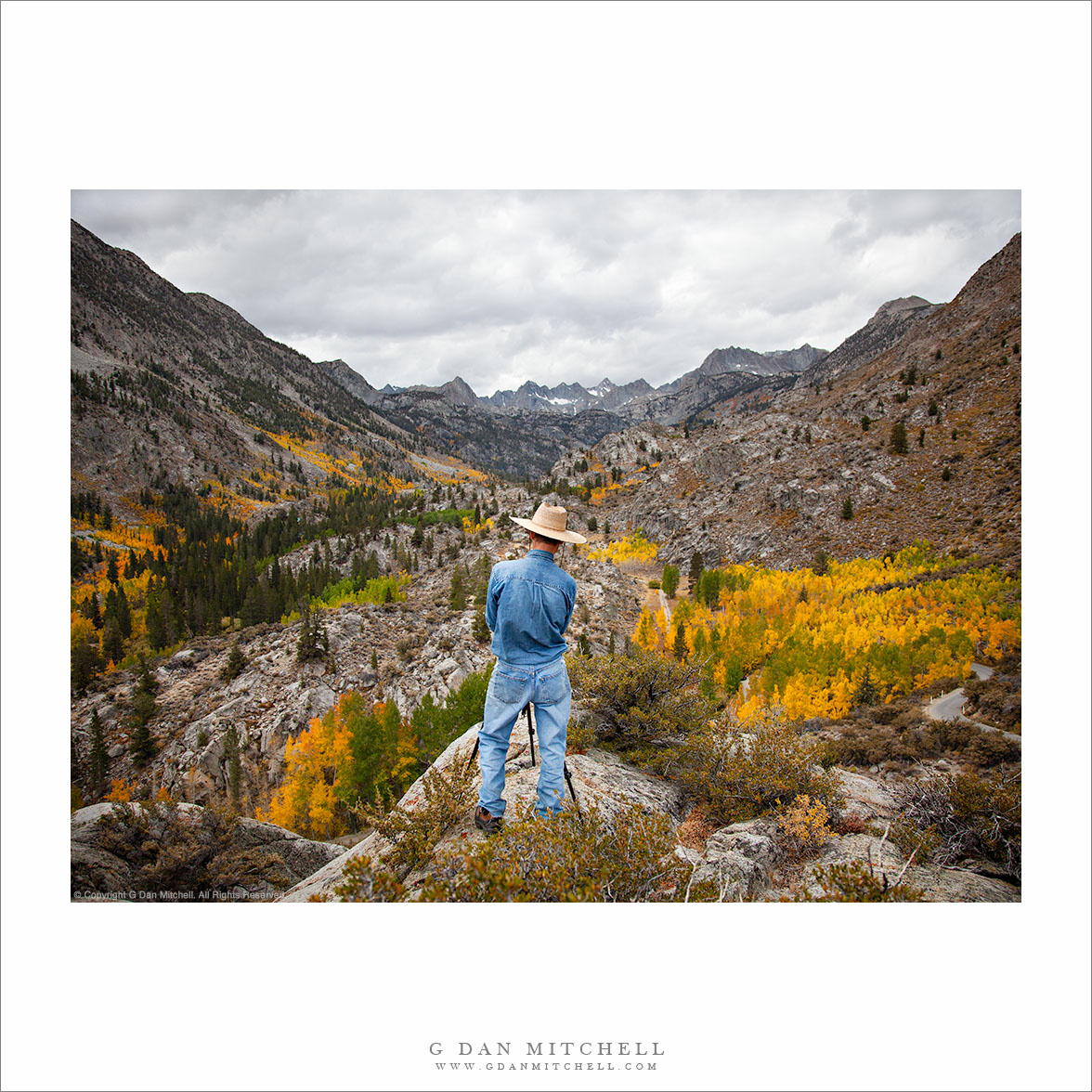
Photographer, Sabrina Basin
“Photographer, Sabrina Basin” — A photographer working the autumn colors from a ridgetop in Sabrina Basin, Sierra Nevada, as an early fall storm comes in.

High resolution cameras can capture images that may be reproduced at much larger sizes, and at those sizes the effects of minor camera stability issues become more visible. If you want to take advantage of such cameras’ potential for higher image resolution, the stability that comes with tripod use can be critical.

Continue reading About Tripods (Morning Musings 11/4/14)
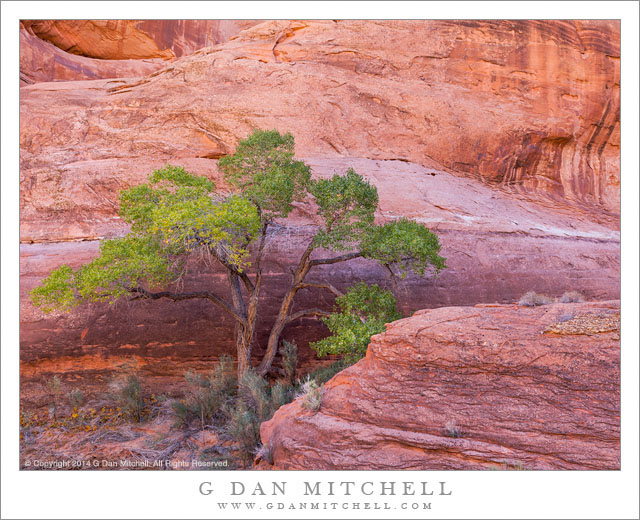
Cottonwood, Red Rock Canyon

Cottonwood, Red Rock Canyon

Cottonwood, Red Rock Canyon. Grand Staircase-Escalante National Monument, Utah. October 24, 2014. © Copyright 2014 G Dan Mitchell – all rights reserved.

A fall color-tinged cottonwood tree grows in the depths of a red rock canyon, Utah

It is time to begin the Utah posts — I already have perhaps a month of photographs to share. (I still have more photographs from my late-summer back-country Yosemite shoot in the queue, but they can wait for a bit.) Utah, especially the southwest portion that I have visited frequently during the past few years, is an intriguing place for this California photographer. After decades of happily photographing my increasingly familiar home territory, it has been a special experience to work in a place where almost everything is new to me. I’ve gone there will few specific expectations, and I’ve made a point of not seeking out the familiar icons — though I have stumbled onto a few of them. (Yes, I do have a photograph of the Watchman. ;-) Compared to the gray tones of California granite, the red rock country of the Southwest is absolutely wild. Combine that rock with intense colors of green plants, yellow/gold fall foliage, blue sky and the effect is very different from what I’m used to shooting.

On my recent visit I managed to get into a number of canyons and gulches, which are perhaps the most magical of Utah places. In many cases, including the canyon where I made this photograph, the visit often begins in a place that looks nothing like this canyon scene — some dry, shallow wash or perhaps out on the flatlands above the canyon, where the air is dry and warm. I follow a path downstream and soon the wash becomes deeper and the walls rockier, and before long these walls rise to become cliffs and the world outside and above disappears, replaced by cool and moist air and water in the bottom of the echoing canyon. Trees and brush grow here, and sometimes you are caught up short when you encounter the sacred traces of people who made this world their home centuries ago. This photograph was made in such a canyon. At a stream crossing I made an almost random decision to climb up onto a higher route around a bend in the stream rather than following the the stream along the bottom of the canyon. As I crossed the slightly higher area I looked down into this world of red rock where a solitary cottonwood tree grows against the curving patterns of the rock.


G Dan Mitchell is a California photographer and visual opportunist whose subjects include the Pacific coast, redwood forests, central California oak/grasslands, the Sierra Nevada, California deserts, urban landscapes, night photography, and more.
Blog | About | Flickr | Twitter | FacebookGoogle+ | 500px.com | LinkedIn | Email

Text, photographs, and other media are © Copyright G Dan Mitchell (or others when indicated) and are not in the public domain and may not be used on websites, blogs, or in other media without advance permission from G Dan Mitchell.

Online Gallery Update

My web presence has long included this blog and a separate online gallery housing a large archive of photographs — perhaps about 3000 of them at last count. Earlier this week the gallery had a technical issue that snowballed and eventually took that gallery completely offline.

During the past few days I have spent way to many hours trying to get the gallery working again, and I have (mostly) succeeded at this point. A new version of the gallery now holds essentially all of the photographs that were at the old gallery. The format is a bit different, though the underlying organization of the images is similar. At this point, the titles of photographs do not display correctly, and you’ll see file names where there used to be titles. This is fixable, but not right away.

If you tried to find the old gallery and couldn’t, thanks for your patience. If you haven’t seen the gallery, feel free to wander over there and take look!


G Dan Mitchell is a California photographer and visual opportunist whose subjects include the Pacific coast, redwood forests, central California oak/grasslands, the Sierra Nevada, California deserts, urban landscapes, night photography, and more.
Blog | About | Flickr | Twitter | FacebookGoogle+ | 500px.com | LinkedIn | Email

Text, photographs, and other media are © Copyright G Dan Mitchell (or others when indicated) and are not in the public domain and may not be used on websites, blogs, or in other media without advance permission from G Dan Mitchell.

Lens For Sale — Canon EF 24mm f/1.4 L II

UPDATE — November 3, 2014:

Three of the four lenses that I’m selling have now found new homes, but the Canon EF 24mm f/1.4 L II prime is still available.

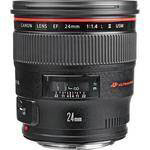
Canon EF 24mm f/1.4 L IICanon EF 24mm f/1.4 L II – This is the newest version of Canon’s wide-angle, large-aperture 24mm prime lens know for its excellent image quality and performance at large apertures. This lens is in essentially “like new” condition — no scratches or blemishes, as it was purchased for a particular project and only used minimally for that purpose. Lens, caps, hood, pouch, original box. Reduced to $1300.
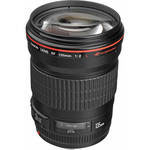
Canon EF 135mm f/2 L

Canon EF 135mm f/2 L – The Canon 135mm f/2 is classic Canon lens and highly regarded for image quality and its ability to produce narrow depth of field and smooth bokeh.  This lens is in excellent “near mint” condition — no scratches or blemishes. Lens, caps, hood, pouch, original box. $875. – SOLD

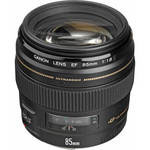
Canon EF 85mm f/1.8Canon EF 85mm f/1.8 – This is one of Canon’s best non-L lenses, and many regard it as a worthy (and much less expensive!) alternative to the excellent 85mm L. It is in excellent condition — no scratches or blemishes. Lens, caps, 3rd party hood*, original box. $300. (Canon does not include a hood with this lens.) SOLD

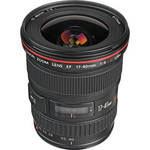
Canon EF 17-40mm f/4 LCanon EF 17-40mm f/4 L – This is a fine workhorse landscape lens, and it is a core lens in the kit of many Canon landscape photographers. The lens is in excellent condition, with some cosmetic blemishes on the lens hood. Lens, caps, hood, original box. $610. –  SOLD

I prefer an in-person sale to someone in the San Francisco Bay Area, but I may consider other arrangements. Email dan@gdanmitchell.com.

G Dan Mitchell is a California photographer and visual opportunist whose subjects include the Pacific coast, redwood forests, central California oak/grasslands, the Sierra Nevada, California deserts, urban landscapes, night photography, and more.
Blog | About | Flickr | Twitter | FacebookGoogle+ | 500px.com | LinkedIn | Email

Text, photographs, and other media are © Copyright G Dan Mitchell (or others when indicated) and are not in the public domain and may not be used on websites, blogs, or in other media without advance permission from G Dan Mitchell.

Photographer and visual opportunist. Daily photos since 2005, plus articles, reviews, news, and ideas.