
Incremental Progress (Morning Musings 10/16/14)

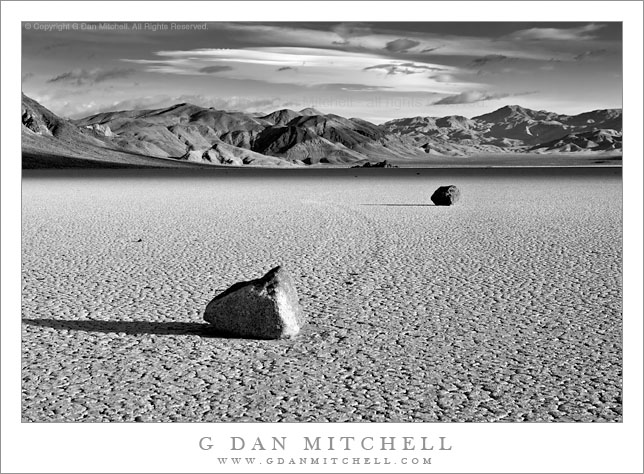
Two Rocks, Morning, Racetrack Playa - Black and white photograph of two "moving rocks" on the Racetrack Playa at Death Valley National Park. Morning light with unusual clouds, and the Grandstand in the distance.
Black and white photograph of two “moving rocks” on the Racetrack Playa at Death Valley National Park. Morning light with unusual clouds, and the Grandstand in the distance.

As always, photographic technology continues to advance. That is not news, or at least it shouldn’t be. This has been the case for the entire 175 year (or so) history of the medium, as the methods of recording light and reproducing images have evolved in beneficial ways. It also shouldn’t be news that the most recent changes have involved the adaption of digital technologies to photography — the capture, storage, processing, sharing, and printing of photographs.

This progress is a good thing and, aside from some who prefer to work with old processes, eventually the value of the new technologies becomes clear to most photographers and we accept and adapt to the new and find it advantageous. Almost everyone welcomes the steady pace of refinement and improvement in the technology of photography. However, it seems to me that some imagine that this progress is happens at rates that are simply not possible.

It is common, when some new technology comes out, to hear some folks say that it makes the older gear irrelevant or that it “blows it out of the water,” and that the improvements are of a tremendous magnitude and will change your photography in radical ways. Eventually this is arguably true, but the time frame over which truly radical change happens is much longer than a few years. In reality, most individual “upgrade” changes are incremental. While they are good and valuable, they do not “change photography as we know it” or improve results in radical ways.

Think about it this way. How many times have we heard the next incremental change described in hyperbolic terms like those in the previous paragraph? If the changes really warranted the use of these radical descriptions every year or so, over a period of a few years (much less over a period of decades!) imagine how astonishingly photographs and photography would have changed. But that hasn’t happened. The changes take quite a while to add up to something earth-shaking. Even the change to digital photography — which I would argue is very significant — has taken place over a time frame of decades.

Progress is real, and progress is good. But, when viewed from a longer perspective, it doesn’t happen as fast as we sometimes imagine.

Morning Musings are somewhat irregular posts in which I write about whatever is on my mind at the moment. Connections to photography may be tenuous at times!


G Dan Mitchell is a California photographer and visual opportunist whose subjects include the Pacific coast, redwood forests, central California oak/grasslands, the Sierra Nevada, California deserts, urban landscapes, night photography, and more.
Blog | About | Flickr | Twitter | FacebookGoogle+ | 500px.com | LinkedIn | Email

Text, photographs, and other media are © Copyright G Dan Mitchell (or others when indicated) and are not in the public domain and may not be used on websites, blogs, or in other media without advance permission from G Dan Mitchell.
Sierra Aspen Groves, Autumn

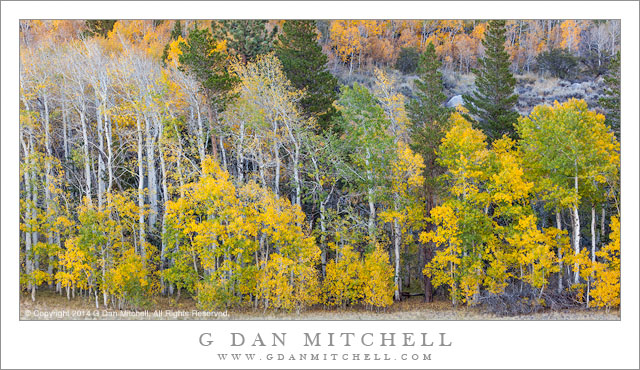
Sierra Aspen Groves, Autumn

Sierra Aspen Groves, Autumn. Eastern Sierra Nevada, California. October 12, 2014. © Copyright 2014 G Dan Mitchell – all rights reserved.

Aspen groves in varying states of autumn color, eastern Sierra Nevada

This photograph was a bit of an unplanned surprise. (The truth is that quite few aspen photographs are just that — partly because I’m always looking around for places I haven’t photographed before, and partly because one never knows what the aspen conditions will like until arrival on the scene.) I had started my morning with a plan that evolved a bit. Up well before sunrise, my initial plan to was to explore an area of east-facing slopes along the edge of the Sierra where I knew that colorful trees would be scattered about. As I drove to what seemed like the obvious starting point, I thought about a very large grove that I had earlier spotted very high up on these slopes… and as I looked that direction I saw a set of headlights up there! That was all the encouragement I needed to find a narrow a steep track that took me way up high on a ridge from which I photographed those trees at dawn.

When I finished shooting there I took a few minutes to finally eat something and then figured that I would try a “sure bet” location nearby. I drove back down the single-track gravel route, got back on pavement, and headed there. Sure enough, there was a lot of brilliant color in this area. As I drove up the road I spotted rows of aspens at the edge of a meadow, still in soft shaded light, but not seeing a photograph there and with my mind on another subject up ahead, I kept going. Before long I was done with that “other subject” and I decided to head toward a third (and non-aspen) subject, so I turned around and headed back the way I came. As I passed this spot again, something about the light and the trees caught my attention again — mainly the soft effect of light reflected into this shaded grove — so I stopped and made a series of photographs that mostly just “show what is” about these trees.


G Dan Mitchell is a California photographer and visual opportunist whose subjects include the Pacific coast, redwood forests, central California oak/grasslands, the Sierra Nevada, California deserts, urban landscapes, night photography, and more.
Blog | About | Flickr | Twitter | FacebookGoogle+ | 500px.com | LinkedIn | Email

Text, photographs, and other media are © Copyright G Dan Mitchell (or others when indicated) and are not in the public domain and may not be used on websites, blogs, or in other media without advance permission from G Dan Mitchell.
No One Else Sees What You See (Morning Musings 10/15/14)

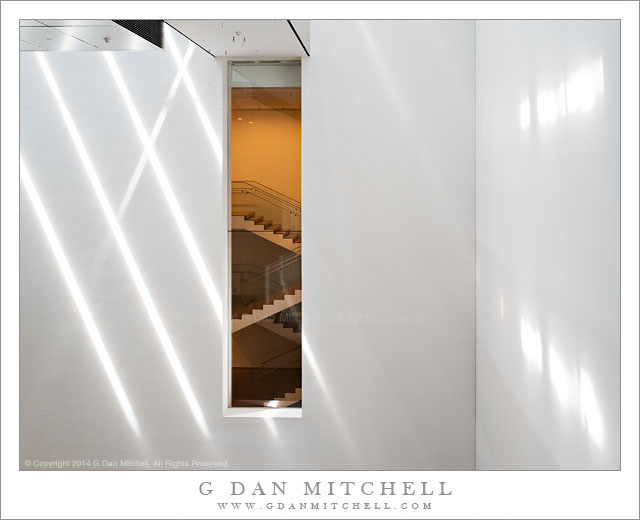
Museum Atrium
Museum Atrium

I’m going to try to keep this post somewhat brief, and touch on two aspects effects of this reality. There is, no doubt, much more to say about both ideas, but not in a “morning musings” post! So I’ll keep it to one paragraph per idea this time.

I believe that photographs are not so much about the things in front of the camera as they are about how the photographer sees the world. Whatever the subject might be, there is only one of it. Yet there are as many ways of seeing that one subject as there are people — perhaps even more. At first we all are certain that the subject of a photograph is that thing at which we point the camera, but the more photographs we see — our own and those of other photographers — the more we understand that the important thing is how and what the photographer sees, and how that way of seeing is shared photographically. In your own photography, this can and should eventually lead you beyond trying to emulate or compete with other photographers, and toward finding your own true and honest way of seeing.

Related to the idea that photographs embody your way of seeing is a secondary issue that affects the difference between how we see our work and how others see it. I sometimes am surprised that a photograph I believe in provokes little response from viewers, while one that I might think is fine-but-not-great will evoke a strong response.  One explanation may be that no one else can ever see a photograph in the same way that the photographer sees it. I don’t write this to suggest that viewers are coming up short when they look at photographs. The point is actually more about a mystery that the photographer often has to deal with. We often “know” our photographs in ways that are inaccessible to others. We recall the experience of making the photograph, what we had in mind when we made it, how the subject might connect to us in a personal way. We understand what we wanted the photograph to be and to do, and we are aware of things that we might have chosen to do differently in retrospect But viewers know none of this and, for the most part, can never fully know it. One of the outcomes of this reality is that we, as photographers, are frequently not the best judges of our own work. For everyone in the world but the photographer, the photographs have to say what they say on a visual basis — whatever meaning and associations they may have must come from that visual object.

Morning Musings are somewhat irregular posts in which I write about whatever is on my mind at the moment. Connections to photography may be tenuous at times!


G Dan Mitchell is a California photographer and visual opportunist whose subjects include the Pacific coast, redwood forests, central California oak/grasslands, the Sierra Nevada, California deserts, urban landscapes, night photography, and more.
Blog | About | Flickr | Twitter | FacebookGoogle+ | 500px.com | LinkedIn | Email

Text, photographs, and other media are © Copyright G Dan Mitchell (or others when indicated) and are not in the public domain and may not be used on websites, blogs, or in other media without advance permission from G Dan Mitchell.

Pond and Autumn Aspens, Evening

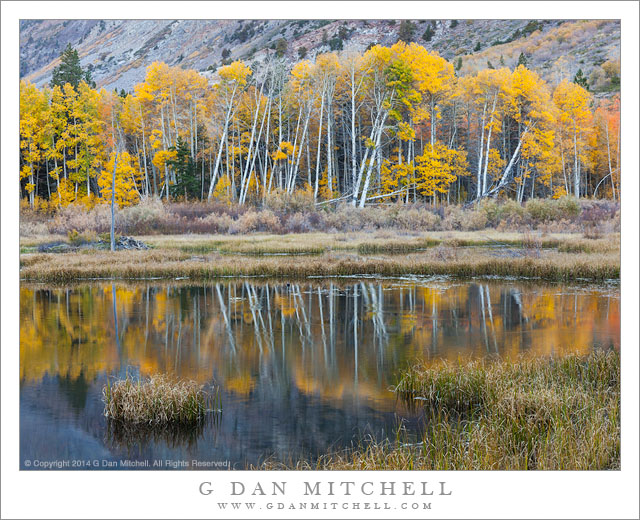
Pond and Autumn Aspens, Evening

Pond and Autumn Aspens, Evening. Eastern Sierra Nevada, California. October 12, 2014. © Copyright 2014 G Dan Mitchell – all rights reserved.

A grove of autumn color aspens reflected in an eastern Sierra Nevada pond

I saved my visit to this place for the final evening of the final day of this year’s aspen hunt. Although I had passed by the mouth of this canyon four days earlier, while heading to another location near the start of my trip, I had only glanced in from the main highway — but I could tell, both from experience and from looking, that there would almost certainly be some good color here later on. Although the color change seemed to start on a rather early schedule this year, later on the pattern seemed to become closer to the norm. Color started high, and by the time I made this photograph a lot of the highest elevation color was going or gone. (Not all of it though — even amidst lots of bare trees up high, I still came across scattered high elevation groves full of color.)

As the color transition continues, it moves to successively lower elevations, and some of the most protected east-side canyons can hold color even longer. In the past this has often been a decent late season location for color, but I’ve also been there when the color came and went early, for reasons I could not decipher. So on this day when I actually entered the canyon for the first time this fall, I wondered if the colors that I could see along the stream where it emptied into larger valley below might be all there was… or if the color would continue up higher. It turned out that the colors did continue, and in outstanding form! The majority of the trees had fully or nearly fully changed color, with a few other trees at either end of the transition — some still all or mostly all green, and a few that had gone to bare trunks and branches. Far up the canyon there are flooded meadows, and I made this photograph at the highest of these ponds.


G Dan Mitchell is a California photographer and visual opportunist whose subjects include the Pacific coast, redwood forests, central California oak/grasslands, the Sierra Nevada, California deserts, urban landscapes, night photography, and more.
Blog | About | Flickr | Twitter | FacebookGoogle+ | 500px.com | LinkedIn | Email

Text, photographs, and other media are © Copyright G Dan Mitchell (or others when indicated) and are not in the public domain and may not be used on websites, blogs, or in other media without advance permission from G Dan Mitchell.

Photographer and visual opportunist. Daily photos since 2005, plus articles, reviews, news, and ideas.