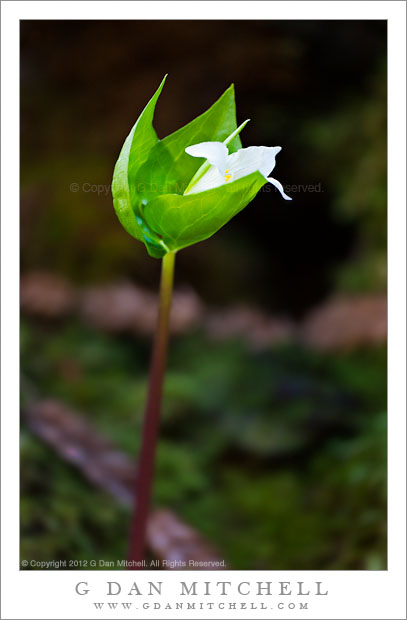
A new trillium plant emerges and begins to blossom beneath the redwood forest canopy.
With enough time to observe these plants – and a few return visits to fill in observational gaps – it is possible to see the full process of their unfolding. Though I still haven’t spotted the very earliest sprouts – probably because I didn’t look quite closely enough – I can spot the newly emerging plants that are about to open up and blossom. The leaves wrap around the incipient flower, and when they begin to open the appearance of the flower itself isn’t far behind.
On this visit to Muir Woods National Monument I found trillium plants in all stages from tiny plants with small leaves to those that had already blossomed and even lost the flowers. A few were at this wonderful stage when the cradling outside leaves are just opening to reveal the new flower. Soon the leaves will drop and flatten to produce the familiar three-part shape and the flower will stand (or droop!) above the leaves.
G Dan Mitchell is a California photographer whose subjects include the Pacific coast, redwood forests, central California oak/grasslands, the Sierra Nevada, California deserts, urban landscapes, night photography, and more. Blog | About | Flickr | Twitter | Facebook | Google+ | 500px.com | LinkedIn | Email
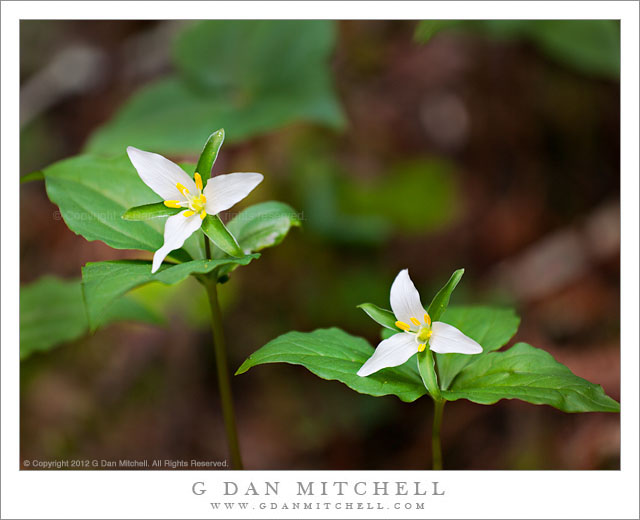
Two trillium blossoms in the redwood forests of the Golden Gate National Recreation Area, California.
It is probably obvious by now that I’m a trillium fanatic. Early March is “trillium season” in the redwood forests around the San Francisco Bay Area, so I have been out photographing these flowers during the past couple of weeks. I was originally concerned that this might be a very poor year for them since we are in the midst of a serious drought in California, but some early March rain seems to have provided enough water to get them to sprout. In fact, this past weekend I saw lots of new plants just starting to emerge, so it seems to me that there may be some life left in the this year’s bloom. (And now we are looking hopefully at an upcoming week of much-needed rain.)
I photographed this pair along a trail that traverses a hillside above a valley filled with coast redwoods. I arrived in this spot just as morning light was beginning to filter down through the tall canopy of this forest and, in spots, hit the ground and the new plants. The trick is is to get some of the brighter color of this sunlight but to avoid the direct sun – the latter is far too harsh for photographing these flowers. So I worked in the shaded areas or, at times, in those spots that were right on the sun/shade boundary. I probably most often photograph single flowers, but when I can find a group I like to see how I can make a composition out of them. It is a bit trickier than it might seem, as there are a bunch of elements that must work together. First, the two flowers need to be fairly close together, and they both need to be at roughly the same point in their development – it isn’t so wonderful to get one beautiful flower and one half-dead, dried hulk. Then they must both be illuminated in roughly the same way – it won’t work so well if one is in brighter light than the other. The background is a tricky thing, too. If it is too bright or too busy (or too well focused) it can easily distract from the flowers themselves, so I usually look for something in shadow and without any very bright objects. While I may be able to find a camera position that accomplishes this, sometimes I need to move a small, bright leaf or twig. And once all of this is worked out, the flowers must be roughly in a plane parallel to the camera’s sensor so that both will be in focus – and this must happen while shooting at the large apertures necessary to throw the background out of focus. And last, but not least, exposure can be slightly tricky – it is very easy to over-expose the bright but delicate form of the flower’s petals, and end up losing detail.
G Dan Mitchell is a California photographer whose subjects include the Pacific coast, redwood forests, central California oak/grasslands, the Sierra Nevada, California deserts, urban landscapes, night photography, and more. Blog | About | Flickr | Twitter | Facebook | Google+ | 500px.com | LinkedIn | Email
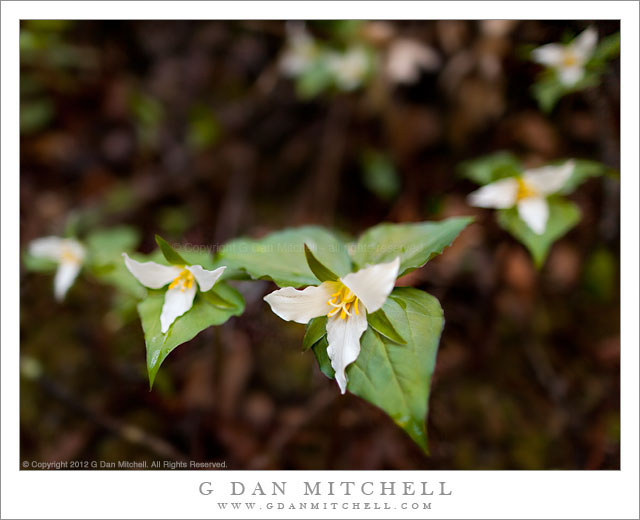
Trillium flowers bloom beneath the redwood forest, Northern California.
This is another in what is likely to be a series of photographs of trillium blooms in the redwood forest just north of San Francisco. On this morning I arrived before the crowds that often come across the Golden Gate to visit this nearby forest, and I walked into the redwood groves while there was still a relatively small number of people. Despite this being a very dry winter, some recent rains had moistened things up a bit and there was a fair amount of water around – and it almost seemed like plants that had been waiting for water were now making up for lost time.
At first I didn’t see too many trillium plants or flowers, but as I walked I began to come across more of them. A hike on a side-trail that traversed a hillside brought me to many more flowers, and in a few places they were thick enough and close enough together that I could include groups of them in the frame. Here I put on a very wide angle lens, and shot from a very close distance at a large aperture so that I could include this row of flowers and throw the background of the forest floor out of focus.
G Dan Mitchell is a California photographer whose subjects include the Pacific coast, redwood forests, central California oak/grasslands, the Sierra Nevada, California deserts, urban landscapes, night photography, and more. Blog | About | Flickr | Twitter | Facebook | Google+ | 500px.com | LinkedIn | Email
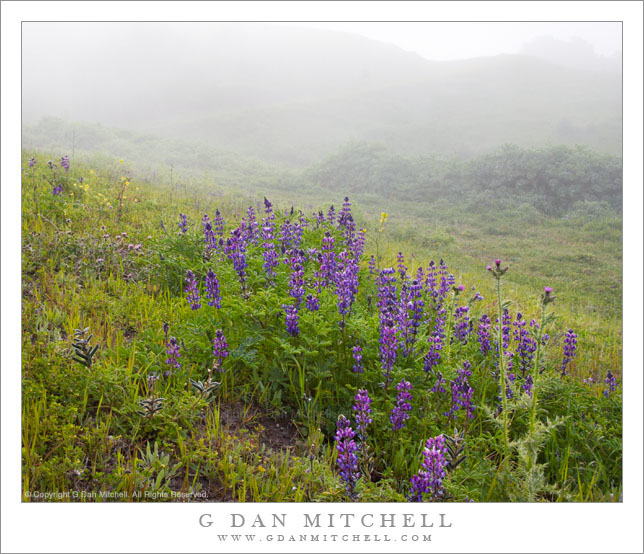
Spring lupine blossoms grow on fog-shrouded slopes of Mission Peak above Fremont, California.
While doing a major review of the past half-dozen years of raw files this week I have come across quite a few photographs that I had more or less forgotten. (I’ve also deleted a lot of old raw files, but that is a different story.) While I had forgotten this photograph, I remember the day I took it quite well and the memory of the photograph came back as soon as I found it.
Mission Peak is more than 2000′ feet above the Mission San Jose (part of Fremont) area of the San Francisco Bay Area, in the East Bay a bit north of San Jose. The peak is a very popular hiking location due to its proximity to urban areas, its quick access to near-wilderness, and the fact the summit provides a spectacular view of the southern parts of the San Francisco Bay, ranging from the South Bay and the Santa Cruz Mountains all the way up to San Francisco and, on clear days, beyond. On this day it was not clear, at least not at the start of the hike – it was extremely foggy, quite wet, and rather cold. But anyone who photographs flowers much knows that soft and diffused light can be your friend, and this fog certainly provided that light. The fog-obscured hills beyond are covered in the intense green (what I call the “impossible green”) of the California grasslands in spring.
By the way, I recall that as I continued on up the trail past these flowers and approached the summit of the peak I emerged above the fog bank to find hillsides carpeted with more lupine and with California golden poppy flowers.
Photographer and visual opportunist. Daily photos since 2005, plus articles, reviews, news, and ideas.
Manage Consent
To provide the best experiences, we use technologies like cookies to store and/or access device information. Consenting to these technologies will allow us to process data such as browsing behavior or unique IDs on this site. Not consenting or withdrawing consent, may adversely affect certain features and functions.
Functional
Always active
The technical storage or access is strictly necessary for the legitimate purpose of enabling the use of a specific service explicitly requested by the subscriber or user, or for the sole purpose of carrying out the transmission of a communication over an electronic communications network.
Preferences
The technical storage or access is necessary for the legitimate purpose of storing preferences that are not requested by the subscriber or user.
Statistics
The technical storage or access that is used exclusively for statistical purposes.The technical storage or access that is used exclusively for anonymous statistical purposes. Without a subpoena, voluntary compliance on the part of your Internet Service Provider, or additional records from a third party, information stored or retrieved for this purpose alone cannot usually be used to identify you.
Marketing
The technical storage or access is required to create user profiles to send advertising, or to track the user on a website or across several websites for similar marketing purposes.