Motion blurred photograph of a Chinatown store window display
Part of what I enjoy about night photography is the way that the environment is transformed and how I often have to resort to “seeing as the camera sees” more than seeing as I see in the dim light. The camera sees better in low light, it can pick up colors that fade almost to monochrome in nighttime human vision, and it can “see” things like blur motion with longer exposures.
For a few minutes on this evening I decided to play around with long exposure blur. Instead of keeping the ISO high so that I could use short shutter speeds in the low light and stop motion, I lowered the ISO and intentionally selected smaller apertures and very long shutter speeds. Then I used the combination of subject motion and intentionally moving the camera myself to create abstractions. It may hardly matter, but the subject here was a store window full of colorful lanterns.
I recently received an email from David, who has some questions about depth of field:
As you have a lot of experience of using the Fuji X-E1, may I please ask you for some advice regarding landscape focusing.
My aim is to use the 18-55mm kit lens with the majority of shots taken at the widest end. I have in mind setting the lens at Hyperfocal distances, based on a crop factor of 1.5 and a circle of confusion of 0.02. I think the first figure is reliable, but I’m not sure about the second in relation to the X-E1 – perhaps you could confirm.
I have already done some testing at home using the attached table (which come from the well respected DOFmaster site).
In my experiment I carefully measured distances at apertures of f8 and f11 using a tripod and a printed card as the subject. I set the lens manually at the hyperfocal distance, using the EVF distance scale. I was disappointed to find that the closest point of focus was not as sharp as I had hoped. Have you any idea why this may be?
I did a further test on aperture f11 and this time set the distance scale at 4 feet (2/3 of the way between 3 and 5 feet). This resulted in a sharp image from 3.5 feet. This would suggest that the distance scale is not accurate.
Any suggestions you have to overcome the problem would be much appreciated.
Let me preface my response on the depth of field (DOF) issue by congratulating you for taking the time to conduct your own experiments. One of the great things about digital cameras is that we don’t have to trust what we read — we can easily and quickly conduct the experiments ourselves. In addition to getting the answer to the question at hand, we end up knowing our gear at a much deeper and even intuitive level, which is extremely important when we are in the field and we don’t have time to ponder and calculate, but must instead make a photograph in the moment.
The rest of this post is going to be somewhat involved, so let me share a quick thought right at the beginning:
The usefulness of DOF calculators is very limited, as they are based on subjective assumptions that may not match what you are doing with your photographs. The best way to align your expectations with exposure choices is to test them yourself and evaluate images in the form that you most often produce — and not just at 100% magnification on a computer screen.
What is DOF? Essentially the depth of field is the distance range in front of and behind (unless you focus at infinity) the focus point within which subjects are likely to sharp enough to seem in focus when the photograph is viewed at some arbitrary magnification. This size of this range increases as we stop down (for example, going from f/2.8 to f/8 expands the DOF) and decreases as we open the aperture (going from f/8 to f/2.8 contracts DOF). This is a source of creative control for the photographer. A smaller aperture can allow subjects across a greater distance range to appear relatively sharp, while a larger aperture can keep the primary subject in focus while pleasingly “un-focusing” elements in front of and behind the primary focus point. Continue reading Reader Question: About Depth of Field→
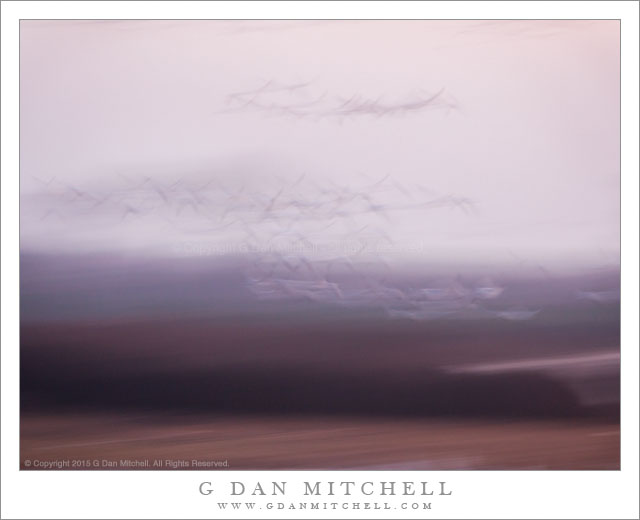
Abstract photograph of low-flying flock of geese in twilight
It has been a while since I share a fuzzy goosescape, so I’ll try to make up for it with this one. Late in the evening of a long day photographing migratory birds and the San Joaquin Valley landscape, after the sun had set, I made this last photograph of the day in very low light. As we photograph on into the evening — typically with the camera off the tripod when photographing birds — we try to keep up with the fading light by opening up the aperture, raising the ISO, and gradually lengthening the shutter speed.
Eventually there comes a point where the light is so low that this won’t allow sharp photographs of moving birds any more. I actually look forward to this end-of-the-evening time and I happily switch over to intentional motion blur photographs. I lower the ISO, close down the aperture, lengthen the shutter speed and try for soft, blurring photographs. A lot of this work is rather experimental, since you can’t completely know what you’ll get ahead of time. You do have some control — shutter speed controls just how much blur there will be; by panning the camera you can get moving subjects to be defined enough to recognize; by moving the camera you can control the angles and curves of lines of blurred light. And when it all works out just right the result can be quite beautiful and, in some ways, more suggestive of the feeling of this place at twilight.
G Dan Mitchell is a California photographer and visual opportunist whose subjects include the Pacific coast, redwood forests, central California oak/grasslands, the Sierra Nevada, California deserts, urban landscapes, night photography, and more. Blog | About | Flickr | Twitter | Facebook | Google+ | 500px.com | LinkedIn | Email
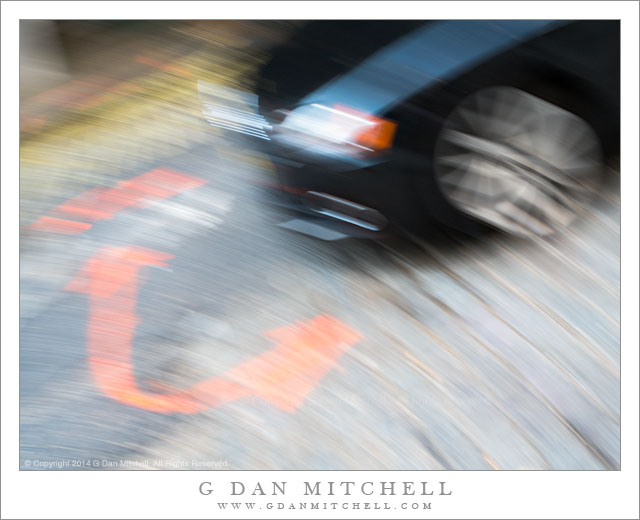
OK, here we go! I’m about to share a string of urban photographs, many of which are from New York City, where I spent slightly more than a week in early August. We were there for several reasons. My wife was attending a music conference at NYU. (A conference of oboe and bassoon players, if you wondered.) Her brother and sister-in-law live in Brooklyn and graciously agreed to host us during our stay, and our two sons also live in Brooklyn. For me this meant that I had the better part of a week to simply head out into Manhattan and Brooklyn, going wherever my intuition took me, and make photographs of the city.
A lot of the photographs fit into the street photography genre — which may seem a bit perplexing to those who know my landscape and nature photography — but this first one is more of an abstraction, created my means of a slow shutter speed and camera motion, most likely as I was crossing some busy street in midtown Manhattan.
G Dan Mitchell is a California photographer and visual opportunist whose subjects include the Pacific coast, redwood forests, central California oak/grasslands, the Sierra Nevada, California deserts, urban landscapes, night photography, and more. Blog | About | Flickr | Twitter | Facebook | Google+ | 500px.com | LinkedIn | Email
Photographer and visual opportunist. Daily photos since 2005, plus articles, reviews, news, and ideas.
Manage Consent
To provide the best experiences, we use technologies like cookies to store and/or access device information. Consenting to these technologies will allow us to process data such as browsing behavior or unique IDs on this site. Not consenting or withdrawing consent, may adversely affect certain features and functions.
Functional
Always active
The technical storage or access is strictly necessary for the legitimate purpose of enabling the use of a specific service explicitly requested by the subscriber or user, or for the sole purpose of carrying out the transmission of a communication over an electronic communications network.
Preferences
The technical storage or access is necessary for the legitimate purpose of storing preferences that are not requested by the subscriber or user.
Statistics
The technical storage or access that is used exclusively for statistical purposes.The technical storage or access that is used exclusively for anonymous statistical purposes. Without a subpoena, voluntary compliance on the part of your Internet Service Provider, or additional records from a third party, information stored or retrieved for this purpose alone cannot usually be used to identify you.
Marketing
The technical storage or access is required to create user profiles to send advertising, or to track the user on a website or across several websites for similar marketing purposes.


 G Dan Mitchell is a California photographer and visual opportunist. His book, “California’s Fall Color: A Photographer’s Guide to Autumn in the Sierra” is available from Heyday Books and Amazon.