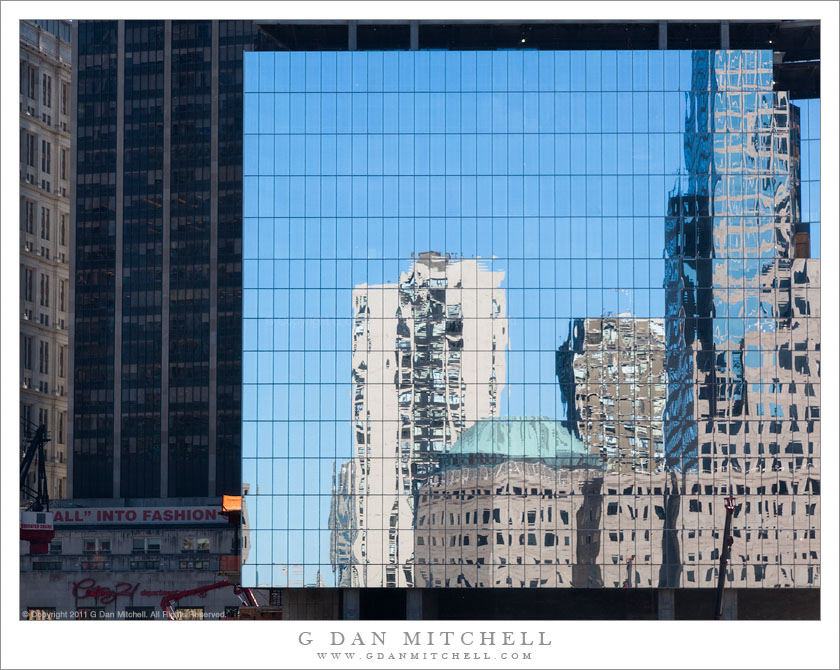
Reflections in new windows during reconstruction at the World Trade Center site, New York City, 2011.
G Dan Mitchell is a California photographer and visual opportunist. His book, “California’s Fall Color: A Photographer’s Guide to Autumn in the Sierra” is available from Heyday Books and Amazon.
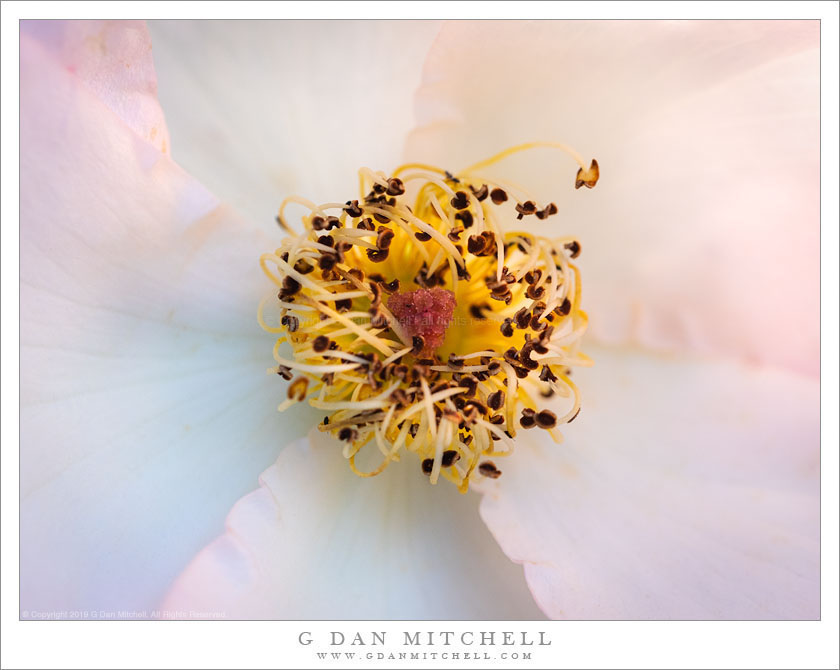
Macro photograph of the center of a delicately colored flower.
A few weeks ago I accompanied the local flower photographer — the one I live with — to one of her favorite area botanical gardens where we spent a morning photographing flowers and plants. I’ve been having some fun with this recently, perhaps because i finally got the right lens for photographing this subject close-up!
Many things intrigued me about this flower. The remarkable patterns in the flower’s center, of course, were prominent. But working in soft light, at least partially created by using a scrim for shade, an amazing range of subtle colors became visible — it seemed at first like a white flower, but in this light the presence of tones ranging from blue to pink became clearer.
G Dan Mitchell is a California photographer and visual opportunist. His book, “California’s Fall Color: A Photographer’s Guide to Autumn in the Sierra” is available from Heyday Books and Amazon.
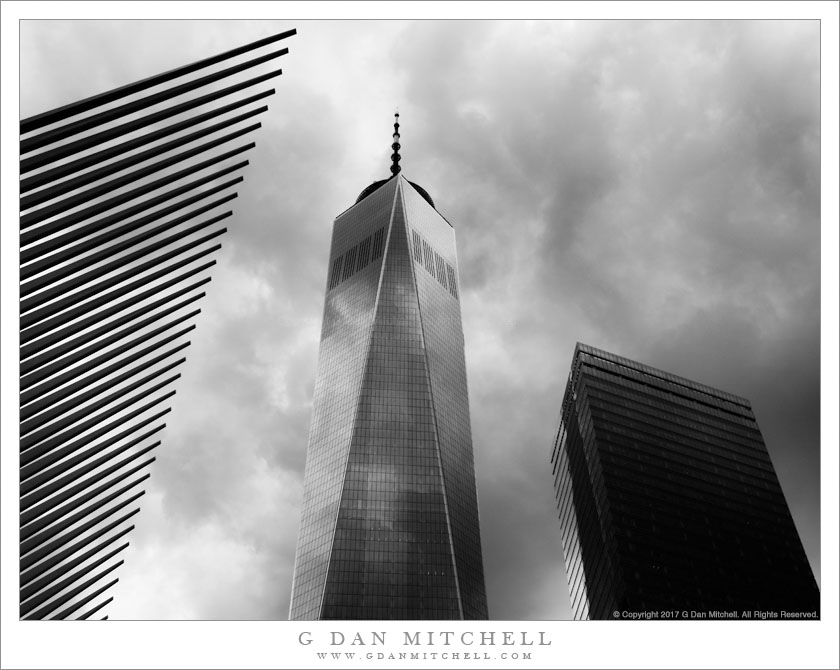
One World Trade Center flanked by building and part of the Oculus structure
Any commentary on a photograph from this location could easily expand to a chapter or more of text, but I’ll attempt to keep it to my usual two paragraphs. If you take the MTA E line spur to the WTC you emerge to more or less this view, one that has changed continuously for the past decade and a half — beginning with the events of September 2001, continuing in the aftermath of clean-up, followed by a long period of monumental construction work, and now beginning to look relatively complete. We did not visit the site for some time after the towers were destroyed, but I recall that our first visit was still a powerful experience — most of all I recall turning a corner and seeing a wall of photographs of FDNY victims.
Today the site, while still carrying the memories of the 2001 incident, begins to feel more and more like it is becoming a finished place and less like it is a perpetual construction zone. The huge Oculus structure now houses the PATH terminal and plenty of businesses. In this photograph its striking, skeletal form intrudes into the frame from the left, and dramatic clouds from another New York summer day are behind the new Trade Center building.
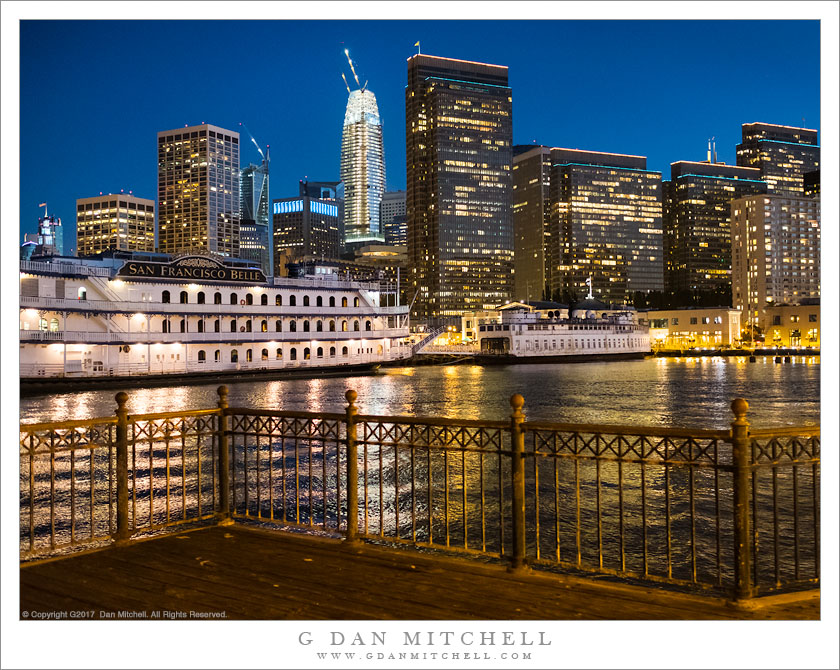
I made this photograph on a lovely, slow, spring evening in San Francisco, where I had gone to meet up with a small group of street photographers. First I joined them for dinner in Chinatown, and then we all headed out to do some photography. While I usually do street photography completely on my own, relishing the ability to move fast from place to place or stay put for long periods of time, it is enjoyable to work with others at times, too. Several folks in the group were interested in the waterfront where downtown San Francisco meets the bay, so we headed that way first, and eventually everyone ended up on a popular pedestrian pier with good views back towards the City.
A few years ago I realized that the image quality and high ISO capabilities of very small digital cameras was making it entirely possible to go out into the street and do handheld photography after dark. Before that time my night photography was almost invariably the long-exposure type, with the camera on a tripod and exposure times measured in minutes rather than fractions of seconds. Then, during a weeklong visit to New York, it hit me that I could push things enough to shoot night, and I was immediately hooked. So when I found myself in front of this subject, one that would typically be a tripod-only subject, I thought I’d give it a try even though I was traveling very light — one small camera, one prime lens, no tripod. And even in this late dusk light it turned out to be quite possible.
Photographer and visual opportunist. Daily photos since 2005, plus articles, reviews, news, and ideas.
Manage Consent
To provide the best experiences, we use technologies like cookies to store and/or access device information. Consenting to these technologies will allow us to process data such as browsing behavior or unique IDs on this site. Not consenting or withdrawing consent, may adversely affect certain features and functions.
Functional
Always active
The technical storage or access is strictly necessary for the legitimate purpose of enabling the use of a specific service explicitly requested by the subscriber or user, or for the sole purpose of carrying out the transmission of a communication over an electronic communications network.
Preferences
The technical storage or access is necessary for the legitimate purpose of storing preferences that are not requested by the subscriber or user.
Statistics
The technical storage or access that is used exclusively for statistical purposes.The technical storage or access that is used exclusively for anonymous statistical purposes. Without a subpoena, voluntary compliance on the part of your Internet Service Provider, or additional records from a third party, information stored or retrieved for this purpose alone cannot usually be used to identify you.
Marketing
The technical storage or access is required to create user profiles to send advertising, or to track the user on a website or across several websites for similar marketing purposes.