
Tag Archives: charlie

A Photograph Exposed: “Submerged Boulders, Lake, and Cliffs”

(“A Photograph Exposed” is a series exploring some of my photographs in greater detail.)
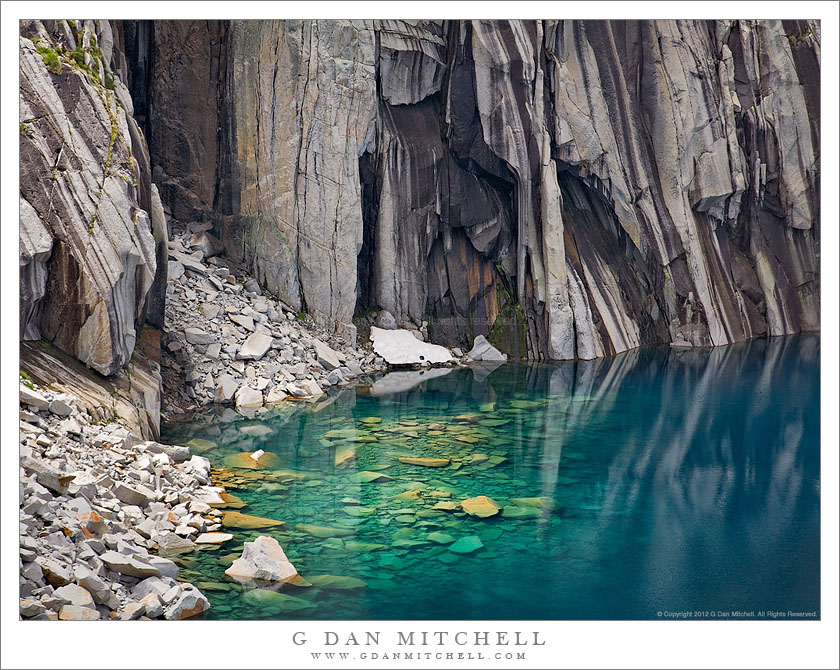
Submerged Boulders, Lake, and Cliffs
Sunlight illuminates submerged boulders near the cliff face along the High Sierra Trail – Sequioa National Park.

Submerged Boulders, Lake, and Cliffs. Sequoia National Park, California. August 6, 2008. © Copyright G Dan Mitchell – all rights reserved.

I have backpacked in California’s Sierra Nevada range for quite a few decades. A number (a large number!) of years ago my wife and I went on a two-week trans-Sierra backpack trip that traversed the range from west to east between Crescent Meadow and Whitney Portal,  following a route known as the “High Sierra Trail.” On the third morning we left our camp and began the stiff ascent toward the pass we had to cross to enter the Kern River drainage. Near the top of the steepest part of the climb the trail momentarily leveled out and we found ourselves facing a high, rockbound lake with a perfectly vertical patterned rock face dropping straight into the water on the far side. The view seemed familiar – and I realized that it was a scene captured by Ansel Adams (“Frozen Lake and Cliffs“) in the early 1930s.  (I also later realized that there is a wonderful and well-known photograph of the subject by Vern Clevenger.)

My wife and I were enthusiastic about photography in those days, too, and we carried a couple of Pentax SLRs and a few lenses and many rolls of film into the back-country. But I don’t think I came back with more than a few “snapshots” of this lake on that trip.

Fast-forward a few decades to 2008 when a group of my backpacking friends decided to follow this same trans-Sierra route — and, of course, I had to join them. Once again, I found myself ascending the trail toward that small bowl, but this time I had a plan to photograph the lake and the equipment to do it right. I recalled parts of the climb from my previous trip, but I had probably forgotten more than I remembered during the intervening decades. As the trail traverses a beautiful wet section full of wildflowers (which I had forgotten) I could tell that the lake was just ahead, and soon I topped a small saddle and saw the familiar scene before me.

As planned, I set to work doing some of the photography that I had contemplated before the trip. To be honest, I mainly worked from more or less the location that Adams must have used, though the conditions were a bit different on this day – the light was changeable as broken clouds passed above, and there was very little snow, much less ice, left at the lake. After perhaps 30 or 45 minutes of work, my hiking partners were getting restless and it was time to move on. I felt that I had worked this scene about as much as possible under the circumstances – and I did get a photograph of the “classic view” that I like a great deal — so I loaded up my heavy 9-day backpack load, put away the camera, and strapped the tripod to the outside of the pack. I hoisted the load and slowly started up the switchbacks immediately above the lake.

A couple of switchbacks up the trail I happened to look back at the lake from a slightly higher vantage point, and from here the astonishing deep blue color of the lake and the apron of rocks falling into the water became visible. My first reaction was a combination of “Wow!” and “No way am I taking this pack off and setting all that stuff up again!” Continue reading A Photograph Exposed: “Submerged Boulders, Lake, and Cliffs”

How I Sharpen – An Overview

(I originally wrote this article way back in 2009. Some portions were revised in February 2019 to reflect changes to sharpening tools and some different ideas I have developed regarding sharpening settings. It was updated and modified again in 2023.)

I just posted something elsewhere about how I sharpen for prints and I figured I’d get some extra mileage out of it by posting it here as well. First, few disclaimers…

  • The title of this article originally referred to a “quick overview.” Clearly, it is too long for that! But there are whole books on sharpening, so by contrast I think this qualifies as a quick description. In fact, I’ve left a lot out of the description!
  • There are people with far more expertise on this topic than I have, and I have no illusions that this description represents the “right” way to do this, much less the “best” way!

The subject of how to sharpen photographs in post for print or electronic output is one that confuses many people… and a subject to which many books, online articles, and forums posts have been devoted. There are any number of ways to get the desired results via sharpening, and different techniques are called for depending upon taste, the nature of the image, and the final form of presentation: size? print? jpg? etc…

Here is a general description of what I do when I print. I’ve left some variations out of this description. The description also covers software that I use in my workflow — you might prefer something different, but you might still be able to adapt these ideas. You’ll note at least one controversial method later in the list, but try it before you dismiss it. The approach I use could well be “over-kill” if you just want to pump out a bunch of jpgs to share with friends and family or if you want to make some small prints — my end goal is good sized prints, and I work on each one rather carefully rather than mass-processing them and printing a bunch at one time.

And please understand that I’m most certainly not implying that my way is the right way. It works for me, and that people who view my prints often remark on their sharpness and detail. (And a few other things, too, I hope! :-)

Continue reading How I Sharpen – An Overview

News From Charles Cramer

I got an email from Charles Cramer last week, meant to pass some of his news along right away, and then became very busy and forgot. (My excuse is a combination of having a ton of papers to grade and about 40 prints to make!) Anyway, better late than never…

The Ansel Adams Gallery in Yosemite Valley is having a show of Charlie’s work through May 27th. You can see some examples of his work from the show here. (I’m fond of most all of his photographs, but the luminous photograph of an aspen grove found in this series is one of my favorites.) If you are in the Valley during the next week and a half, be sure to stop by the Gallery and linger for a while  – if nothing else it sounds like a great way to spend some time during the midday non-shooting interval! (It would certainly be more edifying than what I usually do in the middle of my epic One-Day Bay Area to Yosemite and Back marathons: nap for an hour in my car!)

Charlie does workshops. He reports that almost all of them are currently sold out, but that are still some openings for a workshop in Santa Clara, California on June 26-28. Highly recommended – more information online. I’ve been fortunate to have Charlie share some of his vast knowledge of photography and printing with me, and I know personally how well he explains important concepts and techniques and how insightful he is when it comes to seeing and critiquing your photographs. He also has a great – though slightly twisted – sense of humor as well. If you have a chance to read his Photoshop Techniques booklet, you know what I mean.

Luminous Landscape: Charles Cramer Workshops

Seen at the Michael Reichmann’s Luminous Landscape web site:

I am fortunate to count among my friends some of the top photographic instructors in the world. I list their workshops on my Workshops page, and from time to time feature something new that they’re doing.

Charles Cramer is one of America’s most famous landscape photographers and teachers. For years he and Bill Atkinson have been teaching printing workshops together, but now Bill has decided to retire from these and so Charlie is striking out on his own.

You can find out more about this new series of printing workshops here.

I’m also fortunate to know Charlie. Everything Reichmann says is true, and I can vouch for Charlie’s teaching skills, having been the grateful recipient of some individual time with him in his studio. I’ve also been through his booklet on digital post-processing – it distills more useful and practical information into a small text than anything else I’ve seen, and I regularly consult it.

If you are looking to learn from an outstanding photographer, master printmaker, and fine teacher I highly recommend Charlie’s workshops.