
Tag Archives: curve

Caffe’ La Curva #1

Caffe' La Curva #1
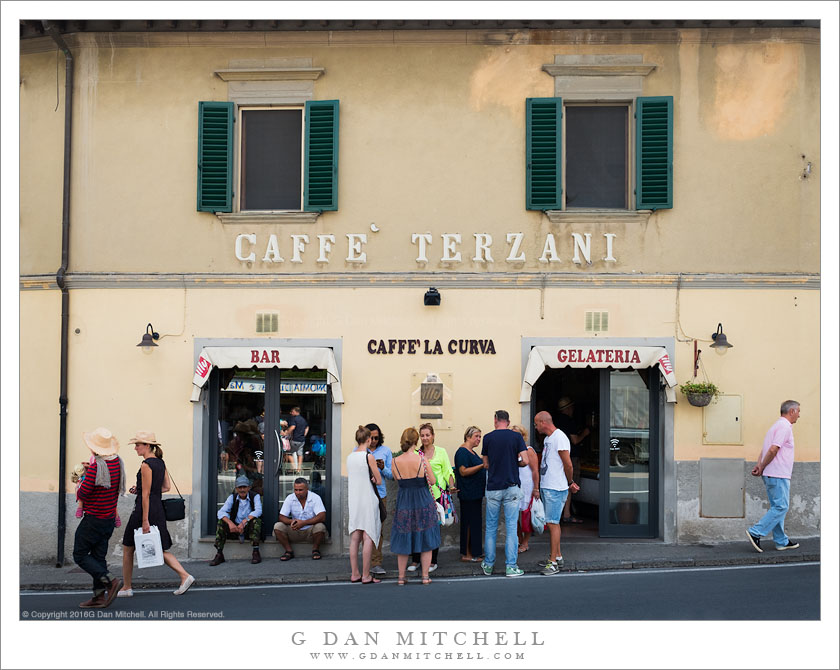
Sunday morning visitors outside Caffe’ La Curva, Panzano

Caffe’ La Curva #1. Panzano, Chianti, Italy. August 21, 2016. © Copyright 2016 G Dan Mitchell – all rights reserved.

Sunday morning visitors outside Caffe’ La Curva, Panzano

On this lazy Sunday morning in the Chianti region of Italy we had gotten up, made coffee, and sat around for a couple of hours before we remembered that we really needed to do some shopping… and that many things would be closed here today. We did some quick research and found that there was a market in this little town a half hour from our location and that it would be open only for another hour and a half. It was suddenly time to go!

Before we arrived we began to see cars parked everywhere along the road and parking wasn’t easy to find — the result, no doubt, of this being the only market open in the area on this morning. We found parking and walked up the small square, which was jam-packed with shoppers and others. The road continued on into the town, where there was just barely enough room for its two lanes to fit between buildings as it curved past and over the high point on the ridge. Across the street I saw this small caffe’, aptly named for the narrow curve, and I waited to photograph people coming and going.


G Dan Mitchell is a California photographer and visual opportunist. His book, “California’s Fall Color: A Photographer’s Guide to Autumn in the Sierra” is available from Heyday Books and Amazon.
Blog | About | Flickr | Twitter | FacebookGoogle+ | LinkedIn | Email


All media © Copyright G Dan Mitchell and others as indicated. Any use requires advance permission from G Dan Mitchell.
Dunes Interrupted

Dunes Interrupted
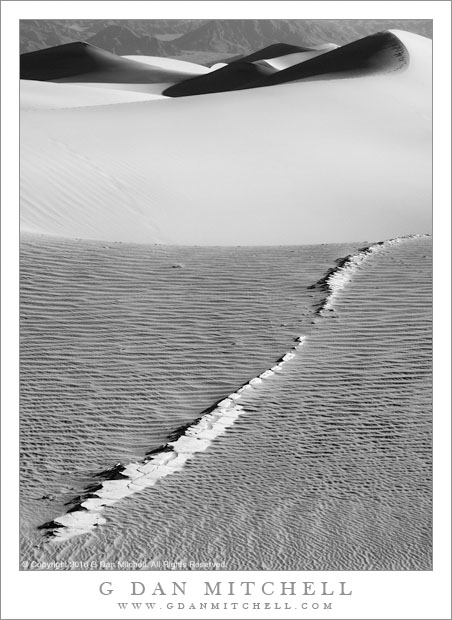
A curving diagonal of rock across sand dunes, Death Valley National Park

Dunes Interrupted. Death Valley National Park, California. March 30, 2016. © Copyright 2016 G Dan Mitchell – all rights reserved.

A curving diagonal of rock across sand dunes, Death Valley National Park

The sand dunes of Death Valley are more complex things than they might appear to be. For example, I have read that beneath their surface they actually hold quite a bit of moisture — quite a contradiction to our intuition about their dryness. (That intuition is based on fact — they can be hot and dry places, and the surface layer of the dunes is quite dry.) At the right times of day and of season they can be cool places, and they support plant and animal life.

These dunes also appear to stand on top of quite un-dune-like features. Around their edges you can find hints. You cross flat playa surface to get to them, and this surface holds abundant evidence of the work of water. In places you can even find areas that mimic perfectly the surfaces of contemporary playas, with their sedimentary formations covered with cracks. Here the edge of what must be a rather old example of this cuts diagonally across the landscape and still manages to poke its edge through the sand.


G Dan Mitchell is a California photographer and visual opportunist. His book, “California’s Fall Color: A Photographer’s Guide to Autumn in the Sierra” is available from Heyday Books and Amazon.
Blog | About | Flickr | Twitter | FacebookGoogle+ | LinkedIn | Email


All media © Copyright G Dan Mitchell and others as indicated. Any use requires advance permission from G Dan Mitchell.
Dunes, Sky

Dunes, Sky
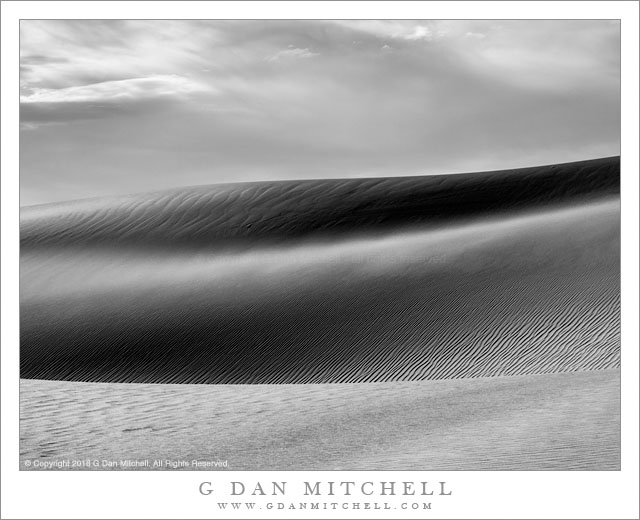
Sand dunes, shadows, and morning clouds

Dunes, Sky. Death Valley National Park, California. March 30, 2016. © Copyright 2016 G Dan Mitchell – all rights reserved.

Sand dunes, shadows, and morning clouds

Another photograph from another morning among the dunes. Because of the daily wind and dust storms during this visit to Death Valley National Park, we had many opportunities to find sand dunes with no or few signs of other visitors besides those creatures that actually live there. We approached the dunes in a variety of ways during this visit, and I photographed them almost daily, sometimes more than one. But I always came at them from a direction that wasn’t the most popular or best known. This time I came around on a looping route from a side and swing around behind some low, sandy areas to photograph in early morning light.

There is a lot to see in the dunes, and I had a few ideas as we arrived at the edge of the dunes. (While I usually don’t begin with a specific photograph it mind, I often have some general conceptual ideas I want to explore, and I keep my eyes open for subjects that could work along those lines.) I started with some old dry playa textures in front of the valley floor leading of toward distant mountains as the sun rose, and then I climbed some short dunes to look for interesting curving shapes and conjunctions of lines and subjects. I photographed some creosote plants against sand patterns and eventually moved deeper into the dunes, seeing the rippling textures of wind-blown sand draped across hills and valleys. I stopped to photograph a bit of sand texture straight on, and when I looked up and to the side I saw this series of curving horizontal lines with the cloudy sky above and beyond.


G Dan Mitchell is a California photographer and visual opportunist. His book, “California’s Fall Color: A Photographer’s Guide to Autumn in the Sierra” is available from Heyday Books and Amazon.
Blog | About | Flickr | Twitter | FacebookGoogle+ | 500px.com | LinkedIn | Email


All media © Copyright G Dan Mitchell and others as indicated. Any use requires advance permission from G Dan Mitchell.
Controlling Highlights (A Napkin Drawing)

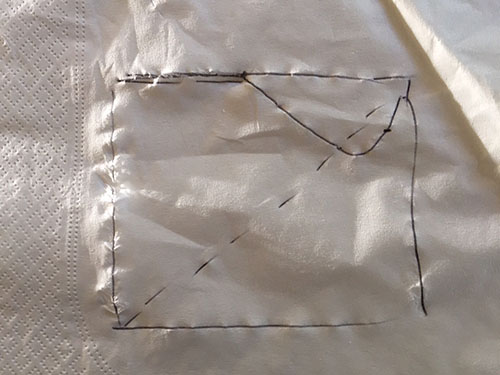
Earlier this month some friends and I got together in San Francisco, as we do every month, to share prints and talk photography. One friend shared prints of some beautiful night photographs he had made of a San Francisco subject. As we looked for little things that could make excellent prints even better we got to talking about highlights and how to control them. There are quite a few ways to do this, and I drew a little picture on a napkin to illustrate one technique I sometimes use to get a bit more detail out of areas that appear to be nearly pure white. The drawing looked a lot like the following.

Drawing on a napkin

It doesn’t look like much here, but trust me when I say that it made sense at the time. My friend picked up the napkin and took it with him as a reminder… and then a few days later contacted me to say he had lost the “napkin notes” from our conversation. He asked if I would mind describing the technique again. I said I’d do it — and three weeks later I finally got around to writing it up in this article!

Photographers using digital cameras have to watch out for over-exposing highlights. While we can recover a lot of detail from dark shadows, especially with current digital cameras, there is much less headroom at the bright end of the spectrum. When the exposure is too bright it is easy to end up with lost details in high luminosity areas. Go a little too far and you end up with that bane of digital photography, blown highlights, where the bright areas are simply pure white, leaving little or no hope of recovering the lost details. Continue reading Controlling Highlights (A Napkin Drawing)