
Tag Archives: eastern

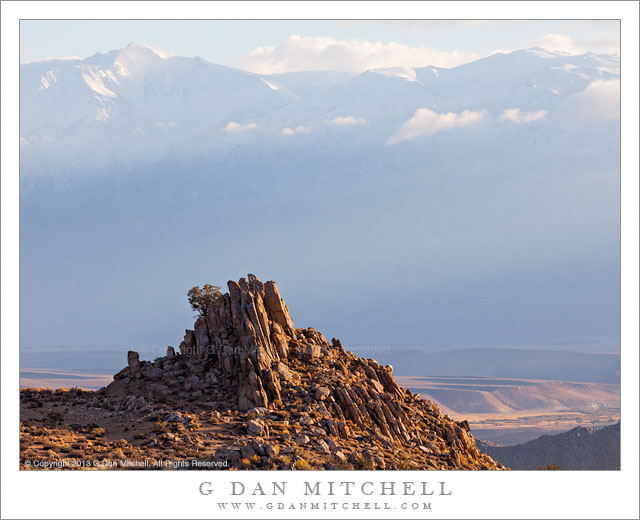
Outcropping, White Mountains, Morning

Outcropping, White Mountains, Morning

Outcropping, White Mountains, Morning. Eastern Sierra Nevada, California. October 10, 2013. © Copyright 2013 G Dan Mitchell – all rights reserved.

The White Mountains with new snow and morning clouds tower above a spire in the Buttermilks above Bishop, California

In early October, my excuse for going – yet again – to the eastern Sierra was, of course, to shoot the beautiful fall color of the aspen trees. That is reason enough to head over there, and I go every fall. And I did photograph aspens while I was over there. But my little secret is that there is a lot more than aspens to photograph on the East Side in the fall, and while aspens were always on my mind, photographing them took up less than half of our time overall.

The first day of the visit was devoted largely to travel, and the travel took longer than usual because a fall snow storm was passing through, closing passes so that we had to cross the Sierra much further north than usual, and then slowing the drive down highway 395. (The slow drive was partially due to road conditions, but perhaps more due to interesting photographic conditions that led to a lot of side trips and stops along the way.) On the second morning I knew that there would be a layer of fresh snow on the east facing slopes of the crest above Owens Valley, so we drove up into the Buttermilk area above Bishop to photograph there at dawn. After finishing up there we headed back down to pick up the road up into the Bishop Creek drainage. As we drove I saw some of the interesting pinnacles of the Buttermilks catching the morning sun as the huge ridge of the White Mountains, also covered with new snow, towered over on the other side of Owens Valley.

G Dan Mitchell is a California photographer and visual opportunist whose subjects include the Pacific coast, redwood forests, central California oak/grasslands, the Sierra Nevada, California deserts, urban landscapes, night photography, and more.
Blog | About | Flickr | Twitter | FacebookGoogle+ | 500px.com | LinkedIn | Email

Text, photographs, and other media are © Copyright G Dan Mitchell (or others when indicated) and are not in the public domain and may not be used on websites, blogs, or in other media without advance permission from G Dan Mitchell.
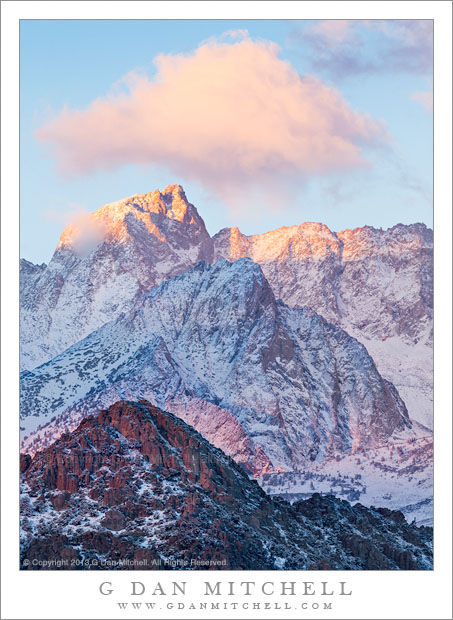

Mt. Humphreys, New Snow, Sunrise

Mt. Humphreys, New Snow, Sunrise

Mt. Humphreys, New Snow, Sunrise. The Buttermilk Range, California. October 10, 2013. © Copyright 2013 G Dan Mitchell – all rights reserved.

Sunrise light illuminates overnight snow on Mt. Humphreys and peaks of the Sierra Nevada crest above the Buttermilks

This was the morning after a day of October snowfall up and down the Sierra Nevada. The previous day we had photographed in snow almost the whole day as we traveled east over Carson Pass, then via Monitor Pass to highway 395, and continued south past Walker, Bridgeport, Lee Vining, and Mammoth (where the snow finally let up) and on to Bishop. Photographing aspen color in the snow was a special treat, since it combined the autumn ritual of aspen chasing with the clear indication that the cold season was on its way, a message delivered by snow.

That night I realized that the snow would certainly coat the peaks of the eastern Sierra the next morning, so instead of heading straight up to photograph aspens, I decided that we would instead go to a place in the sage country above Bishop from which a great section of the eastern Sierra is visible, to see if we might get dawn light on the snow-covered mountains. We arrived – of course! – before sunrise, and the jury was still out. There were clouds floating over the crest and, more importantly, there were clouds high up in the White Mountains to the east. Mornings like this have the potential to either be a complete bust if the clouds block the early light, or to bring especially beautiful conditions if the dawn light finds a way to shine through breaks in the clouds. We got our breaks, and on top of that the clouds above the crest began to break up just as the sunlight arrived. In this photograph, a fluffy cloud has been considerate enough to momentarily park its peak-shaped form above Mt. Humphreys, a bit of light hits the peaks, a band of light lower down illuminates the base of the snow-covered escarpment, and a bit of reddish light even hits the nearer and darker foreground peak.

G Dan Mitchell is a California photographer and visual opportunist whose subjects include the Pacific coast, redwood forests, central California oak/grasslands, the Sierra Nevada, California deserts, urban landscapes, night photography, and more.
Blog | About | Flickr | Twitter | FacebookGoogle+ | 500px.com | LinkedIn | Email

Text, photographs, and other media are © Copyright G Dan Mitchell (or others when indicated) and are not in the public domain and may not be used on websites, blogs, or in other media without advance permission from G Dan Mitchell.
Looking for Eastern Sierra Aspen Color?

Since this is the season of aspen color along the east slope of the Sierra Nevada mountains, it seems like a good time to share a link to my article on where and how to find and photograph these beautiful trees: Sierra Nevada Fall Color Season – Coming Sooner Than You Think

Fallen Aspen Branch, Snow - A small aspen tree branch blown down by an early fall storm rests on snow, North Lake, California.
Fallen Aspen Branch, Snow – A small aspen tree branch blown down by an early fall storm rests on snow, North Lake, California.

“Fallen Aspen Branch, Snow” Sierra Nevada Range, California. © Copyright G Dan Mitchell – all rights reserved.

I originally wrote this article four years ago, in response to a lot of questions about this seasonal change, and I have updated it regularly since then. The short story is that the aspens begin to change near the end of September in a typical year, and if you know where to look you can find aspen color for the next three weeks or perhaps just a bit longer. The change starts in the highest groves of trees and then works its way down to lower elevations as the transformation progresses, with later potential down along the base of the range and in some of the east side canyons.

I have not (yet) been up to photograph the trees this season – though I plan to rectify that situation very soon! – but everything I’m hearing right now suggests that the change came earlier than usual this year. In a more typical year I would expect to see the best color perhaps starting right about now and continuing for another week or longer – but this year there are a lot of reports of high elevation trees already dropping leaves and of lower elevation areas already in peak form. If you are going this year, I would make it sooner rather than later!

G Dan Mitchell is a California photographer and visual opportunist whose subjects include the Pacific coast, redwood forests, central California oak/grasslands, the Sierra Nevada, California deserts, urban landscapes, night photography, and more.
Blog | About | Flickr | Twitter | FacebookGoogle+ | 500px.com | LinkedIn | Email

Text, photographs, and other media are © Copyright G Dan Mitchell (or others when indicated) and are not in the public domain and may not be used on websites, blogs, or in other media without advance permission from G Dan Mitchell.

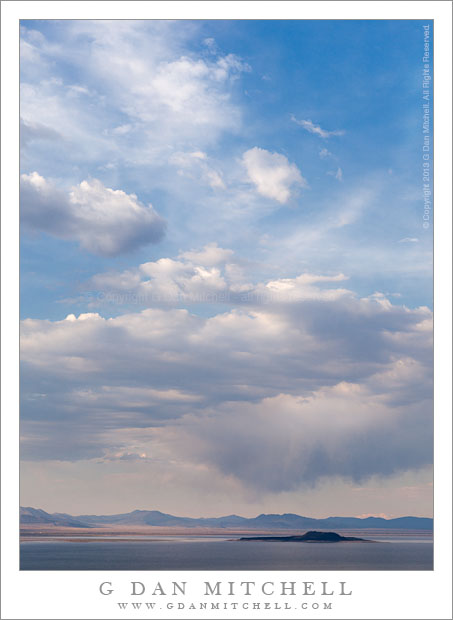
Desert Sky, Negit Island

Desert Sky, Negit Island

Desert Sky, Negit Island. Mono Lake, California. August 5, 2013. © Copyright 2013 G Dan Mitchell – all rights reserved.

Mono Lake and dark Negit Island beneath a vast and cloud-filled summer sky

Mono Lake still seems like a somewhat mysterious place to me. Although I’m familiar with parts of it, having gone by and to it for many years on Sierra trips and having photographed there many times, I find it hard to quite get my mind around it in the same way that I can with many other places. There are probably several factors that contribute to this. First, it is obviously an absolutely huge place. While I can see the far side of the lake and the mountains beyond, they are a great distance away, as I’ve realized when traveling just part way around it – so I have looked at much of it but I have not directly experienced that much of it close up. Second, we feel that we know the chief features of this lake very well – they are, I suppose, the lowering water level of this close-off basin lake, its tremendous size, the mineral-filled water, and the famous tufa formations. But a bit more time, even only that time that I’ve spent there that is mostly secondary to “Sierra time,” and it starts to be clear that these things are not the whole story.

Some years ago, when photographing the tufas around dawn, mostly when almost no one else was around, I began to catch on to the fact that things like the sounds of flocks of birds, the immense distances on land and – especially – in the huge sky, the wind, and the deep quiet of the place have more to do with its character than the tufas. Often when I stop there now I do not go to the tufas at all, instead perhaps expanding my knowledge of other areas of the lake and surrounding country. This photograph was made from above the lake, in a location where I could look slightly down on the water, which better shows its expanse, and on the dark shape of volcanic Negit Island. But I chose to include them primarily not for their own value but rather to anchor that vast sky with its building afternoon clouds.

G Dan Mitchell is a California photographer and visual opportunist whose subjects include the Pacific coast, redwood forests, central California oak/grasslands, the Sierra Nevada, California deserts, urban landscapes, night photography, and more.
Blog | About | Flickr | Twitter | FacebookGoogle+ | 500px.com | LinkedIn | Email

Text, photographs, and other media are © Copyright G Dan Mitchell (or others when indicated) and are not in the public domain and may not be used on websites, blogs, or in other media without advance permission from G Dan Mitchell.