
Tag Archives: eroded

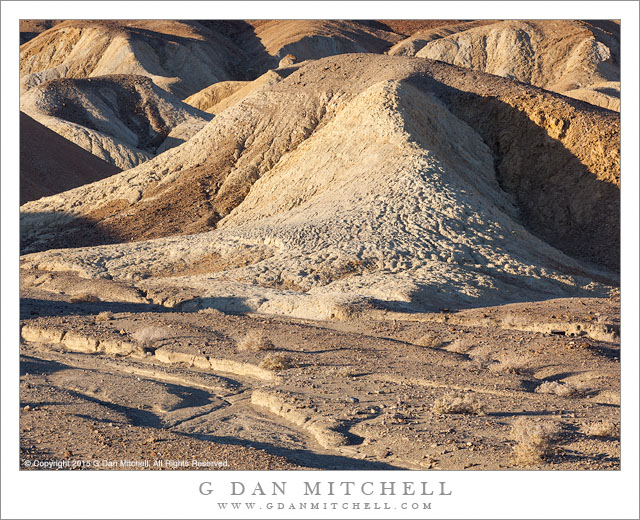
Wash and Eroded Hills

Wash and Eroded Hills

Wash and Eroded Hills. Death Valley National Park, California. April 3, 2015. © Copyright 2015 G Dan Mitchell – all rights reserved.

Morning light shines on eroded hills and a desert wash.

This was the final morning of my spring photographic excursion to Death Valley. On the last day of these visits I always seem to follow the same general ritual — I get up well before dawn (of course!) and visit one final photography location very early, then go back and break camp before leaving the park and starting the long drove back to the San Francisco Bay Area. This means that I almost always pick a familiar “sure thing” location for the last morning, and one that is not too far from wherever I camped the night before. I rarely make this a spur-of-the-moment decision, instead typically deciding ahead of time where I’ll go — there isn’t a lot of time to waste on this final, long day. On this trip I headed back to a little area not far from a familiar Death Valley icon. (I would stop at that icon, but only if the conditions turned out to be spectacularly unusual — I certainly don’t need another photograph of it otherwise, as beautiful as it is.)

I turned off the main road onto the gravel side road, slowed to a crawl, parked and got out with camera gear in hand, and quickly settled into the quiet and stillness of this place in the moments before dawn. Even though I have been to this spot many times, I’m still surprised by how quiet it is and by how few others go here. Although I know specific locations that might offer reliable and predictable photographs, once I’m here I prefer to take my time and look for and at things that I had not previously noticed. At first — and it was the case on this morning — it seems like there is little special to see, and I may momentarily wonder if I’m going to be able to find photographs. But as I slow down and begin to see, I invariably find things that I would have missed if I had not given the place some time. This photograph was the result of spotting a little path up to a higher spot — the path itself intrigued me so I followed it, and I was happy to find that it overlooked this little bit of classic Death Valley geography.


G Dan Mitchell is a California photographer and visual opportunist whose subjects include the Pacific coast, redwood forests, central California oak/grasslands, the Sierra Nevada, California deserts, urban landscapes, night photography, and more.
Blog | About | Flickr | Twitter | FacebookGoogle+ | 500px.com | LinkedIn | Email

Text, photographs, and other media are © Copyright G Dan Mitchell (or others when indicated) and are not in the public domain and may not be used on websites, blogs, or in other media without advance permission from G Dan Mitchell.

Red And White Strata

Red And White Strata
“Red And White Strata” — Eroded layers of red and white material, Red Rock Canyon State Park, California.

Returning from Utah last fall we decided to make a detour up toward Red Rock Canyon State Park. I’ve driven through/past this park many times while traveling to and from Death Valley National Park, and every time I’ve passed through I have promised myself to stop… eventually. Eventually continued for more than ten years, aside from a brief pause at a road side pullout, so it was about time to make a visit. The terrain is striking, not looking anything at all like other areas nearby. The fluted and eroded structures and occasional layers of red rock bring the Utah geology to mind, though in a considerably less intense form.

We only had a short time there since we had started our day back in Zion National Park. Arriving in the late afternoon we took what seems like the main driving loop in the main part of the park, and followed it back up to a campground which was almost completely deserted on this late-season date. We found these formations along the upper edge off the campground. At first the very soft light — from high clouds — and the subtle colors almost made me wonder if photographs would be worthwhile, but eventually I figured out how to “see” this light and the subdued colors.


Leave a comment or question using the form. (Click the title to see the full article and to comment if you are viewing it on the home page.)

G Dan Mitchell is a California photographer and visual opportunist. His book, “California’s Fall Color: A Photographer’s Guide to Autumn in the Sierra” (Heyday Books) is available directly from him. Blog | Bluesky | Mastodon | Substack Notes | Flickr | Email

All media © Copyright G Dan Mitchell and others.

Rising Desert Hills

Rising Desert Hills
Rising Desert Hills

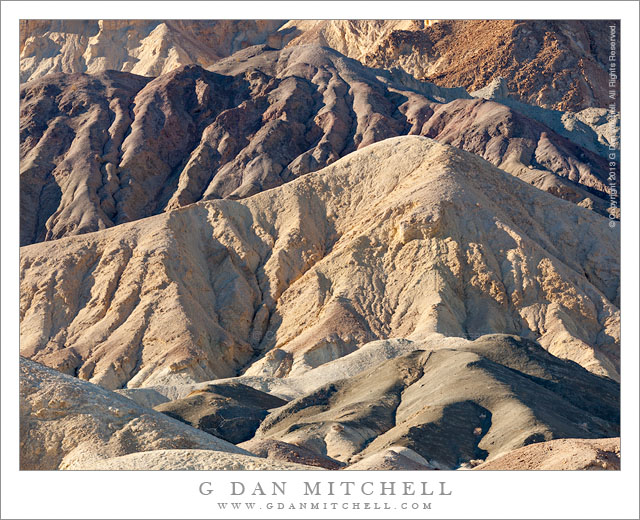
Rising Desert Hills. Death Valley National Park, California. December 10, 2013. © Copyright 2013 G Dan Mitchell – all rights reserved.

A rising series of colorful eroded hills, Death Valley National Park

I get to use this photograph to tell a story at my own expense. Before arriving in Death Valley I had previous shot a very different subject. I don’t recall if it was birds in fading dusk light or perhaps classical musicians in stage lighting and backstage work lights. (Some of you can already guess where this is headed…) On the first morning in Death Valley I headed to a place that I like to photograph in early light – a place where there usually aren’t too many people, despite the easily accessible location, and where the eroded and colorful geology is almost completely devoid of plants. I arrived before sunrise and soon found a nice composition that I had not photographed before. I spent some time working that scene before moving on and photographing another a little ways away. Partway through that second set of shots I realized that my camera was still on the settings for the prior low-light subject – namely ISO 3200. That is not exactly a typical landscape sort of setting, and while good results are possible when shooting low light subjects that way, the noise levels are far from ideal for landscape. I reset and continued shooting. (I did return to the location on the final morning of the trip to reshoot that first subject.)

This scene was one of the first that I shot after realizing my error. These very eroded hills place different color material in a series of rising hills – tan, reddish, purple-black, brown, and more. The smooth features along the tops of some of the small ridges contrast with the very sharp and angular lines of the eroded channels that lead down to the wash. Later in the day the light here is almost impossibly harsh and the colors fade, but for a few minutes at the start (especially) and end of the day the colors briefly intensify.

G Dan Mitchell is a California photographer and visual opportunist whose subjects include the Pacific coast, redwood forests, central California oak/grasslands, the Sierra Nevada, California deserts, urban landscapes, night photography, and more.
Blog | About | Flickr | Twitter | FacebookGoogle+ | 500px.com | LinkedIn | Email

Text, photographs, and other media are © Copyright G Dan Mitchell (or others when indicated) and are not in the public domain and may not be used on websites, blogs, or in other media without advance permission from G Dan Mitchell.
Eroded Desert Canyon Walls

Eroded Desert Canyon Walls

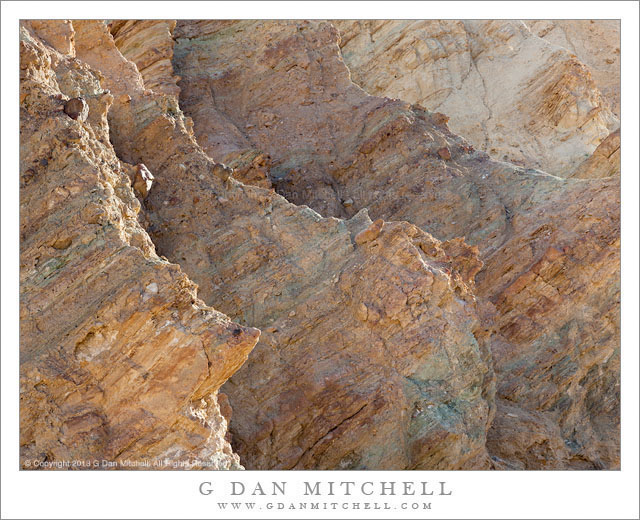
Eroded Desert Canyon Walls. Death Valley National Park, California. April 5, 2013. © Copyright 2013 G Dan Mitchell – all rights reserved.

The eroded rock strata of the walls of a narrow desert canyon, Death Valley National Park

I made this photograph in a place that I most certainly would not want to visit on the day that I am posting this! Back in early April this popular hike up a narrow canyon was relatively comfortable on a day when the temperature might have made it to about 90 degrees Fahrenheit. By now, that would be considered to be a “cool” day, since temperatures in these “warm” months frequently go well over 100 degrees. Some people choose to visit Death Valley in those awful conditions, but I’ll take the late fall through early spring season any time!

In Death Valley, more so than in just about any other area below timberline, the geology of the place is laid open for us to see clearly. Things do grow there, but sparsely and rarely beyond a height that might be measured in inches. The primary impression is of rock – monumental mountains of rock, vast washes over which floods have spread broken up rock and gravel, and the valley floors which may range from gravel to sand – but are still, ultimately, rock. Very little grows in this canyon aside from a few tiny plants peeking out of the odd crack or cowering in bits of shade, so here the erosion features and the underlying rock strata are easy to see. As I came to this point in the canyon, the wall was mostly still in shadows filled by reflected light, with just a bit of direct sunlight rimming the edges of some of the rocks.

G Dan Mitchell is a California photographer and visual opportunist whose subjects include the Pacific coast, redwood forests, central California oak/grasslands, the Sierra Nevada, California deserts, urban landscapes, night photography, and more.
Blog | About | Flickr | Twitter | FacebookGoogle+ | 500px.com | LinkedIn | Email

Text, photographs, and other media are © Copyright G Dan Mitchell (or others when indicated) and are not in the public domain and may not be used on websites, blogs, or in other media without advance permission from G Dan Mitchell.