
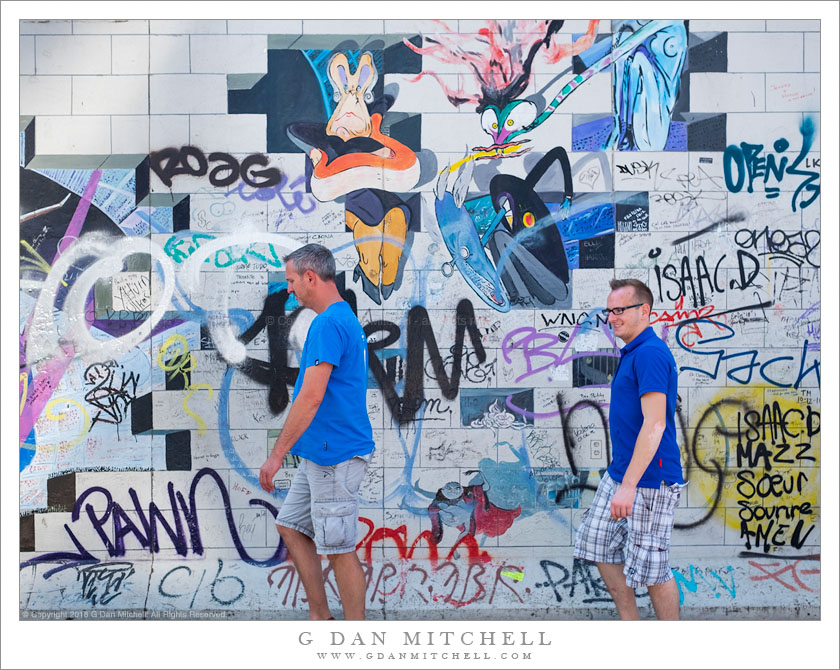
Tag Archives: historic

Whalers Cabin, Point Lobos

Whalers Cabin, Point Lobos
Hidden behind a grove of trees, the Whalers Cabin sits on a bluff above Whalers Cove at Point Lobos

Whalers Cabin, Point Lobos. Point Lobos State Reserve, California. July 18, 2017. © Copyright 2017 G Dan Mitchell – all rights reserved.

Hidden behind a grove of trees, the Whalers Cabin sits on a bluff above Whalers Cove at Point Lobos

For may years I have visiting Point Lobos, the increasingly popular (and sometimes over-run) California coastal reserve along the Pacific Coast just south of Carmel. Decades ago my family visited when I was a child — I recall picnicking there, but most of all I remember exploring the tide pools and descending a steep old trail to a small beach that is now closed. While I knew limited areas of the reserve very well, there were other sections that I simply never visited: some of the forest trails, a few areas close to Monastery Beach and others.

One of the places that, oddly, I never visited was the little “Whalers Cabin” set back on the bluff above Whalers Cove, a sheltered and often placid bay that is protected from the surf of the open ocean. I visited the cove, and I’ve photographed there in the past, but I always went right past the cabin without stopping. This summer I finally stopped in and looked around a bit. As I understand it, whalers may have used the place, but so did fisherman. Today it is a small museum, and (as far as I know) the only very old historic structure still remaining in the park.


G Dan Mitchell is a California photographer and visual opportunist. His book, “California’s Fall Color: A Photographer’s Guide to Autumn in the Sierra” is available from Heyday Books and Amazon.
Blog | About | Flickr | Twitter | FacebookGoogle+ | LinkedIn | Email


All media © Copyright G Dan Mitchell and others as indicated. Any use requires advance permission from G Dan Mitchell.
The Louvre

The Louvre
Courtyard and people, the Louvre

The Louvre. Paris, France. August 11, 2016. © Copyright 2016 G Dan Mitchell – all rights reserved.

Courtyard and people, the Louvre

We spent about a week exploring Paris during the summer of 2016. Mostly we wandered, with a few specific goals in mind, and many opportunities for (sometimes random) discoveries. But there were a few things that we knew we had to visit, and the The Louvre was, of course, on that list. The museum is gigantic, with collections that are so extensive that a single day visit — which is what we had — only affords an opportunity to visit a small portion of the museum. We managed mostly one floor of one wing.

The grounds within and around the Louvre are constructed on a monumental scale. While many parts of Paris feature narrow and twisting streets, here there are vast open courtyards and buildings that extend over great distances. This photograph was made from one of the upper levels of the museum, and it looks back toward the central open area, across which groups of people walk.


G Dan Mitchell is a California photographer and visual opportunist. His book, “California’s Fall Color: A Photographer’s Guide to Autumn in the Sierra” is available from Heyday Books and Amazon.
Blog | About | Flickr | Twitter | FacebookGoogle+ | LinkedIn | Email


All media © Copyright G Dan Mitchell and others as indicated. Any use requires advance permission from G Dan Mitchell.
D8 Crane, Night

D8 Crane, Night
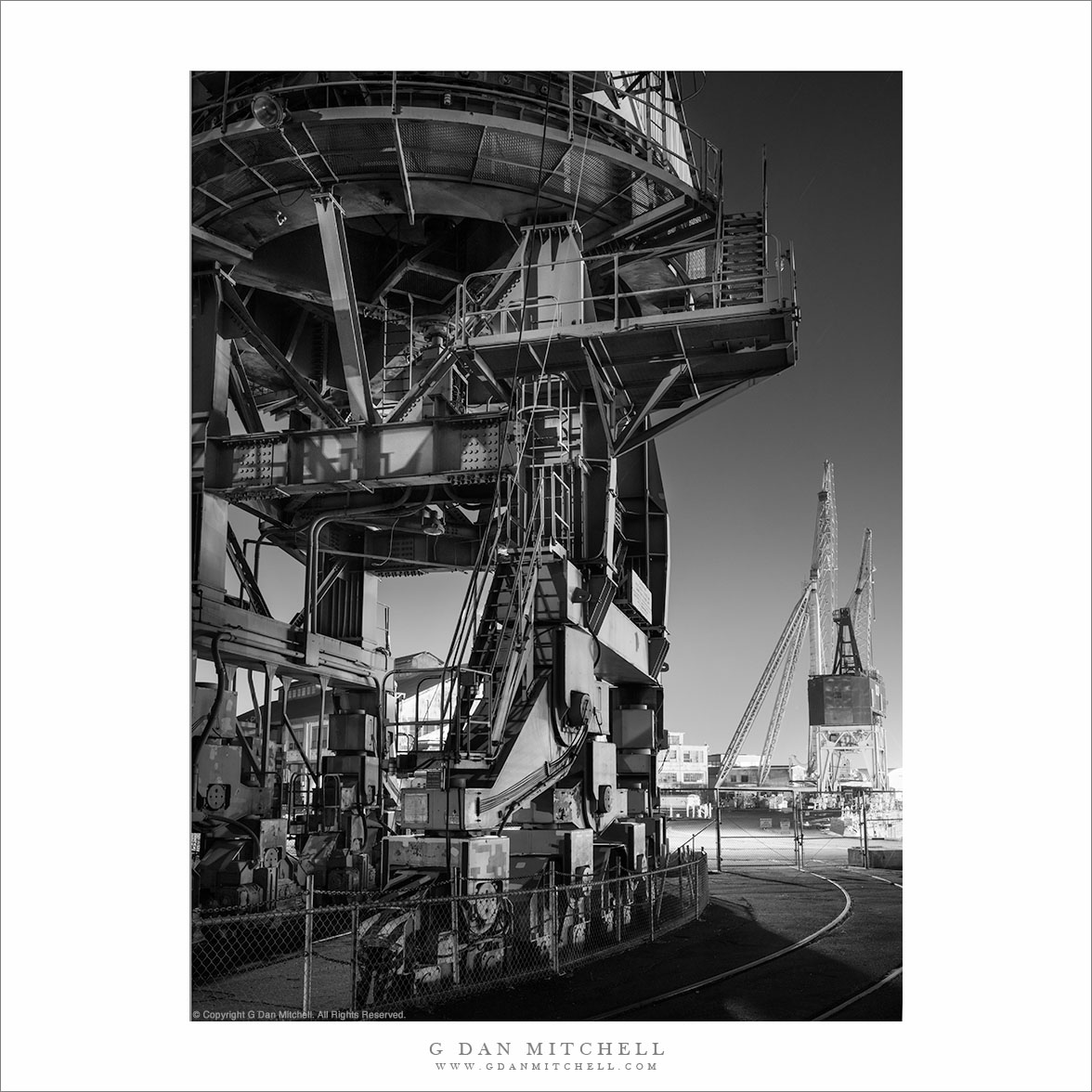
The D8 crane at night, Mare Island Naval Ship Yard

D8 Crane, Night. Mare Island Naval Ship Yard, California. March 11, 2017. © Copyright 2017 G Dan Mitchell – all rights reserved.

The D8 crane at night, Mare Island Naval Ship Yard

As all who photographer there know, these huge crane are among the primary iconic elements of the historic Mare Island Naval Ship Yard. Their size makes them visible from many places including the opposite shore in the town of Vallejo across the harbor. Their appearance is striking, especially at night, when their organic forms are usually lit from below, especially now that they are once again in use as part of a project to dismantle the ships of the old “ghost fleet” that was long moored near the Carquinez Bridge.

Their reactivation has created some photographic opportunities that were rarely available when I first began photographing at Mare Island a dozen or more years ago. Back then the cranes, which can be moved around the dry docks along a system or railway tracks, were often parked in inaccessible locations and seldom well-lit. But on this visit we found two of them had been moved out from behind the security fences and along a closed roadway. We were able to photograph them close-up and from a range of positions and angles. Each has a sort of personality. The closest one is bright yellow in the artificial light, while the further crane has a dark and weathered appearance.


G Dan Mitchell is a California photographer and visual opportunist. His book, “California’s Fall Color: A Photographer’s Guide to Autumn in the Sierra” is available from Heyday Books and Amazon.
Blog | About | Flickr | Twitter | FacebookGoogle+ | LinkedIn | Email


All media © Copyright G Dan Mitchell and others as indicated. Any use requires advance permission from G Dan Mitchell.
Abandoned Loading Dock

Abandoned Loading Dock
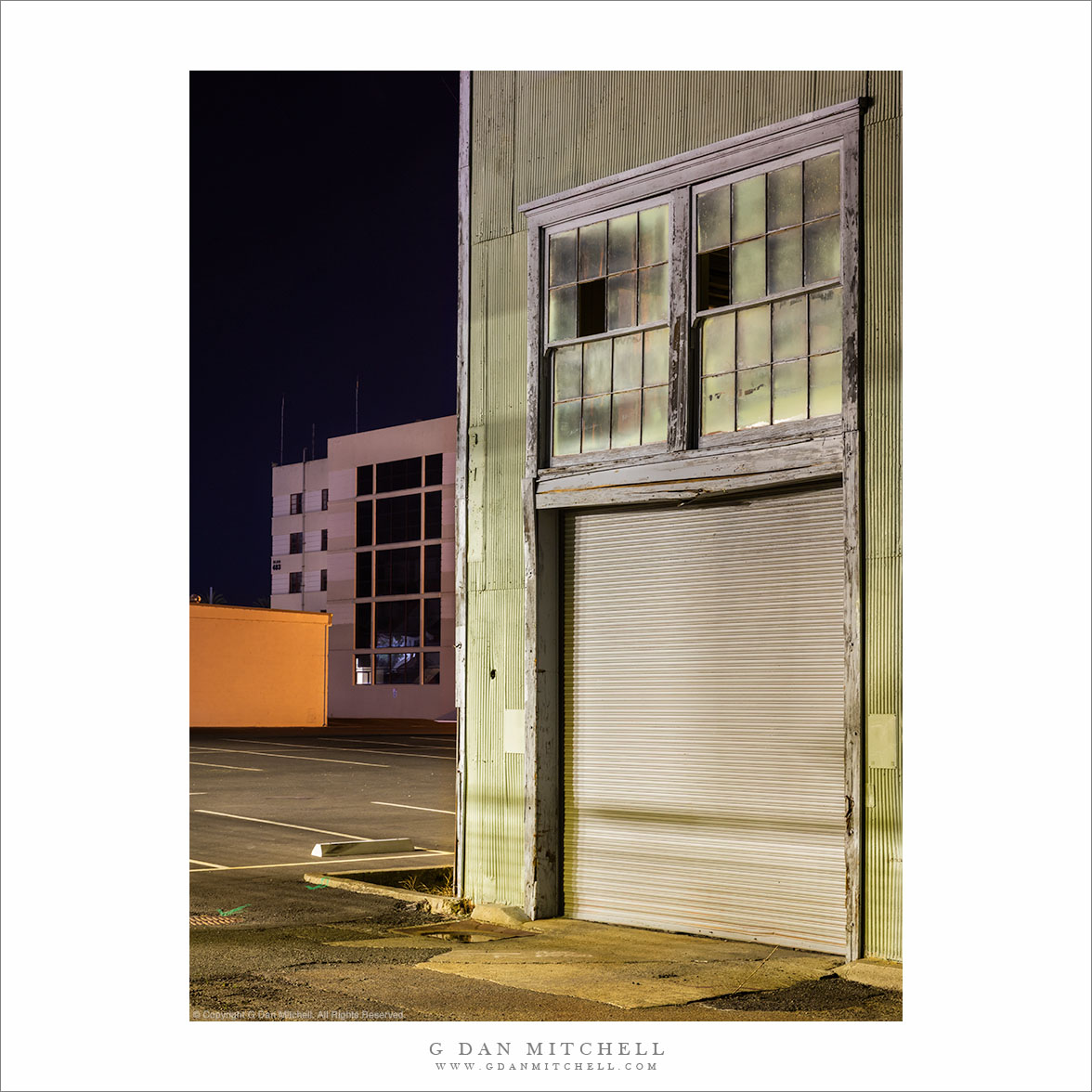
Railroad tracks and a weather protection structure above an old loading dock, Mare Island Naval Ship Yard

Abandoned Loading Dock. Mare Island Naval Ship Yard, Vallejo, California. March 11, 2017. © Copyright 2017 G Dan Mitchell – all rights reserved.

Railroad tracks and a weather protection structure above an old loading dock, Mare Island Naval Ship Yard

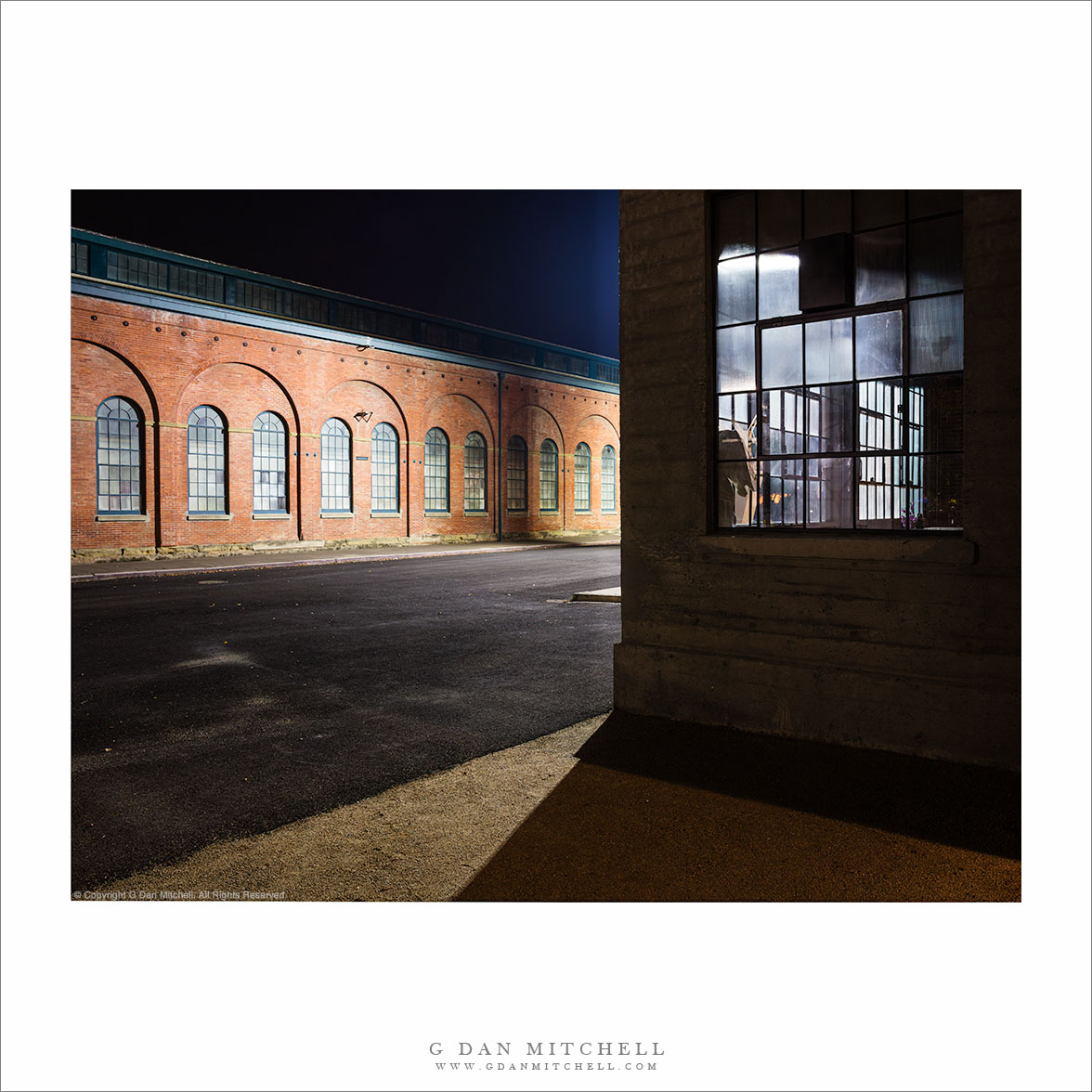
This is another very still and quiet image from my recent evening photographing the historic Mare Island Naval Ship Yard. Image walking alone in the darkness among these old (mostly) abandoned ship yard buildings: shops, warehouses, towers. Occasionally a lone car drives past, momentarily raising my level of alertness. It is mostly silent except for a sound of distant traffic across the water in Vallejo. The air is typically cold and damp, and on this night a bit of a breeze blows. The photographs are visual images, but they also evoke, for me, a whole series of associations, memories, and sensations associated with the place the experience of making the photographs.

There is always a question of just how to treat luminosity and color with these nighttime subjects. The fact of the matter is that many of these scenes are barely visible to the human eye, and details are shrouded in darkness. In this low light color is mostly desaturated, only becoming visible afterwards in the photograph. And much of the color is not the true color of the objects, but rather is the color of the light that illuminates them — and it can range from yellow to reddish, but white or even blue-green. The concept of accurate rendering becomes moot, since an “accurate” photograph (if “accurate” means “what it looked like”) would be almost colorless and nearly pitch black. Instead I take this as an opportunity to capture “what the camera sees” and use that as the raw material for what must be an interpretation of the captured light — almost inevitably brighter and more colorful than the original, but still trying to evoke that mysterious and quiet nocturnal quality.


G Dan Mitchell is a California photographer and visual opportunist. His book, “California’s Fall Color: A Photographer’s Guide to Autumn in the Sierra” is available from Heyday Books and Amazon.
Blog | About | Flickr | Twitter | FacebookGoogle+ | LinkedIn | Email


All media © Copyright G Dan Mitchell and others as indicated. Any use requires advance permission from G Dan Mitchell.