Tag Archives: photography

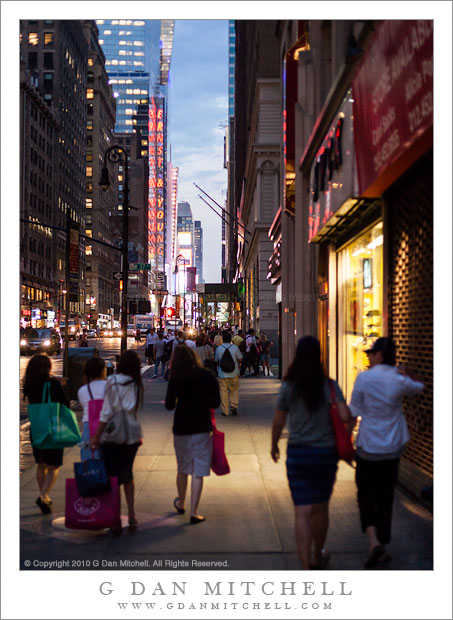
New York Sidewalk, Evening

New York Sidewalk, Evening

New York Sidewalk, Evening. New York City. August 19, 2010. © Copyright 2014 G Dan Mitchell – all rights reserved.

A busy New York City sidewalk in dusk light

We are fortunate to be able to visit New York City from time to time — perhaps once a year and occasionally more often. To anyone who thinks of me a “that landscape photographer guy,” it might seem a bit odd that I also love the intense urban environment of such a place — but I do. Although it can become overwhelming eventually — as almost everyone says, “I love to visit, but I couldn’t live there.” — it is also energizing. There is so much to see and do, whether or not it involves photography.

I always photograph when I visit New York. I photograph in a different way than I do when I’m out in the American West. For example, I work with handheld cameras and tend to work while on the move. But I think that I also see the place at least a bit through the eyes of a landscape photographer, and I think of the city as a place to photograph the “urban landscape.” Although I’ve done night photography for more than a decade, recently I’ve gotten more interested in handheld urban night street photography. This photograph of a little evening street scene with pedestrians walking in and out of the light pools cast from business windows is one example.


G Dan Mitchell is a California photographer and visual opportunist whose subjects include the Pacific coast, redwood forests, central California oak/grasslands, the Sierra Nevada, California deserts, urban landscapes, night photography, and more.
Blog | About | Flickr | Twitter | FacebookGoogle+ | 500px.com | LinkedIn | Email

Text, photographs, and other media are © Copyright G Dan Mitchell (or others when indicated) and are not in the public domain and may not be used on websites, blogs, or in other media without advance permission from G Dan Mitchell.
Testing? Testing? (Morning Musings 12/8/14)

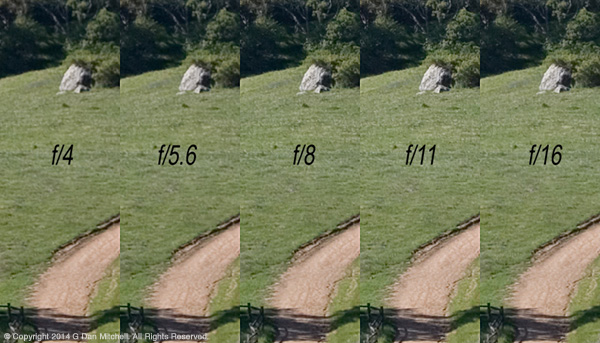
Aperture Test Image
Aperture Test Image (1)

This morning I saw an article over at The Online Photographer (which you should be following) about a particular camera/lens combination and the process of doing a quick and informal test of that gear… right there in the kitchen.

I read a lot of photography questions about how this or that thing works, which setting is “best” for a particular result, what shutter speed range works for hand-held photography, how much the shadows can be pushed, whether a lens is sharp enough for some particular usage, and much more. Folks are often looking for quick answers — and who wouldn’t in most cases. However, the quick answers often turn out to be less clear than they might like, and sometimes the simplest questions can end up in controversy.

A simple answer is to simply try it out yourself!

The answers to many of the questions that we ask are too complex to lend themselves to absolute answers. Yet, we can often get a very good and quite accurate feeling for these things by just giving them a try. In some cases the “testing” can be very informal, while in others it might require just a bit more care and organization. But in our modern photographic world of digital cameras and computer post-processing and display the testing is much easier than it might have been in the past, and it is well within our grasp to do it ourselves.

I recall one of the first times I put this to good use with a digital camera. Continue reading Testing? Testing? (Morning Musings 12/8/14)

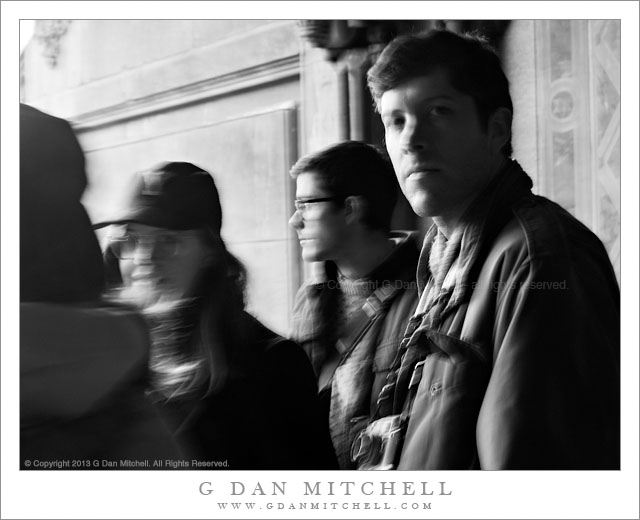
Misplaced Focus (Morning Musings 12/3/14)

Family Portrait
Family Portrait

From time to time I adapt things that I wrote elsewhere and re-share them on the blog. The following is something I contributed to a discussion about a question from a newish photographer who wondered how important it would be to upgrade his camera. 

I’m all for better image quality — which contemporary cameras, software, and printing processes provide in spades. And there is no question that, all else being equal, a photograph captured on a larger film or sensor format can potentially resolve more detail, and may improve other image parameters including dynamic range and noise.

As they say, “So stipulated.”

But the question (which was about choosing a sensor format) deserves a more nuanced and contextual answer than that. Fortunately, the most accurate and useful answer involves quite a bit of that nuance. I think it really comes down to something like, “Will replacing my cropped sensor camera with a full frame camera make my photographs look better?”. The best answer begins with, “It depends.”

As to the question (which also came up in the original discussion) of what is important in a photograph, image sharpness is not unimportant in many cases. (Though there certainly are photographs whose “goodness” is perhaps at least partially because they are blurred — softness and blur are not always things to be avoided.)

I think the issue in photography discussions is frequently about the balance among issues that affect the quality and effectiveness of a photograph. Here, it is not uncommon for some folks to exhibit a misplaced focus on the technical stuff, accompanied by insufficient attention to other things that are more important to their success as photographers. Continue reading Misplaced Focus (Morning Musings 12/3/14)

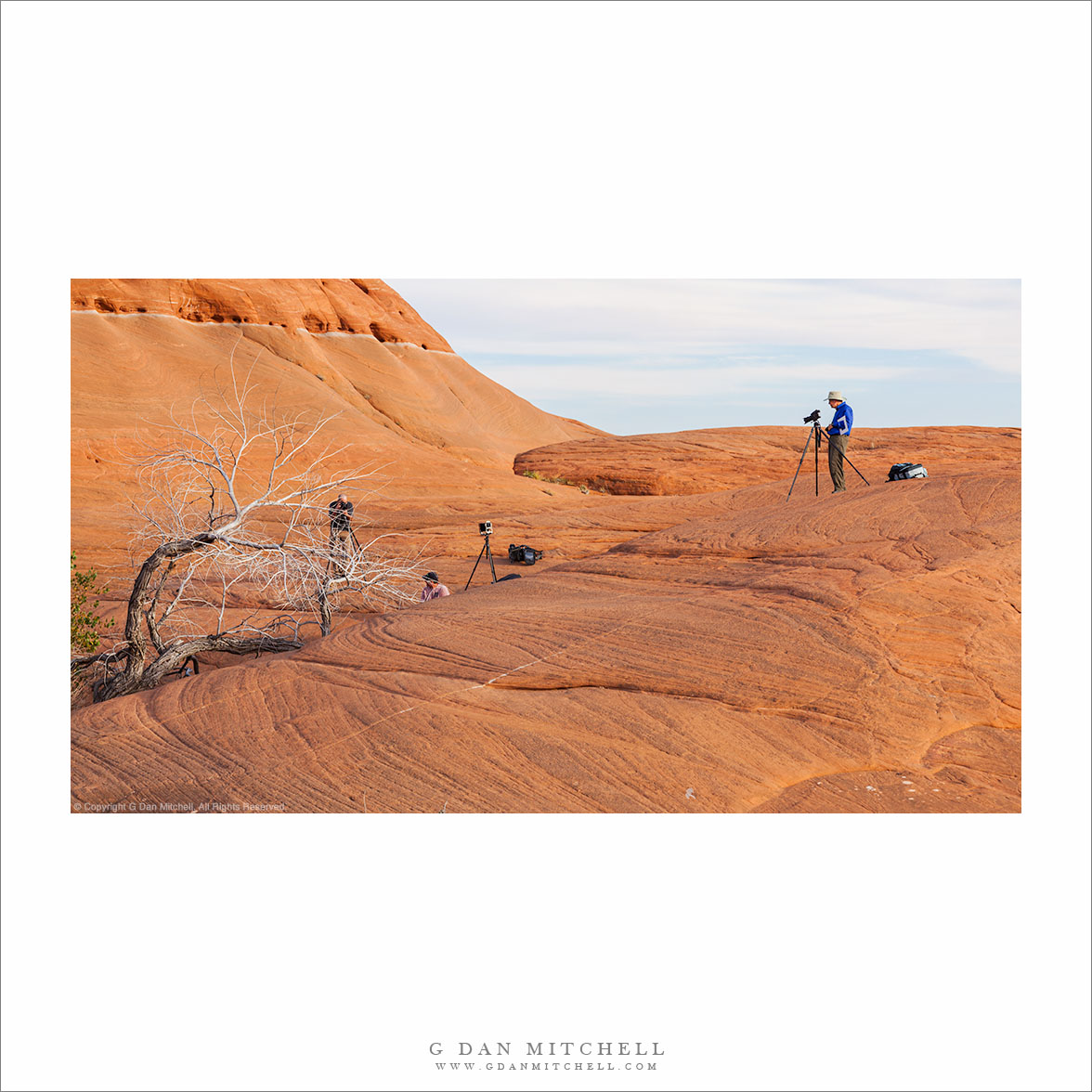
Working the Red Rock Landscape

Working the Red Rock Landscape
P”Working the Red Rock Landscape” — Photographers at work in Utah’s red rock country

A group of us assembled in the outback of southern Utah in October for a few days of landscape photography — and I was perhaps the odd man out as the person least familiar with Utah subjects. Not that I haven’t shot there before… I’ve actually spent perhaps a month and a half photographing in the state in the past few years, all told, and I’m becoming more and more familiar with the visual quality and the rhythms of the place. However, the others were mostly from the Southwest, and they have the same sorts of instincts for this land that I have for the Sierra.

We spent a few days in this red rock landscape of domes, hills, gulches, and canyons. On this evening we went to a location where red sandstone hills rise above the flatlands and stretch into the distance, and are filled with a seemingly infinite variety of textures and shapes and plant life. Here we stopped to photograph an old cottonwood snag in the middle of an expanse of sandstone.


Leave a comment or question using the form. (Click the title to see the full article and to comment if you are viewing it on the home page.)

G Dan Mitchell is a California photographer and visual opportunist. His book, “California’s Fall Color: A Photographer’s Guide to Autumn in the Sierra” (Heyday Books) is available directly from him. Blog | Bluesky | Mastodon | Substack Notes | Flickr | Email

All media © Copyright G Dan Mitchell and others.