
Tag Archives: range

Favorite Time in the Range of Light (Morning Musings 8/31/14)

Thoughts about seasonal light in the Range of Light…
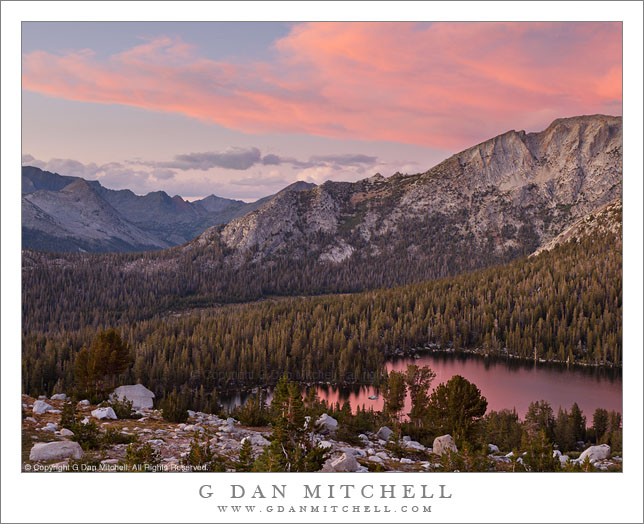
Sunset, Lower McCabe Lake, Shepherds Crest, and Virginia Canyon - Afternoon storm clouds clear from the sunset sky above Lower McCabe Lake, Shepherds Crest, and Virginia Canyon, Yosemite National Park.
Sunset, Lower McCabe Lake

It is no secret that I can find something to love about every season in the Sierra Nevada — the storms and snow of winter, the wildly flowing water and new growth of spring, and the lazy days of summer that bring easy access to the high country. But if I had to pick one perfect day in the Sierra high country it would be in fall.

This ideal day would come some time between the middle of September and the middle of October, when it becomes increasingly clear that summer really is ending and that winter really is on its way. This is not a wild season — no giant winter storms, no raging rivers and waterfalls, no spectacular growth and colorful fields of wildflowers. It is a quieter time. The crowds are almost all gone, and the people you do meet there are more likely to be those with a deeper relationship with this range.

The light is beautiful — perhaps as beautiful as it gets — and perhaps even more precious because it doesn’t last as long on these shortening days of the late season. The sun is lower in the sky and less intense, and there is often a muted, golden quality to the light, amplified by the golden colors of dry meadows, the beginning of fall colors, and softened by seasonal haze. And it is all the more sweet because we know that winter is just around the corner and that these days will end very soon.

G Dan Mitchell is a California photographer and visual opportunist whose subjects include the Pacific coast, redwood forests, central California oak/grasslands, the Sierra Nevada, California deserts, urban landscapes, night photography, and more.
Blog | About | Flickr | Twitter | Facebook | Google+ | 500px.com | LinkedIn | Email

Text, photographs, and other media are © Copyright G Dan Mitchell (or others when indicated) and are not in the public domain and may not be used on websites, blogs, or in other media without advance permission from G Dan Mitchell.

Telescope Peak

Telescope Peak
Telescope Peak

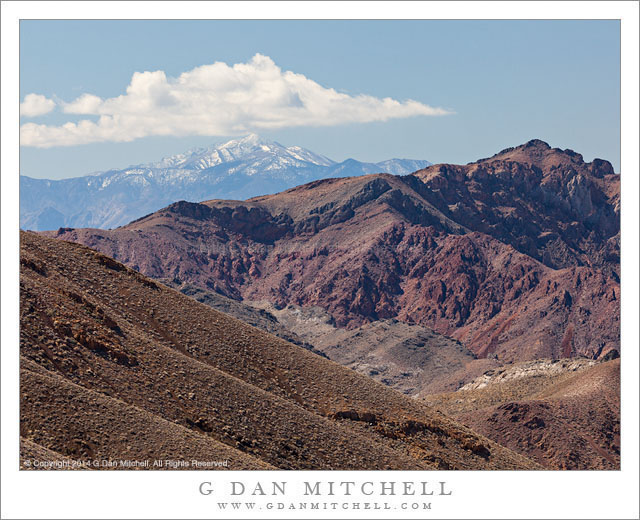
Telescope Peak. Death Valley National Park, California. April 1, 2014. © Copyright 2014 G Dan Mitchell – all rights reserved.

Telescope Peak, the highest point in Death Valley National Park, in the distance beyond the rugged terrain of upper Titanothere Canyon in the Amargosa Range

This one has been sitting in my queue for months now, and it is finally time to send it out with the other photographs! I made the photograph back in early April, while spending a few days in Death Valley exploring a lot of higher elevation area in the mountains on either side of the Valley itself. At one point during this visit, we ended up spending nearly an entire day high up in the Panamint range, at times doing something very unusual — photographing Death Valley wildflowers during a snowstorm!

The distant snow-covered peak in the photograph is Telescope Peak, at over 11,000′ of elevation the highest point in the Panamint range and in Death Valley National Park. While we often think of Death Valley’s reputation for heat, this peak is often covered with snow during the colder times of the year. The location from which I made this photograph is high in the mountains on the other, east side of the Valley, a very arid and rugged region that presents a different appearance than the much lower areas of the Valley itself. Here there is a landscape of dry and rugged mountains and valleys, often receding one behind the other into the distance. I stopped at this spot, where I have photographed before, and was captivated by the conduction of three peak shapes — the nearly peak at upper right, the distant summit of Telegraph Peak, and the peak-like form of the clouds above.

G Dan Mitchell is a California photographer and visual opportunist whose subjects include the Pacific coast, redwood forests, central California oak/grasslands, the Sierra Nevada, California deserts, urban landscapes, night photography, and more.
Blog | About | Flickr | Twitter | FacebookGoogle+ | 500px.com | LinkedIn | Email

Text, photographs, and other media are © Copyright G Dan Mitchell (or others when indicated) and are not in the public domain and may not be used on websites, blogs, or in other media without advance permission from G Dan Mitchell.
Sierra Nevada Fall Color (Morning Musings 8/25/14)

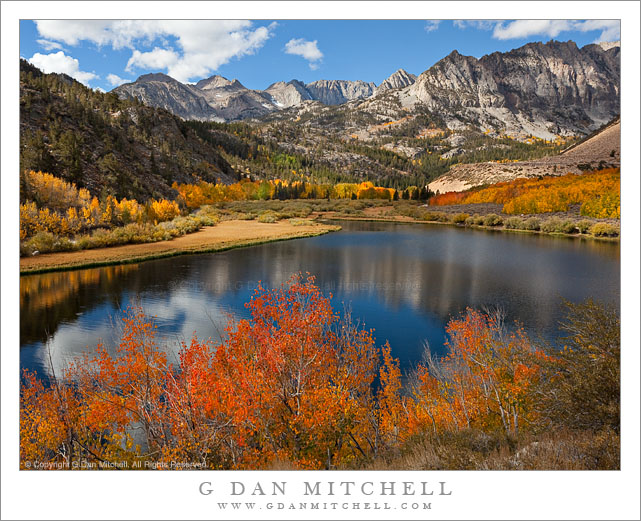
For various reasons — projects I’m working on, clear signs of the changing seasons, photographs I’ve recently seen — I have been getting into that autumn frame of mind that comes at about this time every year. With that in mind, today’s “morning musings” post is about finding and photographing fall color in the Sierra Nevada. Rather than re-writing the whole thing, I’ll start by pointing you to an extensive guide that I wrote a few years ago and have updated every year since that time — if you are thinking of chasing aspen color this fall you may want to take a look: “Sierra Nevada Fall Color — Coming Sooner Than You Think”

If things evolve on a relatively typical schedule, eastern Sierra aspen color is perhaps about six weeks away. I have been photographing this subject for a while now, and it is one of my favorites. I intend to be out there again this fall.

Aspen Color, North Lake

One popular game at this time of year is to predict/guess when the colors will arrive and how good they will be. I’m fully aware that I’ve been wrong quite a few times, and my increasing knowledge of this subject has perhaps only made me more aware of how unpredictable this can be. However, this year I have to wonder about the effects on the trees from our three-year California drought, which has reached an extreme level all across the state this year. I don’t know what the results will be, but I’m considering some possibilities:

  • During the last two years it seemed to me that I was seeing the onset of color move a bit earlier in the season. I have to wonder if we may see stressed trees go into fall mode a bit on the early side this year.
  • Some people say that they are seeing a few aspen groves turning brownish-yellow already and looking like they are drying out.
  • Also during the last few dry years we have seen some anomalous early season storms, and I wonder if that pattern will continue. This can affect the season in various ways if it happens. On the negative side, leaves can blow down early. On the positive side, snow and aspens can make a beautiful pair.

As always, to the extent possible, I like to remain flexible about when and where I’ll photograph the aspens, and I watch the evolving conditions to see what this season may bring. How about you? What are your fall color plans?

G Dan Mitchell is a California photographer and visual opportunist whose subjects include the Pacific coast, redwood forests, central California oak/grasslands, the Sierra Nevada, California deserts, urban landscapes, night photography, and more.
Blog | About | Flickr | Twitter | FacebookGoogle+ | 500px.com | LinkedIn | Email

Text, photographs, and other media are © Copyright G Dan Mitchell (or others when indicated) and are not in the public domain and may not be used on websites, blogs, or in other media without advance permission from G Dan Mitchell.
Basin and Range, Monsoon Clouds

Basin and Range, Monsoon Clouds

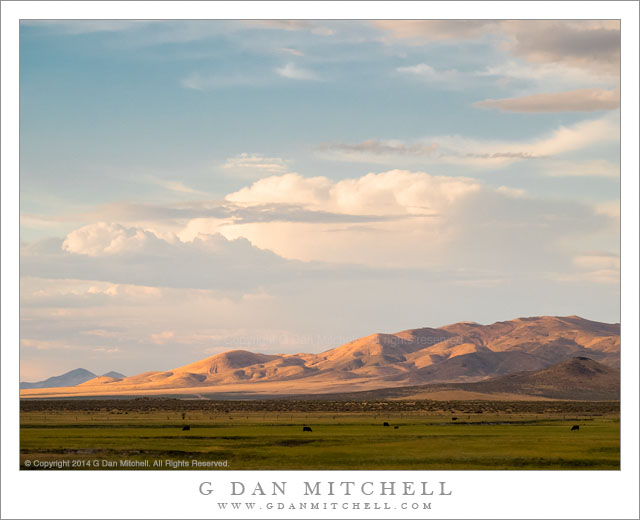
Basin and Range, Monsoon Clouds. Between Winnemucca and Elko, Nevada. July 30, 2014. © Copyright 2014 G Dan Mitchell – all rights reserved.

Evening monsoon thunderstorms dissipate above the basin and range terrain of Nevada

This simple photograph necessarily leads to a long story. It starts many, many years ago when I was a child. My family moved to California from Minnesota when I was four years old, and every few years we took a long trip back to the Midwest to visit my mother’s family in Sioux Falls, South Dakota. (Although I have not been there for some years now, I still have fond feelings for the place.) Sometimes we drove, with my parents figuring out routes that would take us through national parks and monuments — Yellowstone, Rocky Mountain, etc — along the way. Several times we took the train, which in those days was the famous California Zephyr. We would get on the train in Fremont, California and travel all the way to Omaha, Nebraska, arriving very early in the morning and then getting to South Dakota by (usually) rental car or (occasionally) a plane. To a young kid, the California Zephyr was an amazing thing — somehow we got “Pullman” sleeper cars, ate in the dining car, and — if my memory is correct — passed hours in the vista dome car watching the terrain roll by.

Jump forward to the new millennium. Patty’s brother and sister-in-law, and two of our sons and their girlfriends live in Brooklyn, so we find excuses to go to New York City every year or so. This time we went not only to visit family, but also so that Patty could attend the International Double Reed Society conference at NYU. We’ve flown plenty of times, so this time we decided to give the train a try. (We did fly back home at the end of the trip — a good choice in my view.) So on this last day of July we went up to Emeryville, where the Zephyr’s trip starts these days, and embarked on our adventure, nostalgic for me and brand new for Patty. There is much more to say about train travel than I have space for here, but I’ll share just a bit about the first day. The route begins along the shores of the San Francisco Bay and then up the delta to Sacramento, the historic end point of the continental railroad. From there the train crosses the Sierra above Truckee Lake, an absolutely beautiful route that often reveals perspectives on this part of the Sierra that are quite different from what we know from driving Interstate 80. As we crossed the crest, the clouds thickened and we rolled through a hail storm as we descended to Truckee. Not long after that we stopped briefly in Reno, Nevada, and then continued on to the northeast across Nevada. After we passed through Winnemucca (from which I departed some years ago on a grand bike trip across the Black Rock Desert and into Northern California) the train continued on through the Humboldt Basin as evening came on and beautiful light fell on the rangeland and the monsoon clouds overhead as the day came to an end.

G Dan Mitchell is a California photographer and visual opportunist whose subjects include the Pacific coast, redwood forests, central California oak/grasslands, the Sierra Nevada, California deserts, urban landscapes, night photography, and more.
Blog | About | Flickr | Twitter | FacebookGoogle+ | 500px.com | LinkedIn | Email

Text, photographs, and other media are © Copyright G Dan Mitchell (or others when indicated) and are not in the public domain and may not be used on websites, blogs, or in other media without advance permission from G Dan Mitchell.