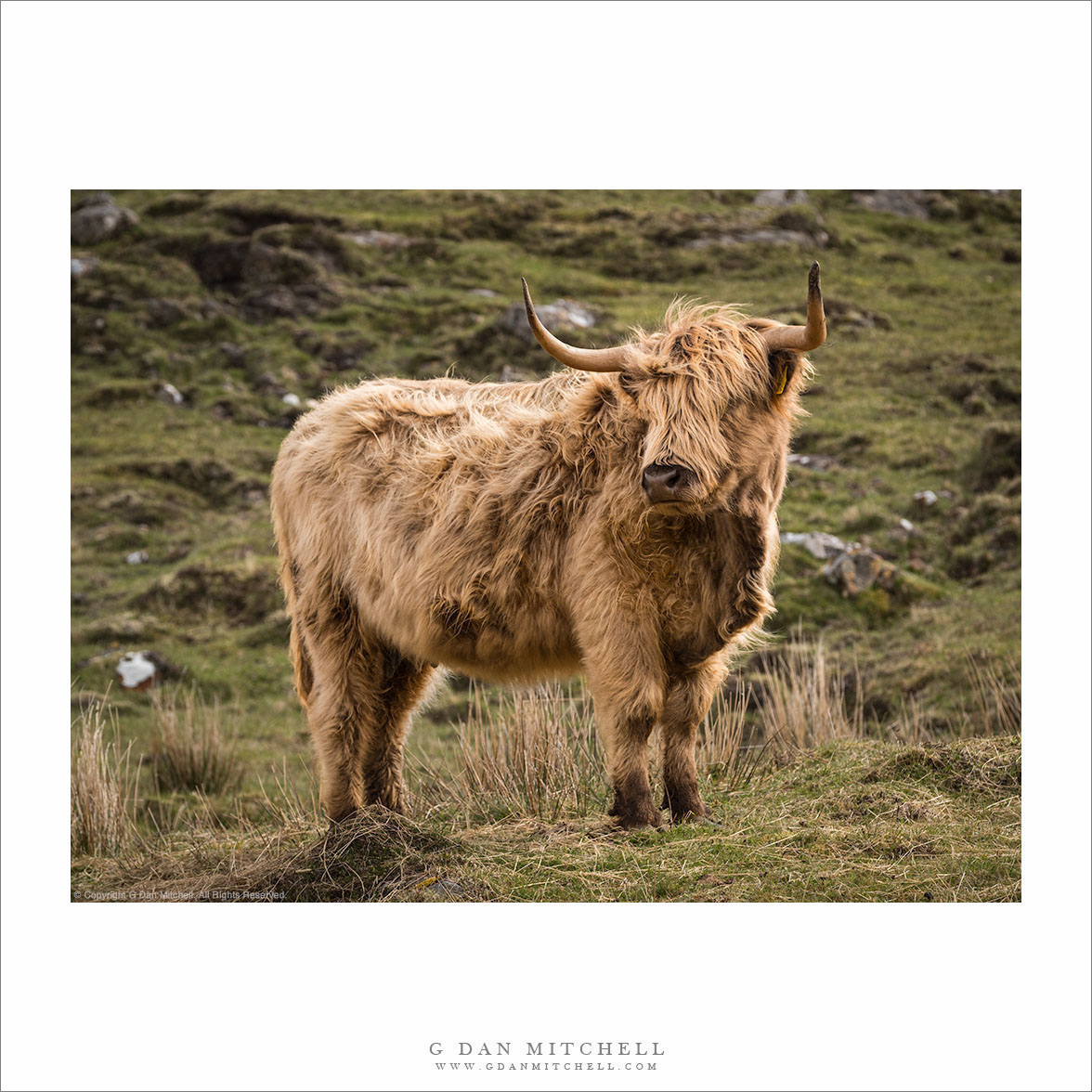
“Highland Hairy Coo” — A “hairy coo” of the Scottish highlands.
Occasionally I have to do the tourist thing… and photograph the “hairy coo,” or its equivalent in other places. So, yes, this is a picture of a cow, or “coo” as they say Scotland. These cattle are apparently a unique breed found in Scotland. Several things distinguish them: that long fur, the ability to thrive in very cold climates, and the horns found on both males and females. The Scots seem to be quite proud of them.
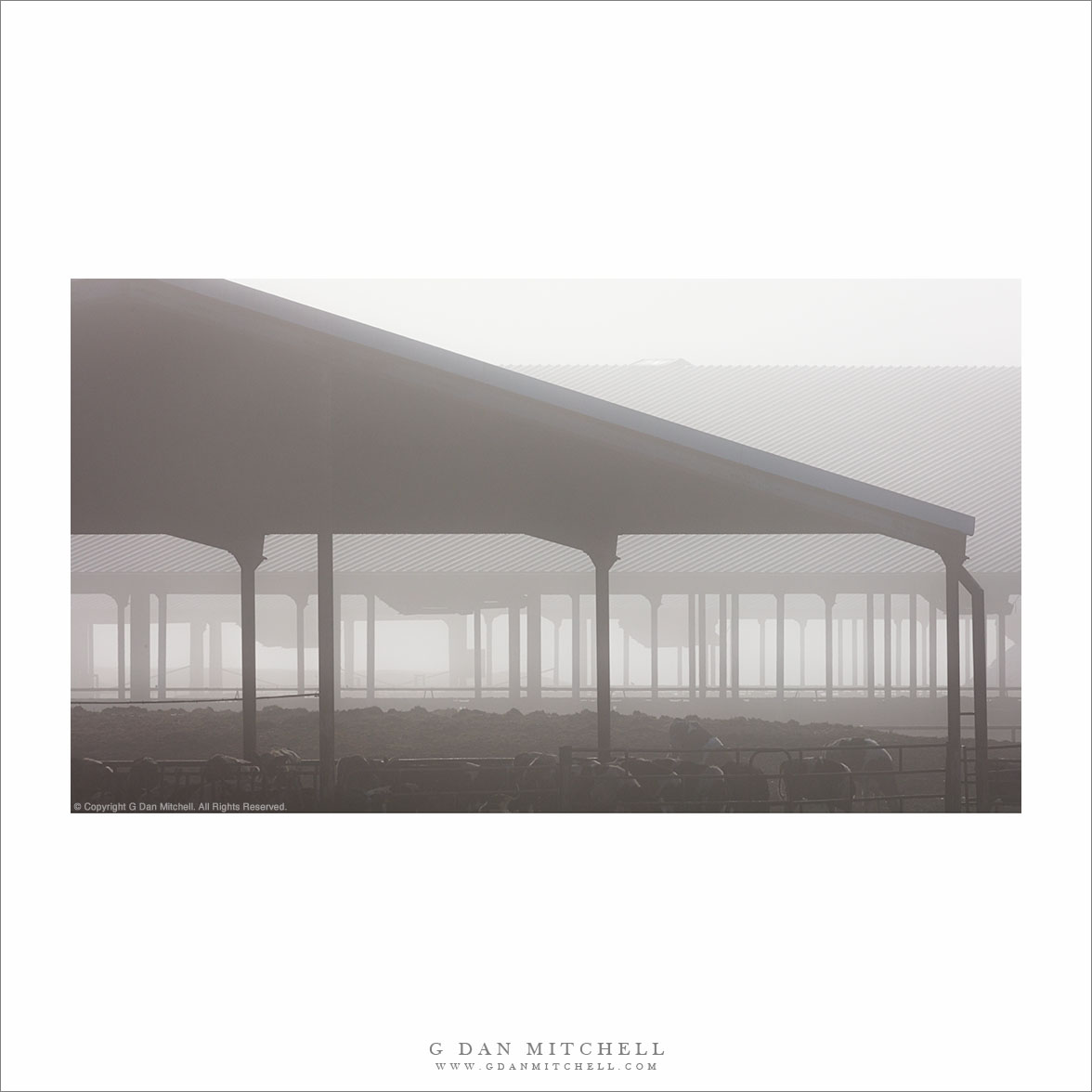
“Feed Lot” — A series of shelters over a feedlot on a foggy Central Valley winter morning.
One of the benefits of photographing in fog is that it can make almost any subject mysterious and moody. Another is that the limited visibilities can mute or eliminate distractions from the visual focus on the elements that are the most interesting. It is hard to imagine a stronger illustration of these principles than a photograph of this particular subject.
I photograph quite a bit in California’s Great Central Valley during the winter months. During much of the year, this is perhaps not an obvious photographic destination (though looking closer may be worthwhile!). But in winter, when dense tule fogs often settle on the landscape, the place can be transformed in magical ways. If you have passed by one of these feedlots on a warm, sunny day… you probably rolled up your windows and held your breath. But morning tule fog on a winter day might can make it worthwhile to stop (while trying hard to ignore the smell!) and make a few photographs.
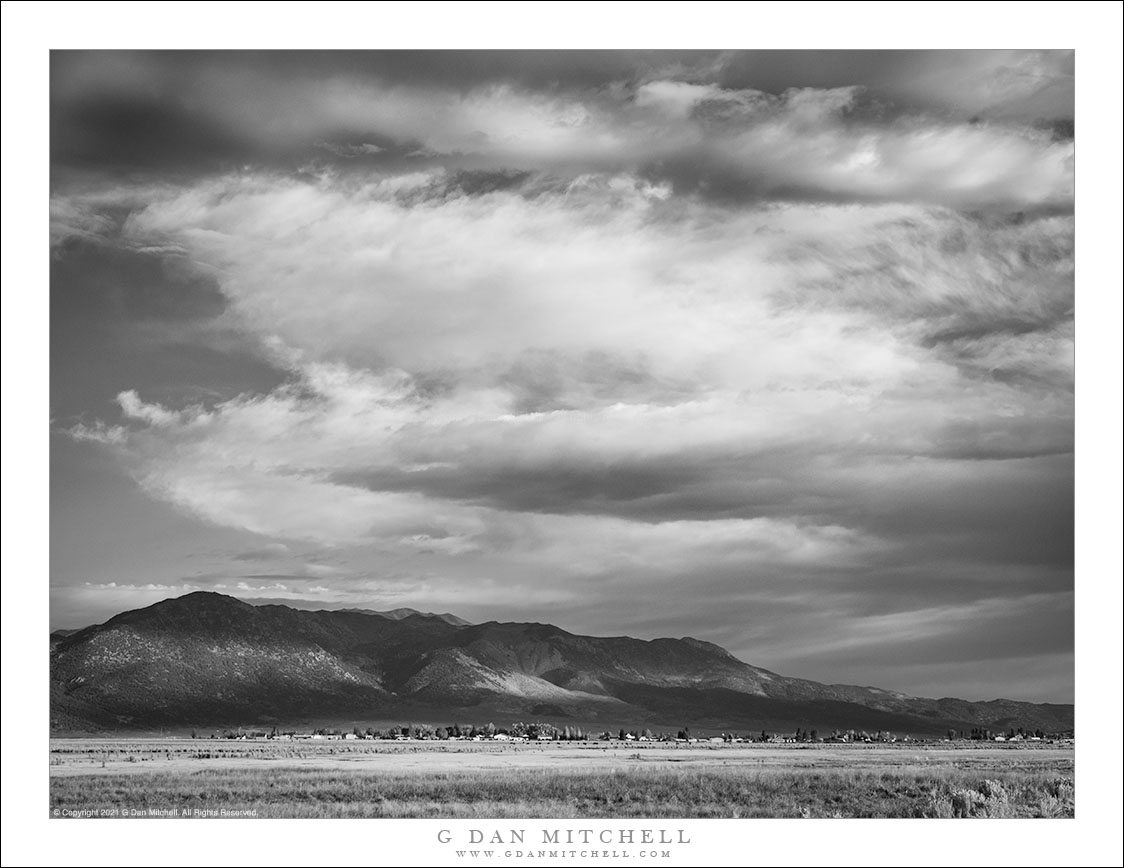
Clouds from an autumn weather front build a above Bridgeport, California.
For those who aren’t from my part of the American West, it is probably important to state up front that this is “the other Bridgeport,” the one in the dry eastern part of California. The town is located in a broad valley at the base of the Sierra Nevada, more or less northeast of Yosemite National Park. The valley is full of cattle grazing in its extensive pasture lands that somehow escaped the clutches of the historic Los Angeles water rights grabs in the eastern Sierra. In addition to cattle, the places relies a lot on campers, anglers, backpackers and other visitors to the outdoors — though in a more laid-back, old-school manner of places a bit off the beaten track. Oh, it is also known for being (at least in my experience) one of the two or three most expensive places in the state to buy gas for your vehicle.
To those of us who live in far more urbanized areas — for me, that is the San Francisco Bay Area — places like this have a bit of an appealing raw edge, a sense that they are closer to the cycles of the natural world and, to some extent, dominated by them. On a day like this one, when the clouds of a Pacific weather front fill the sky, the town itself seems quite small in relationship to the landscape that surrounds it.
G Dan Mitchell is a California photographer and visual opportunist. His book, “California’s Fall Color: A Photographer’s Guide to Autumn in the Sierra” is available from Heyday Books, Amazon, and directly from G Dan Mitchell.
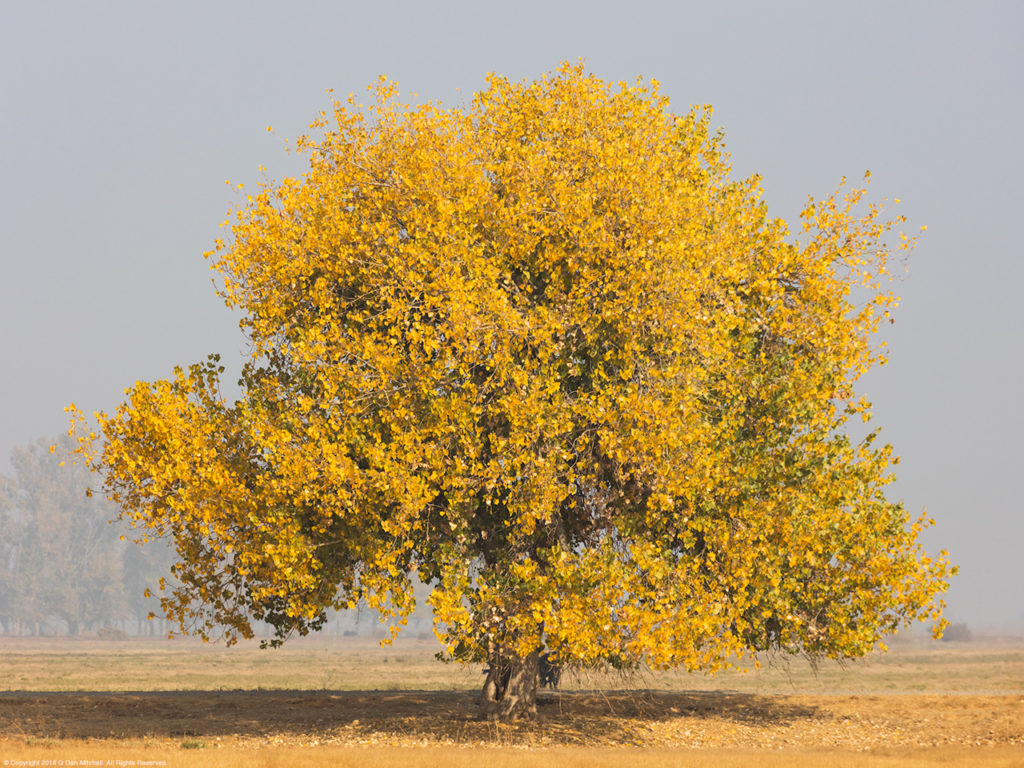
An autumn tree emerges from fog and haze in morning light.
I found this tree, still with full late-season fall color, standing in the middle of a pasture. (If you look very closely you just might be able to spot some cattle.) It was a very foggy morning — mostly quite gray and colorless — until the fog finally began to thin and filtered light started to break through.
It is easy to pass through California’s Great Central Valley and miss its beauty. It is true that the air can become stagnant and that freeway driving isn’t conducive to seeing beyond the traffic in front of you. But get off the main roads, drive a bit more slowly, start very early and stay out until the sun sets, and there is a lot to see.
Photographer and visual opportunist. Daily photos since 2005, plus articles, reviews, news, and ideas.
Manage Consent
To provide the best experiences, we use technologies like cookies to store and/or access device information. Consenting to these technologies will allow us to process data such as browsing behavior or unique IDs on this site. Not consenting or withdrawing consent, may adversely affect certain features and functions.
Functional
Always active
The technical storage or access is strictly necessary for the legitimate purpose of enabling the use of a specific service explicitly requested by the subscriber or user, or for the sole purpose of carrying out the transmission of a communication over an electronic communications network.
Preferences
The technical storage or access is necessary for the legitimate purpose of storing preferences that are not requested by the subscriber or user.
Statistics
The technical storage or access that is used exclusively for statistical purposes.The technical storage or access that is used exclusively for anonymous statistical purposes. Without a subpoena, voluntary compliance on the part of your Internet Service Provider, or additional records from a third party, information stored or retrieved for this purpose alone cannot usually be used to identify you.
Marketing
The technical storage or access is required to create user profiles to send advertising, or to track the user on a website or across several websites for similar marketing purposes.