
Tag Archives: season

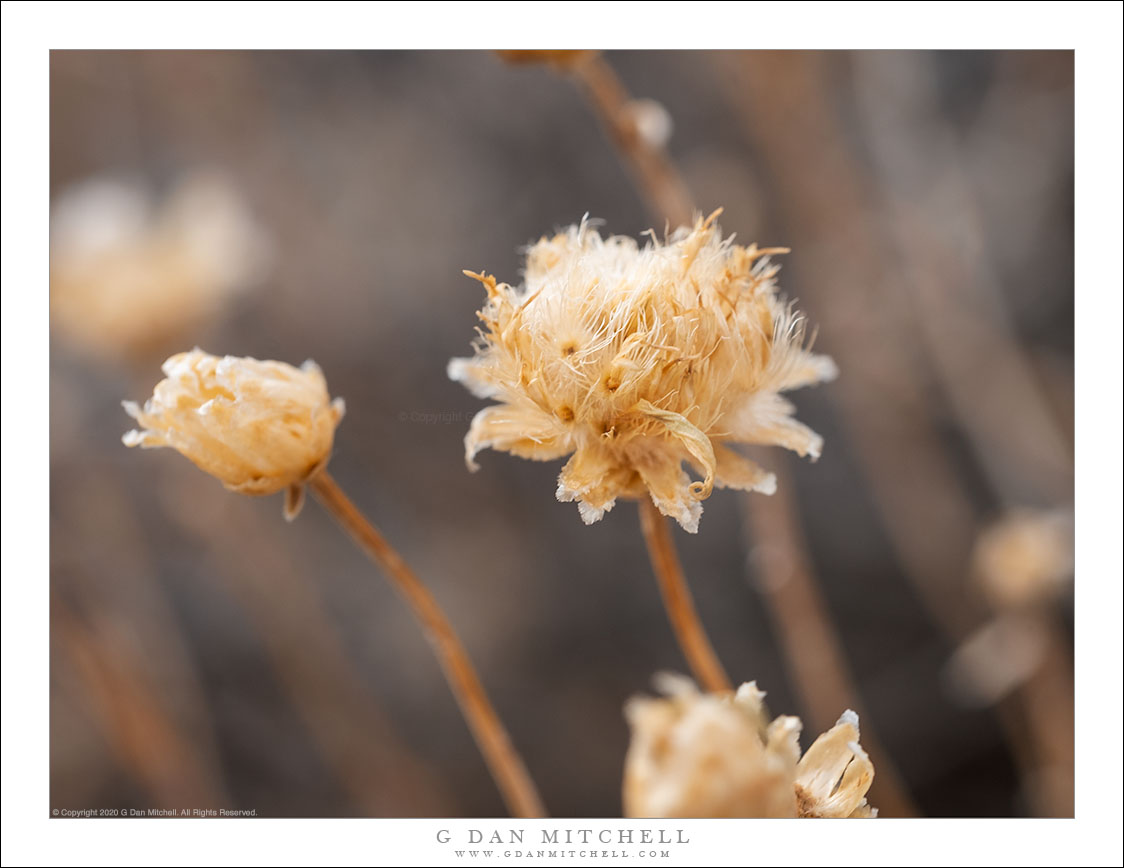
Dry Panamint Flowers

Dry Panamint Flowers
Dry flowers photographed high in the Panamint Mountains of Death Valley during winter.

Dry Panamint Flowers. © Copyright 2020 G Dan Mitchell – all rights reserved.

Dry flowers photographed high in the Panamint Mountains of Death Valley during winter.

The title “Panamint Flowers” refers not to the identification of the flowers, but to the place where I photographed them, high in the mountains of Death Valley National Park. I was there back in January for a four-day visit. The photography was challenging — conditions were less than ideal — so on several occasions I simply went off exploring. On this day I was way out along a lonely gravel road in the Panamint Range when I spotted an old mining site off to one side. I stopped to take a look, and soon my attention shifted from the historical site to the thousands of dry flowers on the surrounding vegetation.

In retrospect, it was very fortunate that I made this trip in the January. Every year I head to Death Valley around the end of March and beginning of April for that brief interval between winter and the arrival of extremely hot and dry weather. That visit isn’t going to happen this year as national parks are shutting down and we are all sheltering in place to slow the spread of corona virus.


G Dan Mitchell is a California photographer and visual opportunist. His book, “California’s Fall Color: A Photographer’s Guide to Autumn in the Sierra” is available from Heyday Books and Amazon.

Blog | About | Flickr | FacebookEmail

Links to Articles, Sales and Licensing, my Sierra Nevada Fall Color book, Contact Information.

Scroll down to leave a comment or question.


All media © Copyright G Dan Mitchell and others as indicated. Any use requires advance permission from G Dan Mitchell.
Winter Landscape

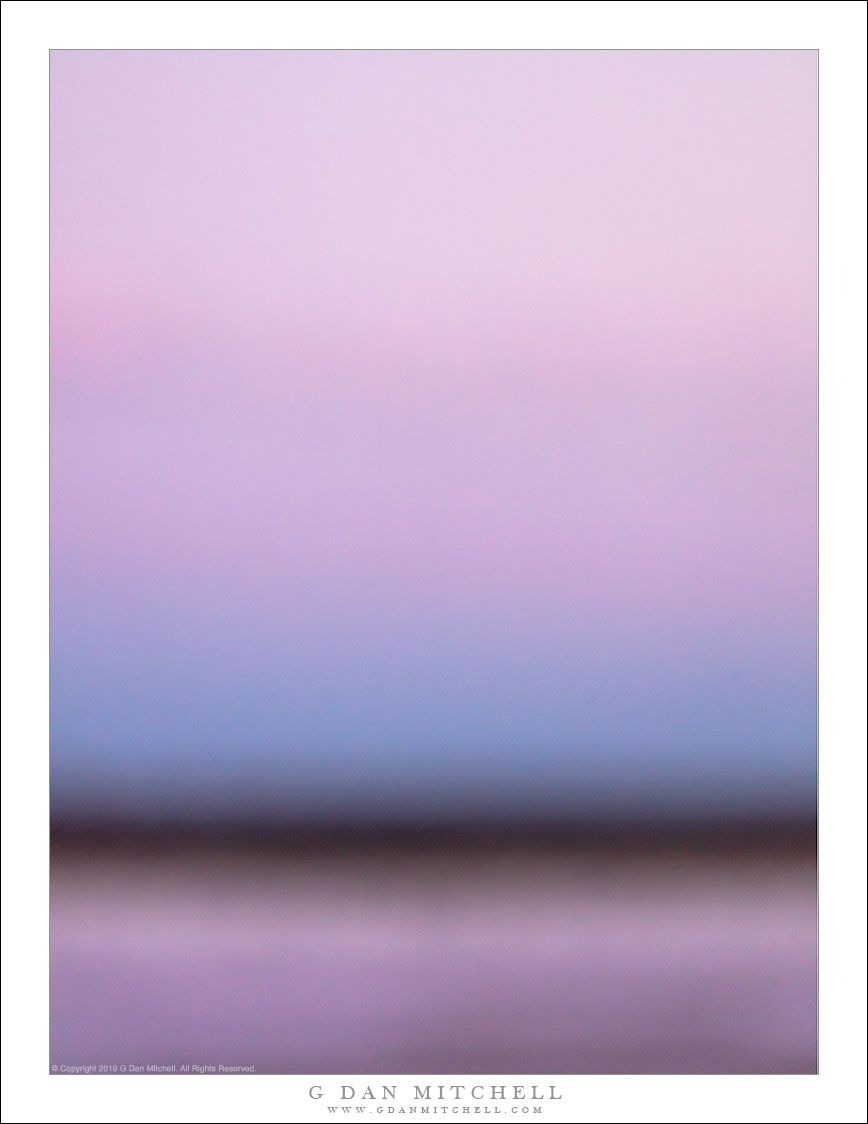
Winter Landscape
A California winter landscape photograph reduced to its compositional fundamentals.

Winter Landscape . © Copyright 2019 G Dan Mitchell – all rights reserved.

A California winter landscape photograph reduced to its compositional fundamentals.

This photograph fits into a category I describe as “imaginary landscapes,” a type defined loosely by where it sits along the continuum between supposed representational reality and abstraction of landscape-derived materials. That might seem an overly-wordy way to describe it, but I’m always cognizant of the fact that no landscape photograph is truly objective or fully “real” — all photographs and certainly all landscape photographs necessarily are subjective. This could be due to something as basic (and obvious!) as the fact that the photographer chose to point the camera at some specific thing (and not at other things). It includes equipment choices( length of lens, aperture, etc.), basic interpretive choices (color or black and white, and how to handle either of those), and much, much more. In my “imaginary landscape” photographs I think I’m simply making this stuff more plainly obvious.

This one also illustrates, I think, something that figures into the landscape (but not just landscape!) photographs of virtually every photographer that I know of — the photograph is not just about the ostensible subject of the image. For most photographers other things also appeal — the shapes of things, their colors (a huge topic, by the way), how the components fit together, how things may be suggested rather than declared, and more. Allow me to make a musical analogy here. There’s a famous (or infamous) piece by composer/philosopher John Cage called 4’33”. In it a performer, takes the stage in the manner of any classical performer, then sits in front of a (usually) piano silently for 4′ 33″. One way to look at this is to recognize that Cage gave us every element of a musical performance but the one we think is central, thus forcing us to think about all of those “other details” and their central role in our perception of music. A photograph with no details (“the horror!”) may work in a somewhat similar (though not quite identical) way. Or maybe you just like the colors? ;-)


G Dan Mitchell is a California photographer and visual opportunist. His book, “California’s Fall Color: A Photographer’s Guide to Autumn in the Sierra” is available from Heyday Books and Amazon.

Blog | About | Flickr | FacebookEmail

Links to Articles, Sales and Licensing, my Sierra Nevada Fall Color book, Contact Information.


All media © Copyright G Dan Mitchell and others as indicated. Any use requires advance permission from G Dan Mitchell.
Mono Basin, Morning

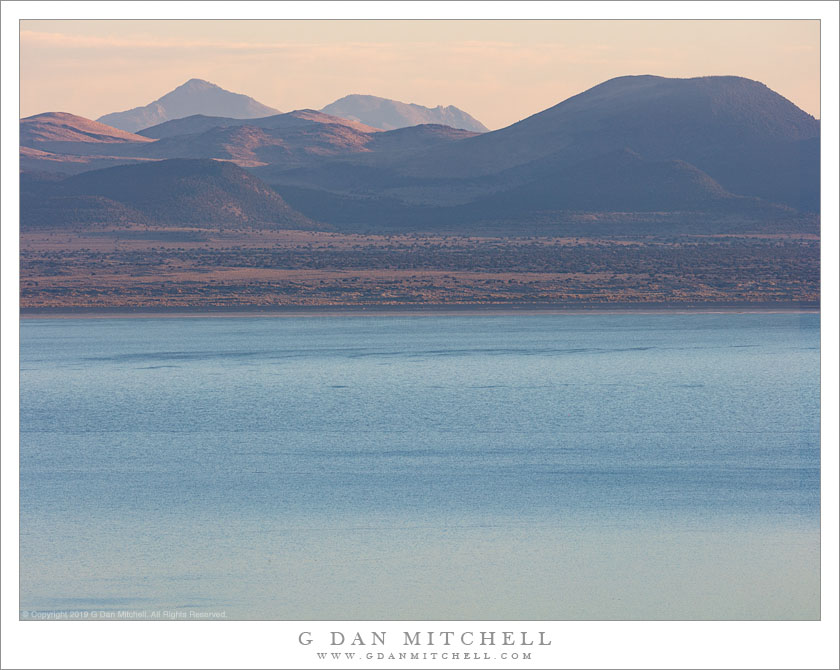
Mono Basin, Morning
Autumn wildfire haze slighlty obscures mountains on the far, eastern side of Mono Basin

Mono Basin, Morning. © Copyright 2019 G Dan Mitchell – all rights reserved.

Autumn wildfire haze slighlty obscures mountains on the far, eastern side of Mono Basin.

Early on this autumn morning, before heading off to find aspen trees to photograph, we made a side trip to a high spot with a view of the Sierra Crest, Mono Lake, and most of the the Mono Basin. We arrived before sunrise and set up our equipment to photograph the sunrise, which turned out to be a subtle experience due to the prevalence of drifting wildfire smoke east of the Sierra Nevada.

Mono Basin is a gigantic landscape. It is one of those places where the scale is so grand that it is actually hard to realize just how big the distances are. This photograph looks across the surface of the huge lake to its far, eastern shoreline and to the dry mountain ranges beyond. That distant landscape lies in the rain shadow of the Sierra Nevada, and it quickly takes on the dry quality of Nevada’s basin and range country.


G Dan Mitchell is a California photographer and visual opportunist. His book, “California’s Fall Color: A Photographer’s Guide to Autumn in the Sierra” is available from Heyday Books and Amazon.

Blog | About | Flickr | FacebookEmail

Links to Articles, Sales and Licensing, my Sierra Nevada Fall Color book, Contact Information.


All media © Copyright G Dan Mitchell and others as indicated. Any use requires advance permission from G Dan Mitchell.
Aspen Layers

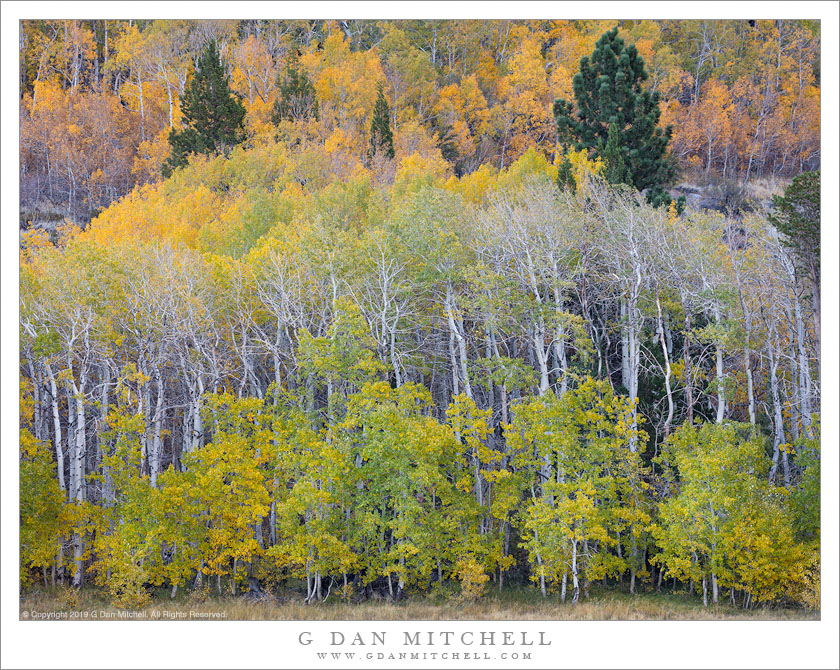
Aspen Layers
Layers of autumn color in shaded aspen groves

Aspen Layers. © Copyright 2019 G Dan Mitchell – all rights reserved.

Layers of autumn color in shaded aspen groves.

Overall, the current Eastern Sierra Nevada fall color season has seemed less stunning than in the best years. The start was promising, with good high elevation color arriving on the expected schedule. But later on a number of areas that frequently offer up amazing color did not quite deliver. However, a few points are in order. Even in a less-than-astonishing year there is great color to be found if you just look around a bit. (And some of it is not in the usual iconic locations.) And a lot depends on the specific moment you arrive — the day and even the time of day.

This grove may serve as an example. We first spotted it while driving past in the early morning, when the sun had not yet arrived on this spot. We continued up the road a bit, thinking we’d turn around and photograph it a bit later. It turned out that “a bit later” produced some pretty uninspiring light on this subject… so we returned the next day and timed our visit more carefully. Photographing fall color in shaded light can produce a very different effect than photographing in full sun, with more color subtle and varied color with more shadow detail. This grove offered an additional compositional detail — the heights of both the small and large trees produced a sort of arch shape.


G Dan Mitchell is a California photographer and visual opportunist. His book, “California’s Fall Color: A Photographer’s Guide to Autumn in the Sierra” is available from Heyday Books and Amazon.

Blog | About | Flickr | FacebookEmail

Links to Articles, Sales and Licensing, my Sierra Nevada Fall Color book, Contact Information.


All media © Copyright G Dan Mitchell and others as indicated. Any use requires advance permission from G Dan Mitchell.