
Tag Archives: southern

Canyon Bend

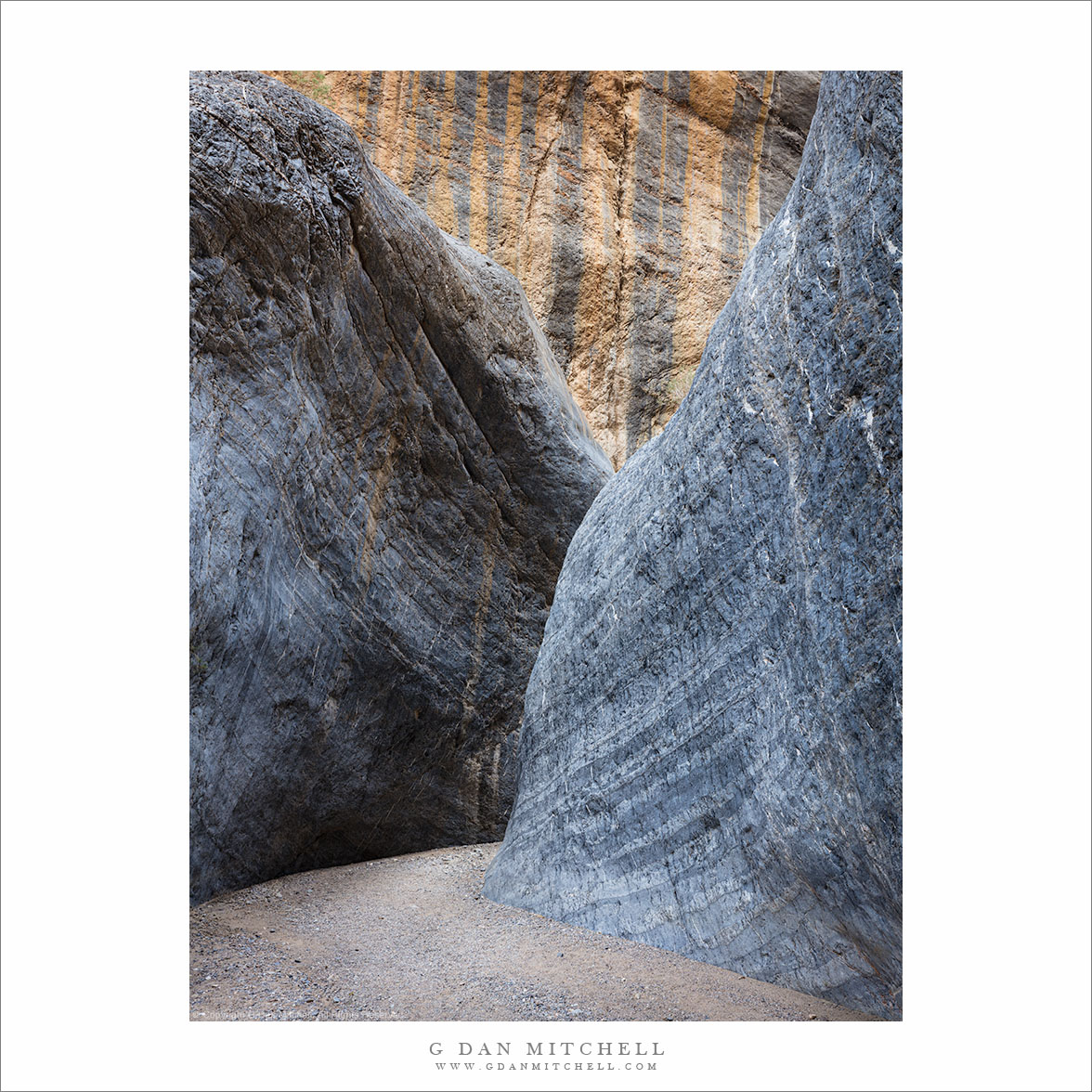
Photo of Death Valley slot canyon
“Canyon Bend” — A bend in the canyon narrows, Death Valley National Park.

Slot canyons and “narrows” are among the most compelling desert landscapes. Desert landscapes tend to be exposed, open to the sky and wind, and blasted by the midday sun. The space seems horizontally oriented, often with a distant horizon and perhaps low mountains rising from playas. The canyons contrast almost every way. They are places of shade, protected from wind, and the distant horizontal views are cut off, replaced by close surfaces covered with angles and curves.

There are many small canyons in Death Valley National Park, and they may be among its least-known and most interesting features. A few are popular, but most are off the beaten path and some are downright difficult to get to. Their lonely quality is part of the charm, and I hope it stays that way. This spot presents a fascinating combination of the blue-light, shadowed stratified walls, the water stained face in the warmer light above, and the canyon floor covered in gravel washed down by flowing water.


G Dan Mitchell is a California photographer and visual opportunist. His book, “California’s Fall Color: A Photographer’s Guide to Autumn in the Sierra” from Heyday Books, is available directly from G Dan Mitchell.

Blog | Bluesky | Mastodon | Substack Notes | Flickr | Email
Articles | Sales | Sierra Nevada Fall Color | Contact Info

All media © Copyright G Dan Mitchell and others as indicated. Any use requires advance permission from G Dan Mitchell.
Sea of Dunes

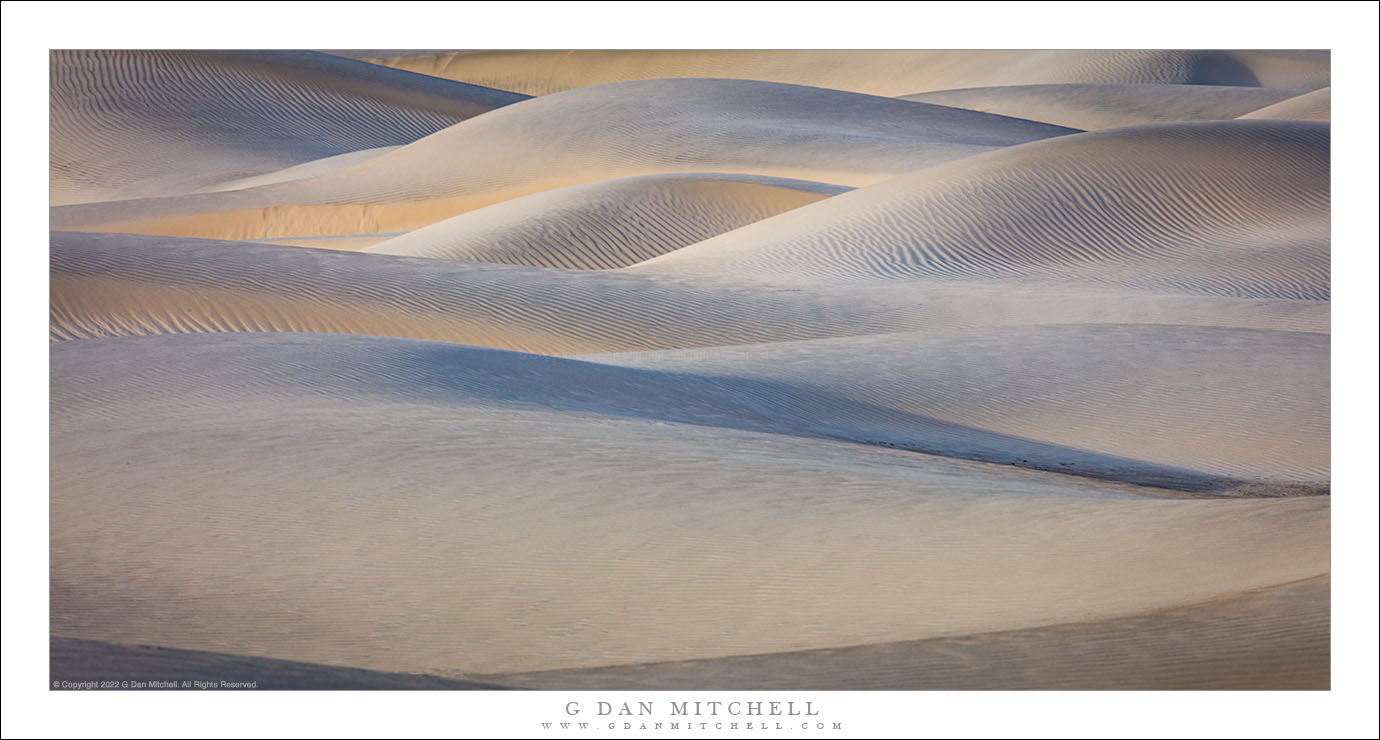
Sea of Dunes
Undulating patterns of overlapping sand dunes extending into the distance.

Sea of Dunes. © Copyright 2022 G Dan Mitchell.

Undulating patterns of overlapping sand dunes extending into the distance.

Sand dunes occupy a tiny fraction of Death Valley National Park but are one of the most common photographic subjects. They loom large in our sense of the place, perhaps because sand dunes evoke of a sort of alien landscape. But they also present a visual blank slate that is open to diverse interpretations. We can approach them as “grand landscapes” or as intimate landscapes, as abstractions of shape and color, as backdrops for photographs of people and wildlife, and more. I think I began by seeing them as grand landscapes but now find it more interesting to seek out little fragments of form and light.

Perhaps because it makes everyone a bit uneasy we don’t speak a lot about the extent to which photographers treat dunes as a photographic starting point for visual experimentation. By this I mean to acknowledge that most interesting, compelling photographs of sand dunes involve a lot of “interpretation,” much of it done via post-processing techniques. To be sure, I regard this as conceptually legitimate and even necessary, and I embrace it in my own photography— I egard post-processing to be as integral to photograph-making as setting up the camera and clicking the shutter.


G Dan Mitchell is a California photographer and visual opportunist. His book, “California’s Fall Color: A Photographer’s Guide to Autumn in the Sierra” is available from Heyday Books, Amazon, and directly from G Dan Mitchell.

Blog | About | Flickr | FacebookEmail

Links to Articles, Sales and Licensing, my Sierra Nevada Fall Color book, Contact Information.

Scroll down to leave a comment or question. (Click this post’s title first if you are viewing on the home page.)


All media © Copyright G Dan Mitchell and others as indicated. Any use requires advance permission from G Dan Mitchell.
Winding Canyon, Morning Haze

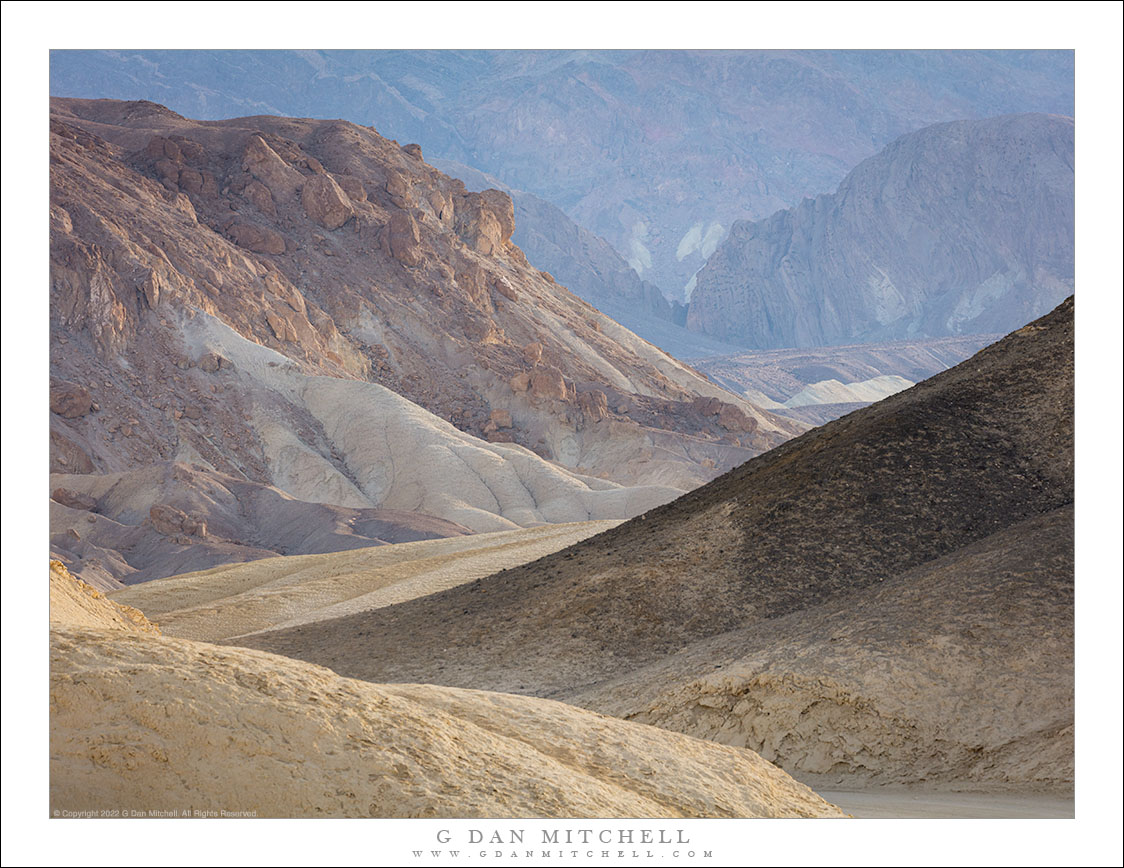
Winding Canyon, Morning Haze
Morning haze mutes the features of a distant mountains beyond a winding desert canyon.

Winding Canyon, Morning Haze. © Copyright 2022 G Dan Mitchell.

Morning haze mutes the features of a distant mountains beyond a winding desert canyon.

I am not sure how many times I have photographed in this location over the past fifteen years or so, but it may have been dozens. There are striking features here, and I’m sure that they are what attracted me at first. I recall many years ago setting up on a high spot before sunrise and photographing for the next hour or two from within perhaps a 25-foot radius. Since then I’ve gone back on every visit, which at this point is perhaps twenty or more times. The fascinating variety of the spot attracts me, but part of the story is that it is relatively easy to get to, even when I only have a few hours on a morning when I’m about to start the long drive home.

Due to the nature of access to the area, I start at the same end every time I photograph there. At some point the early morning light comes over mountains from the east and lights up the formations, and I typically stop and intensively photograph wherever I am at that point. As a result, I always seem to arrive at the end of this little loop too late for the best light. I’ve often looked up this canyon and others like it, hoping to photograph their winding paths with the mountains in the background… and too often realized that the light was gone. But this time I arrived at a lovely high spot in good light and photographed into the morning haze that muted the details of the mountains beyond the twisting canyon.


G Dan Mitchell is a California photographer and visual opportunist. His book, “California’s Fall Color: A Photographer’s Guide to Autumn in the Sierra” is available from Heyday Books, Amazon, and directly from G Dan Mitchell.

Blog | About | Flickr | FacebookEmail

Links to Articles, Sales and Licensing, my Sierra Nevada Fall Color book, Contact Information.

Scroll down to leave a comment or question. (Click this post’s title first if you are viewing on the home page.)


All media © Copyright G Dan Mitchell and others as indicated. Any use requires advance permission from G Dan Mitchell.
Sand Dunes, Soft Light

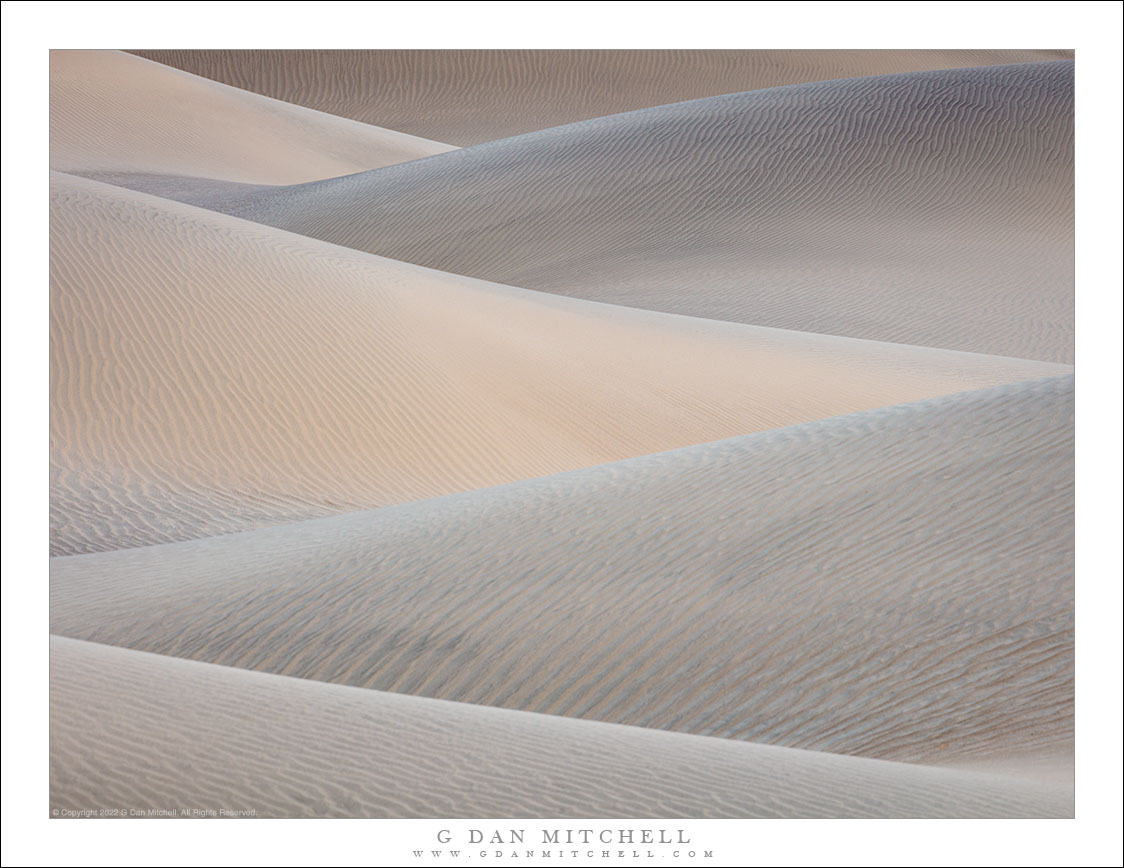
Sand Dunes, Soft Light
Soft morning light on overlapping sand dunes, Death Valley National Park.

Sand Dunes, Soft Light. © Copyright 2022 G Dan Mitchell.

Soft morning light on overlapping sand dunes, Death Valley National Park.

We often hear that photography is all about light, and nowhere is this more true than when photographing sand dunes. In the middle of the day the dunes can be challenging to photograph, with harsh light and little definition of their forms. But all sorts of magic can happen when the angle of the light is lower and the dunes act as a canvas to capture and reflect the light and its color, intensity, softness, and more. The colors can vary through almost every shade from blue through red, and the light may be soft and gentle or stark enough to turn shadows almost black. And at times the light passes through all of these stages and more in moments.

I’ve long felt that dune photography gives the photographer more creative and interpretive freedom than many other subjects. Because the subject is so basic, it is possible to take liberties with the light — its intensity and color — and render photographs of dunes in a variety of subjectively true ways. The light was extremely soft when I made this exposure, so I used to tools of the post-production stage to bring out the colors and forms of the subject.


G Dan Mitchell is a California photographer and visual opportunist. His book, “California’s Fall Color: A Photographer’s Guide to Autumn in the Sierra” is available from Heyday Books, Amazon, and directly from G Dan Mitchell.

Blog | About | Flickr | FacebookEmail

Links to Articles, Sales and Licensing, my Sierra Nevada Fall Color book, Contact Information.

Scroll down to leave a comment or question. (Click this post’s title first if you are viewing on the home page.)


All media © Copyright G Dan Mitchell and others as indicated. Any use requires advance permission from G Dan Mitchell.