
Tag Archives: wash

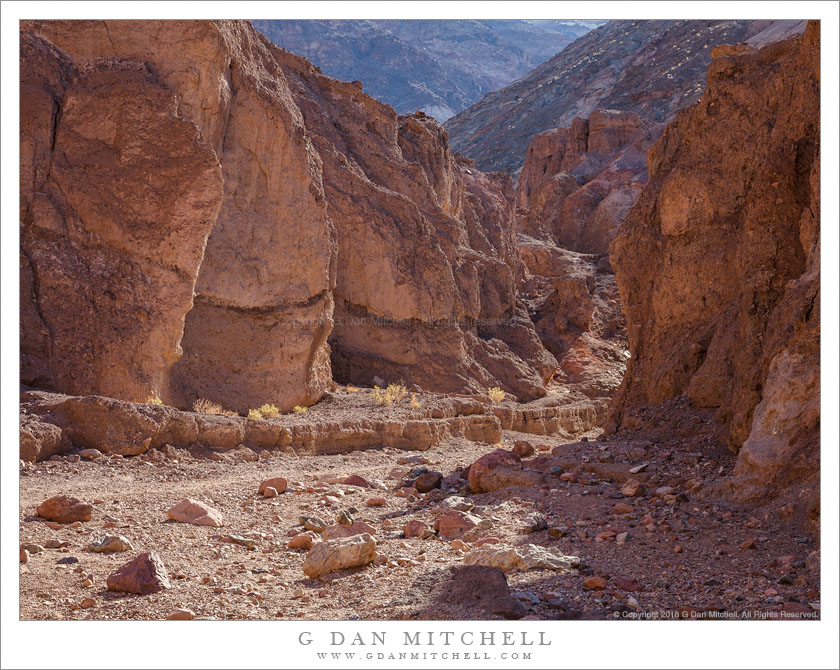
Winding Desert Canyon

Winding Desert Canyon
A desert canyon winds into the Black Mountains of Death Valley

Winding Desert Canyon. © Copyright 2018 G Dan Mitchell – all rights reserved.

A desert canyon winds into the Black Mountains of Death Valley

These desert canyons come in a variety of forms. In many ways, the slot canyons are the most appealing, with their tall, often vertical walls, serpentine paths, and sometimes very narrow dimensions. But the constitute the minority of the canyon types. Others may be quite wide and shallow, almost having the character of wide washes instead of canyons. These are often found lower in the mountains, and are easy to spot from a distance where the canyons spill out onto (sometimes vast) fans of gravel. Another type feels like a canyon, but has a more open character, with hills rather than walls along the sides, and often with a wide path up the center.

This canyon has the latter character, at least at this point. (Elsewhere in the same drainage it has more of the character of a slot canyon.) While there are low walls along its edges, one wouldn’t be too hard pressed to pass over them, and above these walls the sides of the canyon slope away at relatively low angles that allow sunlight to penetrate to the bottom. Recently it finally occurred to me that one of the things that makes such canyons so enjoyable to walk is that there is no single path to follow. Where the canyon is wide enough, the feeling is midway between following a trail and walking in trail-less country. You do follow the course of the canyon, but you can pick your way through it in any way that seems to make sense.


G Dan Mitchell is a California photographer and visual opportunist. His book, “California’s Fall Color: A Photographer’s Guide to Autumn in the Sierra” is available from Heyday Books and Amazon.
Blog | About | Flickr | Twitter | FacebookGoogle+ | LinkedIn | Email


All media © Copyright G Dan Mitchell and others as indicated. Any use requires advance permission from G Dan Mitchell.
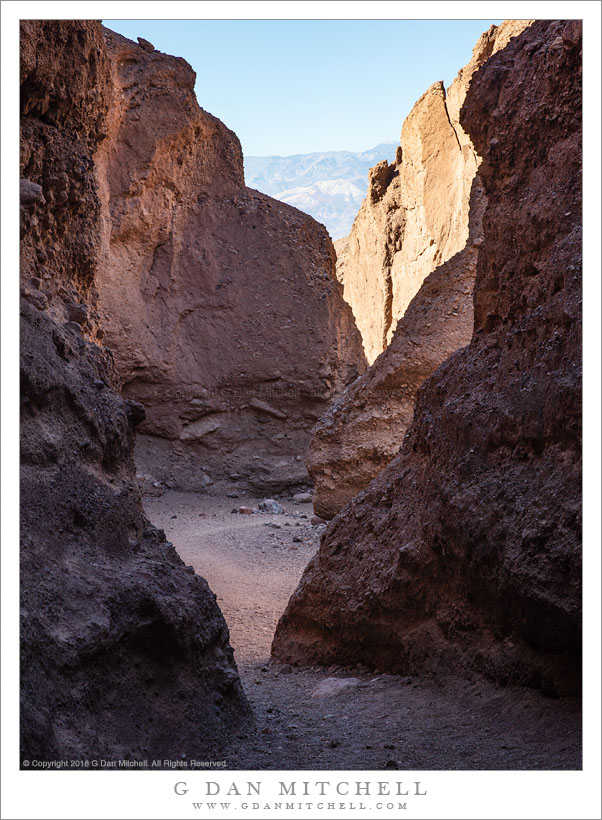
Toward the Valley

Toward the Valley
Reflected light in a twisting desert canyon as it approaches Death Valley

Toward the Valley. © Copyright 2018 G Dan Mitchell – all rights reserved.

Reflected light in a twisting desert canyon as it approaches Death Valley

To walk into a canyon like this one from a huge valley such as Death Valley is to walk from an overwhelming, immense space into a smaller, more intimate place. In the canyons distances are often measured in feet rather than miles, and long distance views are most often cut off entirely. This is especially true when entering such canyons where the route often begins in a wide wash above the Valley, then constrict through the mouth of the canyon, and soon begins to wind back and forth in a serpentine manner between hills or cliffs.

The trip back out often seems to have a different feeling. It usually takes less time, partly due to the downhill slope and even more because one is now retracing familiar terrain rather than discovering it for the first time. In many cases, the closer one gets to the outlet of the canyon the more that signs of the valley below appear. The canyon walls become shorter, and views over the nearer walls being to reveal blue sky and distant mountains instead of more canyon walls. Before long the light changes and the route leaves the canyon confines and is again back in the huge, open space.


G Dan Mitchell is a California photographer and visual opportunist. His book, “California’s Fall Color: A Photographer’s Guide to Autumn in the Sierra” is available from Heyday Books and Amazon.
Blog | About | Flickr | Twitter | FacebookGoogle+ | LinkedIn | Email


All media © Copyright G Dan Mitchell and others as indicated. Any use requires advance permission from G Dan Mitchell.
Hiker, Natural Bridge Canyon

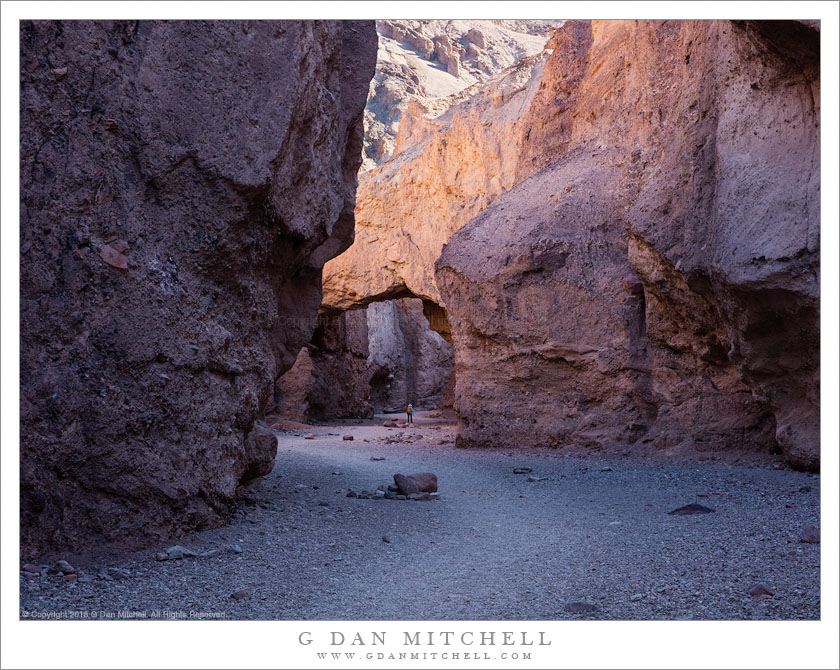
Hiker, Natural Bridge Canyon
Hiker passes beneath a thick natural bridge spanning a narrow Death Valley canyon

Hiker, Natural Bridge Canyon. © Copyright 2018 G Dan Mitchell – all rights reserved.

Hiker passes beneath a thick natural bridge spanning a narrow Death Valley canyon

With the exception of a couple of very accessible and popular canyons, many Death Valley Canyons are not visited all that much. Even canyons that are a short distance from major iconic locations and roads are often uncrowded. Canyons that are more remote can be wonderfully lonely places, locations to find the solitude that the desert supplies in such abundance. They are magical places though, to be honest, if you have experienced the red rock sandstone canyons of the Southwest, many of the canyons of Death Valley are more subtle. The canyons are also an undeniable reminder of the tremendous role of water in forming this landscape, odd as that may seem in what is now a desert.

While many Death Valley sights are arguably at their best during or near the golden hour period around dawn and sunset, the canyons can be good a bit later in the morning and earlier in the afternoon. In fact, too close to the sunset/sunrise times and the canyons can be quite dark — perhaps too dark for most photography. But when the sun is a bit higher in the sky the light can strike upper canyon walls and bounce and diffuse down into canyon depths. This light can be soft, gentle, and take on the colors of the canyon rocks. You can see some of that light on the massive bridge that crosses this canyon, and if you look closely you may see a small hiker providing a sense of scale.


G Dan Mitchell is a California photographer and visual opportunist. His book, “California’s Fall Color: A Photographer’s Guide to Autumn in the Sierra” is available from Heyday Books and Amazon.
Blog | About | Flickr | Twitter | FacebookGoogle+ | LinkedIn | Email


All media © Copyright G Dan Mitchell and others as indicated. Any use requires advance permission from G Dan Mitchell.
Desert Mountains

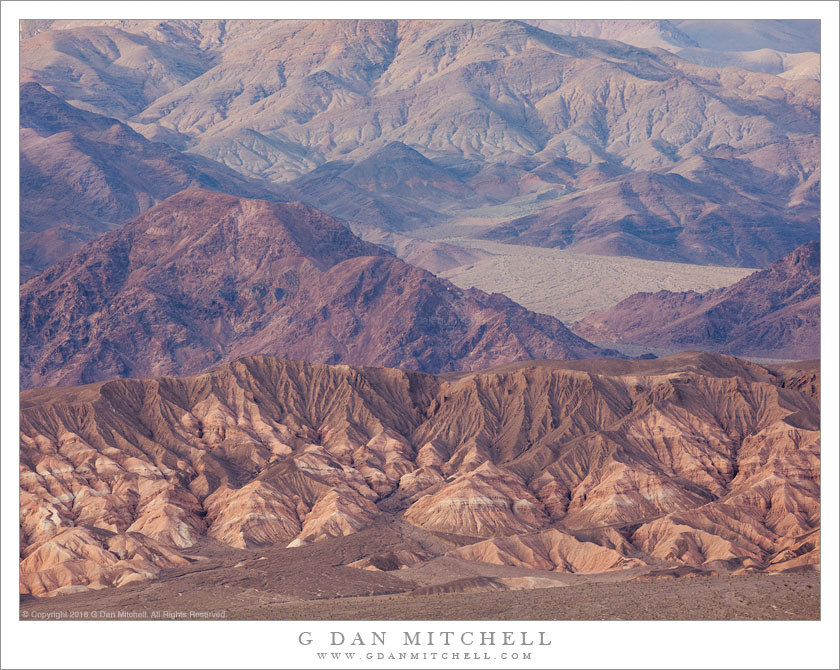
Desert Mountains
Desert mountains rise above Death Valley in evening light

Desert Mountains. © Copyright 2018 G Dan Mitchell – all rights reserved.

Desert mountains rise above Death Valley in evening light

This view takes me back to something I believe I understood the very first time I saw Death Valley. It was close to twenty years ago, and I had gone there as an adult with a group of middle school and high school kids who were planning a long hike in the park. (The event did not come off quite as planned, but that is a long story that I’ll have to tell some other time.) We arrived at the park boundaries after dark and made camp at the first possible place, a small and mostly unimproved campsite right off the road between the pass we had come over and the valley itself. In the dark I could tell little about the place: it was warm, the wind was blowing, I didn’t see much in the way of plant life. We climbed into tents and sleeping bags for the night.

Early the next morning I crawled out and got my first view of Death Valley. There’s nothing quite like suddenly coming upon your first view of such an iconic place. I recall the specific view even today, looking down across massive alluvial fans, across the valley itself, and at these rugged and bare hills and mountains on the far side so many miles away. This photograph, made from a different location this spring, includes a small section of the scene I looked at back then. It also illustrates one of my strongest impressions of Death Valley — it is a place where the geology is laid bare with virtually no forests or water to obstruct the land itself, even more so than above timberline where there are still lakes and where snow may linger all year. It is also a place, perhaps to our surprise, in which one of the largest factors shaping the landscape has been… water!


G Dan Mitchell is a California photographer and visual opportunist. His book, “California’s Fall Color: A Photographer’s Guide to Autumn in the Sierra” is available from Heyday Books and Amazon.
Blog | About | Flickr | Twitter | FacebookGoogle+ | LinkedIn | Email


All media © Copyright G Dan Mitchell and others as indicated. Any use requires advance permission from G Dan Mitchell.