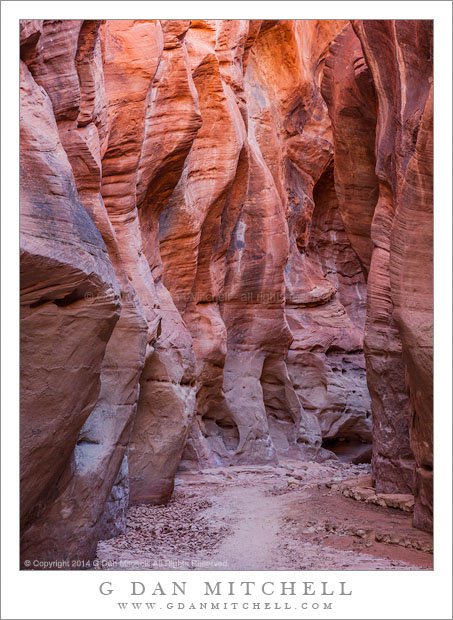
Warm reflected light filters into the depths of a Utah slot canyon
I’m somewhat new to the world of Utah slot canyons, but I’m also increasingly enthusiastic about them and their photographic potential. I have not visited some of the iconic “big name” slots (and I may or may not do so), but I have found similar experiences in other locations. During my recent Utah visit I had thought about exploring a particular area in southwest Utah. I had a few place names in mind, but I really did not know much about them in any detail. (I often prefer to not know too much about these places, preferring instead to discover them on my own.) This canyon has a name that I had heard before, so one morning I decided to head out that direction and see what I could discover.
I drove down a gravel road, parked, loaded up camera equipment and a snack, and headed down a broad wash into the upper part of the valley though would eventually narrow and become a slot canyon. While it is no doubt more efficient to begin closer to such canyons, I enjoy the process of moving from the wider valleys to the narrower canyons, and the walk down the meandering path of the stream above the narrow canyon was enjoyable. Inside the narrow section the walls rose vertically, the canyon floor was often quite wet, and beautiful soft light filtered down from above, reflecting the warm reddish colors of the rocks and highlighting their shapes and patterns.
G Dan Mitchell is a California photographer and visual opportunist whose subjects include the Pacific coast, redwood forests, central California oak/grasslands, the Sierra Nevada, California deserts, urban landscapes, night photography, and more. Blog | About | Flickr | Twitter | Facebook | Google+ | 500px.com | LinkedIn | Email
This is another multi-photograph post — in this one I share four photographs from the Grand Staircase-Escalante National Monument that feature trees in various back-country landscapes ranging from the canyons and rock formations to one otherwise perhaps un-notable stop near a campsite where I stayed.
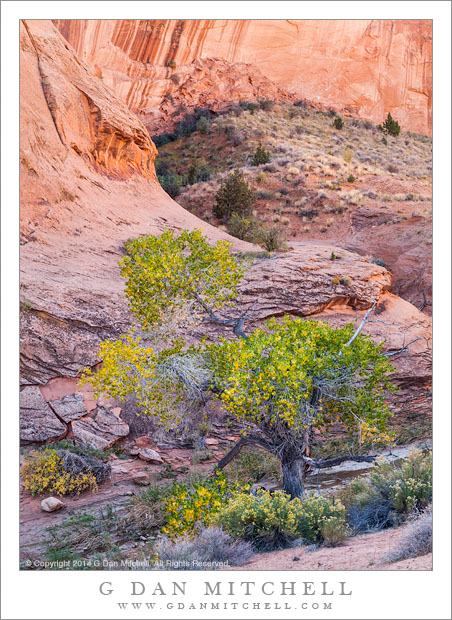
Colorful autumn foliage on a cottonwood tree next to a creek at the bottom of a deep sandstone canyon
This stout cottonwood tree grows in the wash at the bottom of this deep canyon, at the base of huge sandstone walls that tower above and wrap around curves in the canyon’s path. I had stopped here to photograph a different tree — it is among those shared in this group — and after finishing with that tree I looked over here to see this one standing against the worn and curving rock shapes at the base of the canyon walls.
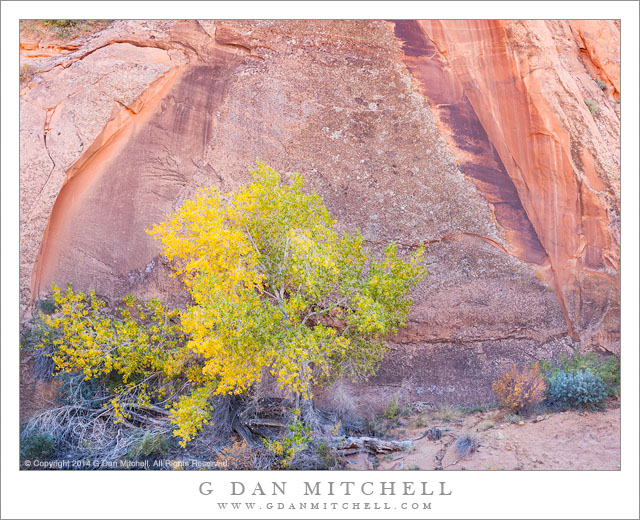
Fractured and sandstone canyon walls arch above a cottonwood tree with fall foliage
This is one of two photographs of this tree that I like. (The other is a in portrait orientation, and may give a better sense of the trees size and the relative scale of the huge sandstone canyon wall.) The tree grows in the bottom of the wash and right up against the canyon walls, with several arch shapes in the sandstone creating a sort of frame for it.
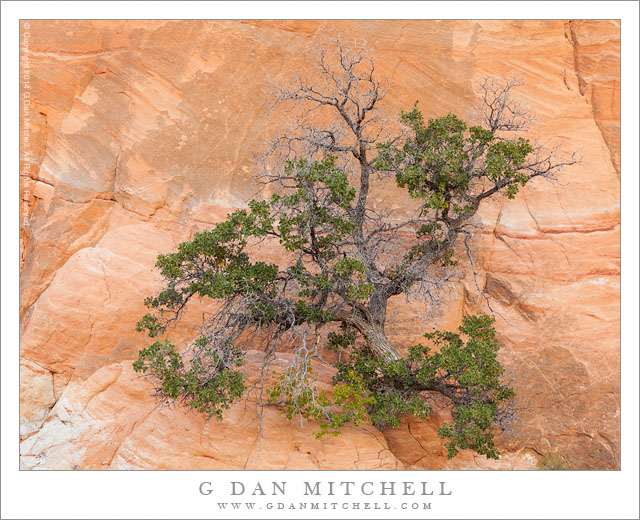
A solitary oak tree grows from a crack in Utah sandstone
This photograph comes with a bit of a personal story. In the morning we (a group of six photographers) had departed our camp on foot to hike down a nearby wash and drop into a deeper canyon. Although the morning began well, with a pleasant walk down the wash, followed by some exploration as we tried to find a good way to drop into the deeper canyon, I suddenly developed a knee problem — I decided to remain behind as the group went on. I walked back to camp, making photographs along the way, and then drove to some other places along our gravel road looking for other subjects. In the late afternoon I returned to camp, though no one else had yet returned. So I decided to do a bit of exploring near camp, and I ended up at the base of a sandstone face as the sun dipped behind mountains to the west — and I photographed this tree in the low light before heading back to camp.
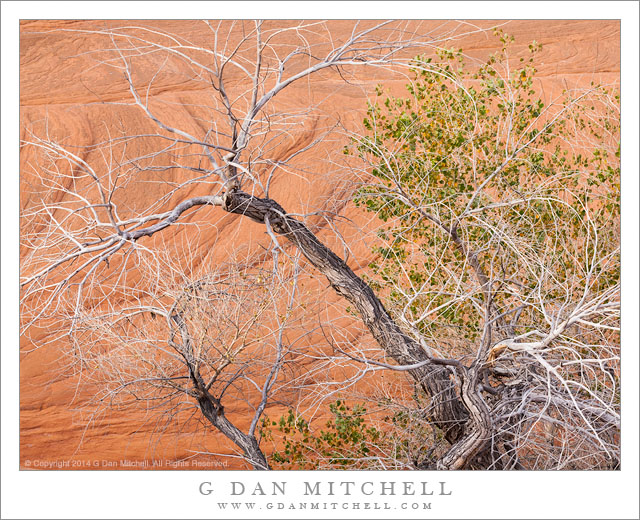
On our first night together as a group in a back-country area of Utah we set up camp and then headed out to photograph something as the evening approached. We drove, ending up at a spot where large sandstone formations are backed by an even larger area of smooth sandstone surfaces, interrupted by potholes and other features. At one point we were in one of those locations where the number of obvious photographic subjects was limited — basically, there was a beautiful pothole with a true and there was this old snag. With six photographers, interesting questions arise. Do we all shoot the same subject? If one person shoots it first, is it OK for the next to photograph from the same angle? How could we each take this common subject and do something different with it? I initially resolved to not shoot this snag, but a bit later I came back and gave in to temptation! ;-)
G Dan Mitchell is a California photographer and visual opportunist whose subjects include the Pacific coast, redwood forests, central California oak/grasslands, the Sierra Nevada, California deserts, urban landscapes, night photography, and more. Blog | About | Flickr | Twitter | Facebook | Google+ | 500px.com | LinkedIn | Email
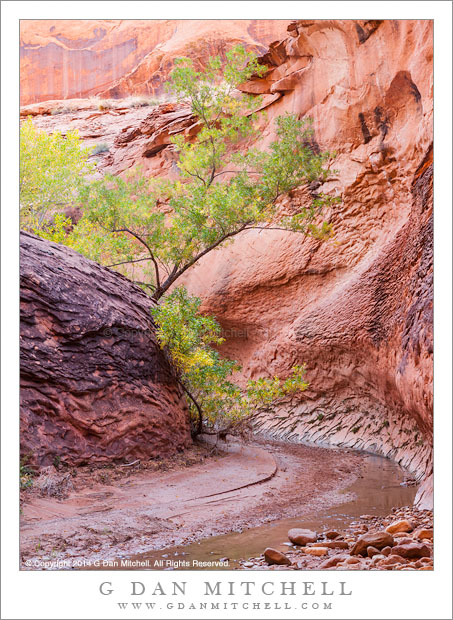
A box elder with autumn foliage grows along the stream at the bend in a red rock canyon
There are many patterns familiar to those who enter these canyons. In many cases, the creeks and rivers meander back and forth, and over time they may have cut paths deep into the sandstone layers that also meander in the same way. Walking along such a small creek, looking up, and realizing that a winding canyon hundreds of feet deep was cut but the little creek gives you a sense of deep time… and also a clear indication that such creeks are not always so gentle. The winding patterns also lead you on as you descend the creeks. Each time you round a bend like this one you get a view further along in the canyon… to the next bend, where the creek turns out of sight again. And you say/think to yourself, “just one more bend and then I’ll turn around.” So you keep going and round that next bend, where you can see a bit further into the canyon… to the next bend. And you say/think to yourself, “just one more bend and then I’ll turn around…”
This creek doesn’t follow the perfect pattern of consecutive meanders that are found in some canyons, but it did in this section where I found a single box elder tree growing at the edge of a rock that butted up against the wetter, sandy section of the water course. And far above, the gigantic walls of this canyon mirrored, as expected, the curves of the bottom of the canyon, and warm light bouncing among the canyon walls filtered down here to gently illuminate the depths of this red canyon.
G Dan Mitchell is a California photographer and visual opportunist whose subjects include the Pacific coast, redwood forests, central California oak/grasslands, the Sierra Nevada, California deserts, urban landscapes, night photography, and more. Blog | About | Flickr | Twitter | Facebook | Google+ | 500px.com | LinkedIn | Email
“First Light, Capitol Reef” — Early morning light on the peaks of Capitil Reef.
Before dawn we drove across Capitol Reef National Park to the east, with a plan to head down the rural road that goes south on the park’s east side. We were hoping for interesting dawn light, but we weren’t quite ready for it when it arrived just after we exited the park and arrived at our intersection. The sun wasn’t up yet, but we could see a light show about to develop, with interesting light likely to strike the high ridge to the west and fantastic clouds appearing in the sky.
We quickly found a spot with an open view on much of the surrounding terrain, left the main “road,” grabbed camera gear and headed off to photograph. Within moment the first real light hit these domes and ridges to our west and turned the sky slightly pink. The formations were a good distance away, so I worked quickly with a long lens — and this light diminished within moments.
Photographer and visual opportunist. Daily photos since 2005, plus articles, reviews, news, and ideas.
Manage Consent
To provide the best experiences, we use technologies like cookies to store and/or access device information. Consenting to these technologies will allow us to process data such as browsing behavior or unique IDs on this site. Not consenting or withdrawing consent, may adversely affect certain features and functions.
Functional
Always active
The technical storage or access is strictly necessary for the legitimate purpose of enabling the use of a specific service explicitly requested by the subscriber or user, or for the sole purpose of carrying out the transmission of a communication over an electronic communications network.
Preferences
The technical storage or access is necessary for the legitimate purpose of storing preferences that are not requested by the subscriber or user.
Statistics
The technical storage or access that is used exclusively for statistical purposes.The technical storage or access that is used exclusively for anonymous statistical purposes. Without a subpoena, voluntary compliance on the part of your Internet Service Provider, or additional records from a third party, information stored or retrieved for this purpose alone cannot usually be used to identify you.
Marketing
The technical storage or access is required to create user profiles to send advertising, or to track the user on a website or across several websites for similar marketing purposes.

 G Dan Mitchell is a California photographer and visual opportunist whose subjects include the Pacific coast, redwood forests, central California oak/grasslands, the Sierra Nevada, California deserts, urban landscapes, night photography, and more.