Category Archives: Commentary

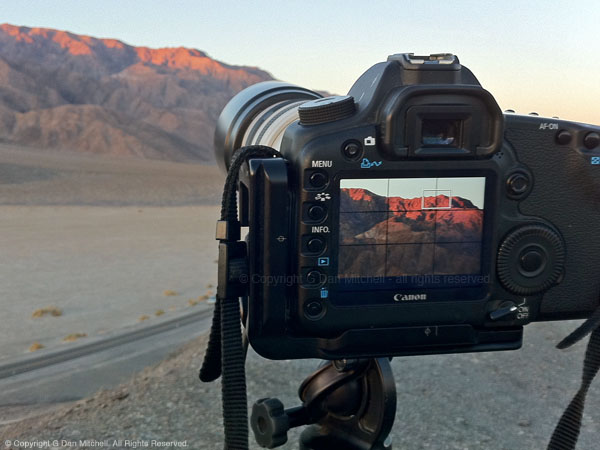
What the Camera Sees

What the Camera Sees

What the Camera Sees. Death Valley National Park, California. March 31, 2011. © Copyright G Dan Mitchell – all rights reserved.

An iPhone snap of my camera set up to photograph dawn light on Tucki Mountain, near Stovepipe Wells in Death Valley National Park.

Fun, eh? ;-)

G Dan Mitchell Photography | Flickr | Twitter | Facebook | Email
Text, photographs, and other media are © Copyright G Dan Mitchell (or others when indicated) and are not in the public domain and may not be used on websites, blogs, or in other media without advance permission from G Dan Mitchell.

See You at the San Francisco Photo Meetup Group?

I’ll be at tonight’s monthly San Francisco Photography Meetup Group get-together. It is always a fun event and a good time to get together to view photographs and talk photography. I’m bringing some recent prints from my recent Death Valley visits and perhaps a few others.

G Dan Mitchell Photography | Flickr | Twitter | Facebook | Email
Text, photographs, and other media are © Copyright G Dan Mitchell (or others when indicated) and are not in the public domain and may not be used on websites, blogs, or in other media without advance permission from G Dan Mitchell.

Rising Gas Prices: Where Will It End?

IMPORTANT: Read on for an important update to this April Fool’s Day 2011 that I have posted near the bottom of the page below the original story.

Gas Station Sign, Death Valley

From a quick iPhone snap as I drove through this part of Death Valley a few days ago. Sometimes it seems like only thing higher than the temperature in Death Valley is the price of gasoline. I tell you, after putting 30 gallons in the Hummer, it will be a long time before I can afford to take another vacation!

© Copyright G Dan Mitchell – all rights reserved.


NOTE: This photo apparently “went viral” recently, on disinformation posts on social media claiming that this is the price of gas in California today. LOL. I have a bit more to say about that below in an “update” and in the comments section.

If you enjoyed this (hint!) April Fool’s Day post, you might enjoy these, too:

And, of course, the rest of this site features years of my photography, along with articles and stories on photography-related subjects.

And, more fun with Photoshop…

UPDATE 3/10/22: Because the image in this post was ripped off by disinformation posters on social media and used as a fake news meme… I need to give readers the full truth. (Sadly, it does kind of wreck the original April Fool’s joke, but here we are.)

In early 2011 I was in Death Valley to make photographs. I passed by this gas station at Furnace Creek, which is known for having some of the highest posted gas prices in the country. (Smart visitors get their gas for much less at nearby Stovepipe Wells or to the east of the park in Nevada, where it is way cheaper.)

For several years I had been doing an April Fool’s Day post that includes some preposterous story. (See links in the story below.) It occurred to me that I could do one this year (2011) by photographing the sign and Photoshopping preposterous gas prices in place of the actual prices. I don’t actually recall the real prices at the time, but they were probably in the $3-something range. So I pulled over and made an iPhone snap of the sign. (Some wonder: Did I buy gas here. Are you crazy! No! See the previous paragraph. And, no, I do not own a Hummer. ;-)

Conveniently, the “6” on the price for “Supreme” was easy to invert, so I used it to create a “9” that I photoshopped in for the dollar amount. And on April Fool’s Day 2011 I posted the image and the text you’ll find lower on this page.  There were several obvious hints in the story about its April Fool’s Day trickery, though I did manage to fool a few folks. 

That was the last I thought of it until (I think) 2019 when someone contacted me to point out that the image had been ripped off and posted by alt-right conspiracy theory disinformation social media accounts as “evidence” of the outrageous prices for gas in California. Yeah, our prices are higher than the national average, but not this high! Several media outlets contacted me about it, and if you look around you might still be able to find a few of the stories in which I debunked the claim and pointed to this old post. 

So, if you see this “photograph” somewhere online along with claims about the high prices of gas, let them know it is fake and point them here for the truth. ;-)


COMMENT OR QUESTION? Scroll down to the comment form.

G Dan Mitchell is a California photographer and visual opportunist. His book, “California’s Fall Color: A Photographer’s Guide to Autumn in the Sierra” (Heyday Books) is available directly from him. Blog | Bluesky | Mastodon | Substack Notes | Flickr | Email

All media © Copyright G Dan Mitchell and others.

The Economics of DSLR “Protective” Filters

The subject of whether or not to get so-called “protective” UV filters for DSLR lenses comes up a lot. I used to respond to the question frequently – so frequently that I eventually gave up and just wrote a post on the subject that I could refer people to when they ask.

However, during a recent weak moment I wrote a new response to the notion that ‘protective’ filters provide good value for all photographers. As I do from time to time, I’m sharing it here:

Someone wrote: … would you rather pay $150 on a filter that *might* compromise your shot or spend $150 on replacing the front element and have *no* possible risk of image degradation from the extra piece of glass?

I replied: This is essentially an insurance question. Obviously, if we knew that our lens would certainly be destroyed in a way that was 100% preventable by using a filter we would almost certainly get a filter. But that is an imaginary scenario that is far from reality.

Most lenses will never be damaged in any serious way. My hunch is that this is actually the fate of a very small percentage of lenses – probably far less than 10%, and I would bet closer to 1%.

Of those that are damaged, only some will suffer a blow to the front element. There are many other modes of failure – a dropped lens that breaks the mechanism, something crashing into the side of the lens, water damage, etc.

Of those that suffer a blow to the front of the lens structure, only some will result in contact with the front element. Of those in which contact with the front element occurs, some would not cause any damage or any significant damage. Some would damage the front element, but would be violent enough that the filter would not have prevented the damage. A few that might not have damaged the front element will send glass shards from the broken filter into the front element and damage it. In some subset of cases, all of the variables might line up just right and prevent damage.

At this point the user would have to replace the broken high quality filter at a cost that varies depending on a number of factors. Let’s use a figure if $100 for an expensive L zoom. The owner has now invested something on the order of $200… which is not much different from the cost of replacing a front element, as I understand it.

In terms of the probability of damage, the cost of the filter, the likelihood that the filter would save the day… the filter is probably one of the worst insurance investments you could make.

Am I unalterably and completely opposed to the use of ‘protective’ filters? Almost, but not quite. While I do not think that it makes sense to automatically stick such a filter on every lens for general use – see the link above for more on this topic – I can think of one sort of situation in which I might use one. I would consider a filter if I were shooting a sealed-body camera (such as a Canon 1-series) and was working in conditions that were truly dangerous to my equipment (and not just a bit of mist or ocean spray) and I was using of the small number of L lenses that become sealed (and not all do) with the addition of a filter.

Other than that? No.

G Dan Mitchell Photography | Flickr | Twitter | Facebook | Email
Text, photographs, and other media are © Copyright G Dan Mitchell (or others when indicated) and are not in the public domain and may not be used on websites, blogs, or in other media without advance permission from G Dan Mitchell.