
Category Archives: Photographs: Desert

Purple Dawn, Mono Lake

Purple Dawn, Mono Lake

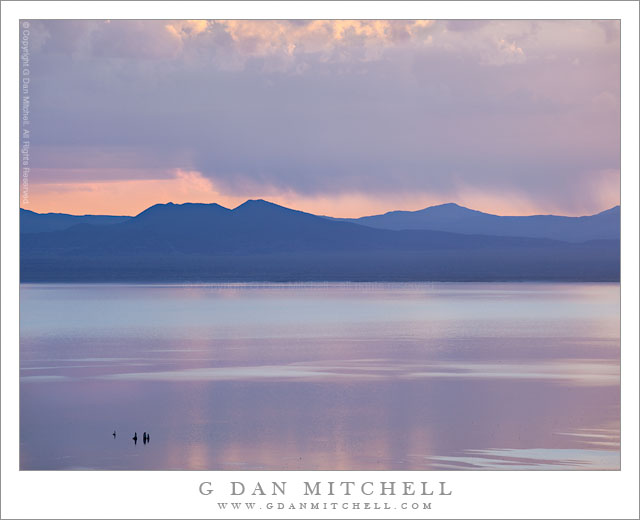
Purple Dawn, Mono Lake. Eastern Sierra Nevada, California. June 29, 2010. © Copyright G Dan Mitchell – all rights reserved.

Pastel shades of purple and blue just before dawn at Mono Lake.

Back at the end of 2010 I wrote that I was going through all of my 2010 raw files to look for images that I had passed over, as I do near the end of every year. Things got busy, I got distracted, and I only got about half way through the year’s files. Recently I have returned to the 2010 photographs to try to complete the task, and this is one of the photographs that I rediscovered as I resumed the search with images taken near the end of June.

This was my first real photographic trip to the Sierra during the summer season of 2010. I had made a brief trip up there, visiting Yosemite Valley and then crossing Tioga Pass, back in early June right about the time that the pass opened. However, on this trip I was able to spend several days in the high country and kicking around near Mono Lake. This can be a great time of the year up there since conditions range from what seems like late winter in the high country to real summer in places like Owens Valley and around Mono Lake.

On this morning I decided that I’d head down to Mono Lake well before dawn and see what I could turn up. I did not go to the iconic South Tufa area on this morning, thinking instead that I’d try for some different and longer views of the lake. (Later in the morning I traveled a good distance south of the lake on the less-used section of highway 120.) There were, obviously, clouds in the morning and they blocked the sunrise. However, the light glowed through and over and under and around them, and even though there was not direct light in very early morning image, the colors were quite something. The group of tufa towers at the lower left are offshore not far from the South Tufa area.

G Dan Mitchell Photography | Flickr | Twitter | Facebook | Email
Text, photographs, and other media are © Copyright G Dan Mitchell (or others when indicated) and are not in the public domain and may not be used on websites, blogs, or in other media without advance permission from G Dan Mitchell.
Saltgrass and Water from a Salt Spring

Saltgrass and Water from a Salt Spring
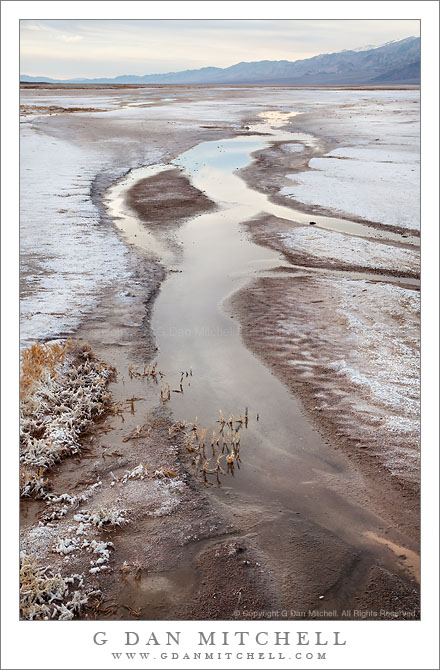
“Saltgrass and Water from a Salt Spring” — Saltgrass grows into water from a salt spring at the edge of salt flats in Death Valley National Park.

This is another image from my productive half hour or so on the edge of the Death Valley salt flats near a salt spring on a cloudy February morning. These shallow pools obviously have the potential to reflect light and shape from the clouds and the surrounding terrain, and their narrow winding channels provide a relief to the otherwise relatively uniform terrain of the flats.

This photograph includes just a bit of the plant (which I believe is a type of saltgrass) that grows in the hostile and alien terrain at the source of the salt spring on the edge of this sun-blasted salt flat. Aside from places like Antarctica or the very highest alpine peaks, I’m hard pressed to think of other places that are less conducive to life. Yet, even here some small creatures are found in the water and these grasses somehow manage to survive. (And a short distance up the wash above the salt flat, new plants were beginning to sprout among the stones.) The grasses not only grow in very salty water, but many of them – including some at the lower left in this image – are encrusted in the dry salt.

Dealing with the extremely large difference in distance between the foreground mud, water, and plants at my feet and the distant mountain range and sky was tricky. The fact that a relatively long 50mm focal length was required for the composition I saw made it even more difficult – a shorter focal length would have given me much more depth of field. This would have been the perfect place to use a tilt/shift lens… but I don’t have one! Instead I resorted to a technique that can work very effectively when you shoot digitally, namely “focus bracketing.” Once I composed the shot I made three exposures, with each focused at a different distance from the camera. In the end it turned out that two covered it pretty well, with one focused on the mud/water/plants at my feet and the other focused on a much more distant point. In the post-processing stage in Photoshop I carefully aligned the two images (necessary since they shift with the different focus settings) and then used a mask to blend the sharpest portions of the two shots.

The jury is still out on whether this is better than using tilt/shift lenses or just a different alternative. With a tilt/shift I could have captured the scene in a single exposure that would have been sharp throughout the frame, making the post-processing technique unnecessary. However, in addition to having to carry another expensive prime lens I would have had to spend considerably more time setting up the shot… and the conditions out here were not exactly static!


G Dan Mitchell is a California photographer and visual opportunist. His book, “California’s Fall Color: A Photographer’s Guide to Autumn in the Sierra” (Heyday Books) is available directly from him.

G Dan Mitchell: Blog | Bluesky | Mastodon | Substack Notes | Flickr | Email


All media © Copyright G Dan Mitchell and others as indicated. Any use requires advance permission from G Dan Mitchell.

Desert Pool, Panamint Range, Morning

Desert Pool, Panamint Range, Morning

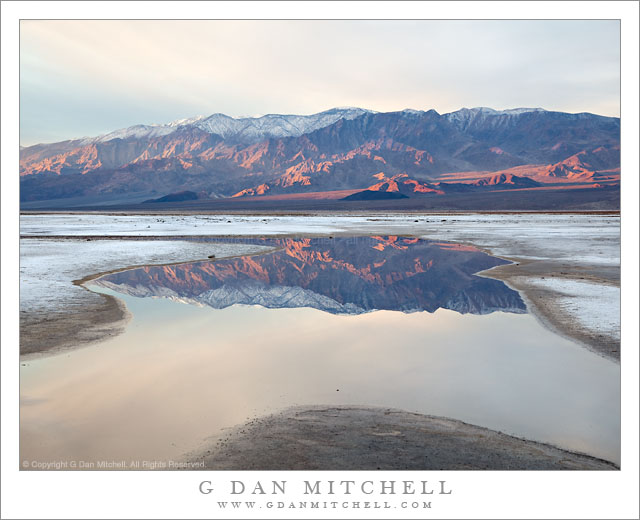
Desert Pool, Panamint Range, Morning. Death Valley National Park, California. February 21, 2011. © Copyright G Dan Mitchell – all rights reserved.

A salt spring pool on the salt flats in Death Valley reflects winter dawn light on the east face of the Panamint Range.

Sometimes I hear people describe how they think or imagine that landscape photography is done, and I wonder where they get their ideas. I will acknowledge that there are many ways to shoot landscape, ranging from working very slowly and carefully to produce a single image, to shooting like crazy and seeing what you end up with. But often people dismiss approaches closer to the latter and assume that the former is the “right way” to shoot landscape.

In my experience it isn’t quite that simple. Sometimes the experience is like certain others in which long stretches of time during which one seemingly accomplishes nothing or perhaps just looks and thinks are suddenly followed by quick and intense spurts of work that come almost as a surprise and may be over as quickly as they begin. This little morning shoot in Death Valley along the edge of a the salt/mud flats where the water from a small salt spring spreads across the flats and forms shallow pools was one of these. Very early in the morning, well before dawn, it was difficult to know what the best shooting option might be. There were clouds in the sky that promised to block the dawn light and everything seemed gray and flat. I wandered a bit, not sure where or what to shoot, and finally, more or less by chance, ended up at this spot that I had visited earlier on this trip. It occurred to me that even if the light wasn’t great I could possibly find a photograph that included this water. So I stopped and began to unpack in no particular hurry.

As I walked across the wash toward the area of the spring, much to my surprise it began to appear that there might be some interesting dawn light after all. I quickened my pace and headed toward the area of the shallow pools, and when I arrived there a moment later I could see some color on the top of the Panamint range. I quickly found a decent foreground pool and as the surprising light worked its way down the front of the range I began photographing. I first made several exposures at much shorter focal lengths, including a larger portion of the sky and the foreground. Then I quickly moved the tripod to place this pool in the center of the frame and hold the reflection of the range. I had little time to contemplate as the light was changing very quickly. I had just enough time to find my composition and make a few exposures, and within moments the light was gone.

G Dan Mitchell Photography | Flickr | Twitter | Facebook | Email
Text, photographs, and other media are © Copyright G Dan Mitchell (or others when indicated) and are not in the public domain and may not be used on websites, blogs, or in other media without advance permission from G Dan Mitchell.
Morning Sky Reflected in Desert Stream

Morning Sky Reflected in Desert Stream

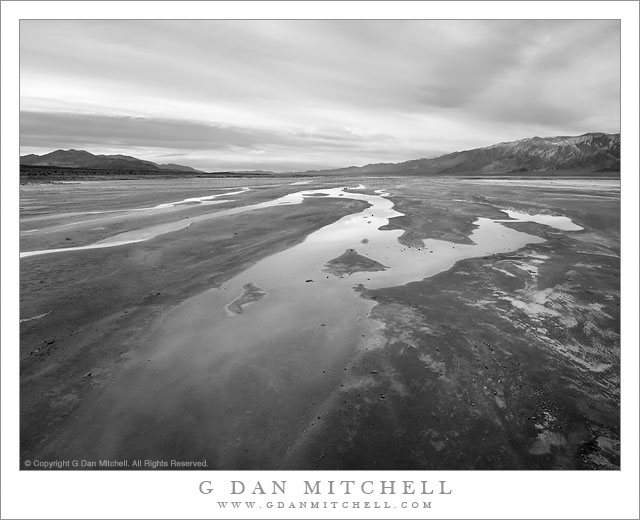
Morning Sky Reflected in Desert Stream. Death Valley National Park, California. February 21, 2011. © Copyright G Dan Mitchell – all rights reserved.

Black and white photograph of water from a salt spring reflecting cloudy morning sky above Death Valley.

Moments before I made this stark and, I think, desolate photograph of the shallow stream from a salt spring flowing slowly over the flats of Death Valley and reflecting the light from morning clouds, the Panamint Range mountains at the left side of the frame had been briefly lit by colorful sunrise light. But this light lasted only a couple minutes and shortly everything went largely gray.

The patterns of the very shallow and slowly flowing water as they spread out across the flats and reflected the light from the cloud filled sky intrigued me as soon as I arrived at this location. But before I made this photograph I had taken a different approach, positioning the camera down very low and very close to the water so that its reflective surface filled a larger portion of the frame and then lining things up to catch the first light on the Panamints and its reflection. But when that passed so quickly, it seemed like the flat and gray effect could also make an interesting photograph. When I made the exposure I wasn’t quite certain, but I think I was leaning towards a black and white rendition of the scene. Frankly, there wasn’t a lot of color to work with! The sky was mostly clouded over, though there was a hint of faded blue in a few spots. Any color in the Panamints was muted by the distance and haze. The mud is essentially gray and white (where salt has formed) and the water held less color than the sky!

G Dan Mitchell Photography | Flickr | Twitter | Facebook | Email
Text, photographs, and other media are © Copyright G Dan Mitchell (or others when indicated) and are not in the public domain and may not be used on websites, blogs, or in other media without advance permission from G Dan Mitchell.