
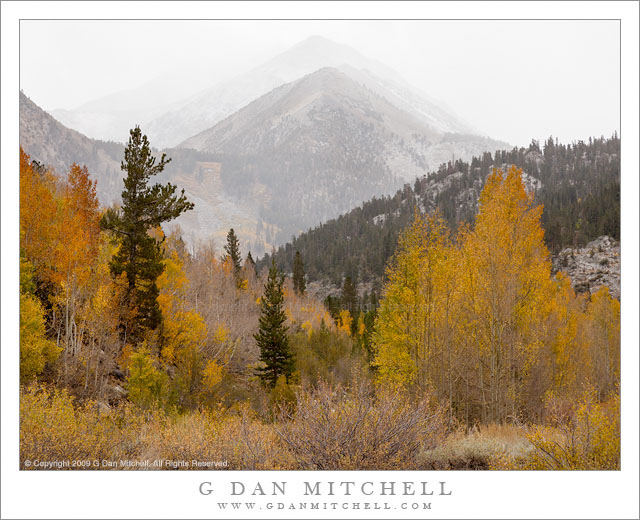
Snow Flurries, Bishop Creek

Snow Flurries, Bishop Creek

Snow Flurries, Bishop Creek. Sierra Nevada, California. October 4, 2009. © Copyright 2009 G Dan Mitchell – all rights reserved.

Light autumn snow falls on peaks above aspen groves along the South Fork of Bishop Creek

This is a photograph from a wonderful, short trip into the eastern Sierra about five years ago. I believe that I made two trips to the “east side” that fall to photograph aspens, and on this one (the first of the two) I had a couple of days of winter-like weather with clouds and snow. This could put a damper on photography… unless you share my fascination with “interesting” weather, in which case it seems like that best thing that could happen.

I came back from this trip with some very special photographs, mostly because I ran into conditions that were not quite so typical for Sierra autumn. The most typical Sierra day at this time of year starts cold but then becomes warm and sunny with the beautiful autumn light. I love those days, but I’ve seen enough of them to like some variety, too. And that’s what I got on this trip. On one morning it was so cloudy up high that I decided to drive down out of the range and shoot back up towards in the broken light of a stormy dawn. On this day I headed back up toward the high country and photographed aspen color against a backdrop of mountain peaks disappearing into snow showers.


G Dan Mitchell is a California photographer and visual opportunist whose subjects include the Pacific coast, redwood forests, central California oak/grasslands, the Sierra Nevada, California deserts, urban landscapes, night photography, and more.
Blog | About | Flickr | Twitter | FacebookGoogle+ | 500px.com | LinkedIn | Email

Text, photographs, and other media are © Copyright G Dan Mitchell (or others when indicated) and are not in the public domain and may not be used on websites, blogs, or in other media without advance permission from G Dan Mitchell.
Photographic Myths and Platitudes — ‘Landscape Photography Lenses’ (Part II)

(The “Myths and Platitudes” series of posts concerns common photographic beliefs that may be open to question. This article has been updated periodically.)

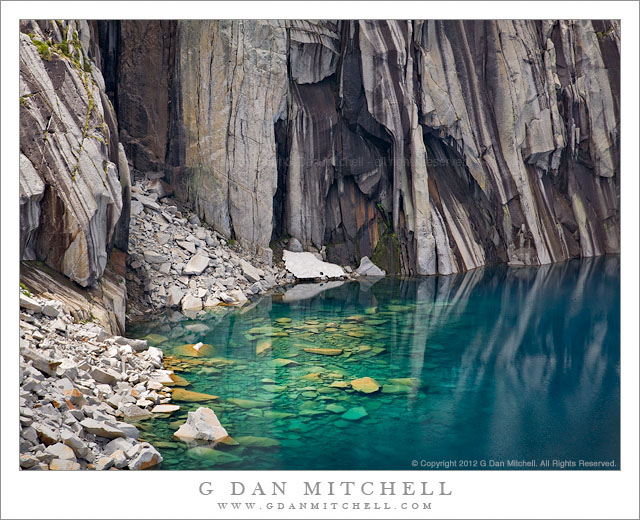
Submerged Boulders, Lake, and Cliffs

Recently a reader asked about lenses for landscape photography. As part of my reply (see “Landscape Lenses” in my “reader questions” series) I referred him to the older article on landscape lenses: .”Photographic Myths and Platitudes – ‘Landscape Photography Lenses’ (Part I).” In doing so I realized that “Part I” had been written way back in 2009, and that Part II was long overdue! (And… in the years since I originally wrote that article, parts of it have also needed updating.)

The myth or platitude that I left out of  part I is a perennial one: Primes lenses are best  for landscape photography. Given how often this comes up, it might seem surprising that I didn’t write about it sooner, but I put off dealing with it for several reasons. It can become a very big subject. Not everyone cares, since today most photographers have moved happily to zooms. The “primes are best” notion has been cherished by some for a long time. It is a subject about which folks can become quite passionately partisan, perhaps in part because it is one of the gear issues that lend themselves to technical arguments, or because lens choices can be a way to try to align oneself with certain approaches to landscape photography.

We often hear arguments for using prime lenses in landscape photography that include the following:

  • Primes can produce higher resolution
  • Primes may better control certain kinds of image distortion
  • Using primes will slow you down and make you think more about your photography. (Conversely, using zooms will make you lazy.)
  • Great landscape photographers have relied on primes for a long time.
  • Primes provide some features that aren’t available from zooms

Before dealing with the question, let me reveal my own background and point of view.

Continue reading Photographic Myths and Platitudes — ‘Landscape Photography Lenses’ (Part II)

Reader Questions: Landscape Lenses

From time to time I get questions from readers, and I usually like to share the answers so that other might learn something, too.

Recently “Gregory” wrote:

I just read one of your articles on appropriate lenses to use for landscape photography. I’m a hobbyist photographer in California that has a passion for landscape photography. I sold my Canon equipment and will be purchasing some Nikon lenses and camera body. I wanted to get your input as to what the majority of landscape photographers use – prime lenses or zoom lenses? Based on my limited budget, here is what I am thinking of:

Option A — Primes: 20mm, 28mm, 50mm, 85mm
Option B — Zooms: 24-70mm, 70-200mm
Option C — Zooms: 16-35mm, 24-70mm

I don’t have the budget to purchase both a super wide zoom AND a telephoto. I’ll have to settle for one of these and then acquire an additional zoom later on. I’m thinking the primes maybe slightly sharper in the borders and lighter to carry, but what about the hassle of constantly switching lenses back and forth? Not sure I want to do this. I would appreciate any recommendations/suggestion you might have.

Before I reply here, let me share a couple of articles that I wrote about more or less this topic:

By the end of this article… I probably will not tell you which lenses to select! But perhaps I’ll help you consider factors that will assist in making a good personal decision that is right for your photography.

To a great extent, many of these decisions are personal and they come down to your own personal preferences and the ways in which you approach your subjects. Some people have reasons for preferring prime lenses, some have reasons for preferring zooms, and others have good reasons for wanting both. Some are comfortable working with a relatively narrow range of focal lengths, while other feel the need for a wider range. Some have a predilection for wide-angle lenses, while others are drawn to longer focal lengths. And this doesn’t even get into the questions about tilt/shift lenses and other variables.

I mention this for a couple of reasons. First, there are going to be people who disagree with my preferences — listen to their perspectives, too, and then use your own judgment. Second, consider your own preferences at least as much. Continue reading Reader Questions: Landscape Lenses

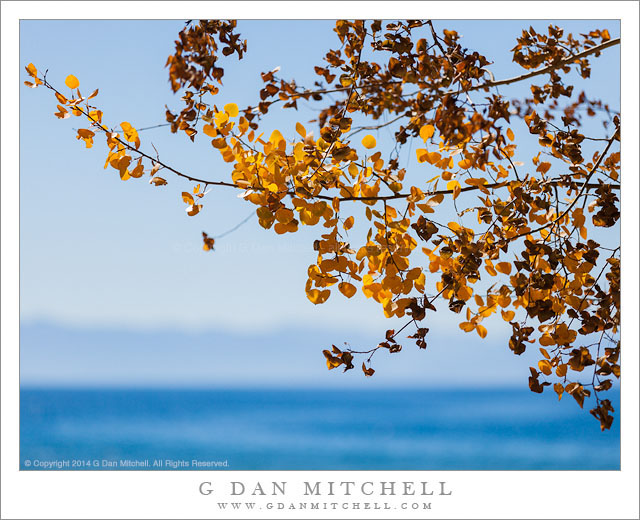
Autumn Leaves, Tahoe Shoreline

Autumn Leaves, Tahoe Shoreline

Autumn Leaves, Tahoe Shoreline. Lake Tahoe, California. October 9, 2014. © Copyright 2014 G Dan Mitchell – all rights reserved.

Colorful autumn leaves along the northern shore of Lake Tahoe, California

As part of a project that I’m working on I spent a few days photographing and exploring in the greater Lake Tahoe area in early October. I’ve gone to Tahoe for years, but mostly in the winter for cross-country or Telemark skiing or in the summer for family trips, back when we would occasionally get a cabin up there. Oddly, my experience with the lake in the fall was almost nonexistent.

So this trip was part of a process to fix that omission. I spent time in some of the surrounding areas where there can be some spectacular autumn color and I spent one full day circumnavigating the lake. It was on that day that I paused at the north end of the lake, just inside the California border, to photograph these colorful trees against the deep blues of the sky, mountains, and lake.


G Dan Mitchell is a California photographer and visual opportunist whose subjects include the Pacific coast, redwood forests, central California oak/grasslands, the Sierra Nevada, California deserts, urban landscapes, night photography, and more.
Blog | About | Flickr | Twitter | FacebookGoogle+ | 500px.com | LinkedIn | Email

Text, photographs, and other media are © Copyright G Dan Mitchell (or others when indicated) and are not in the public domain and may not be used on websites, blogs, or in other media without advance permission from G Dan Mitchell.

Photographer and visual opportunist. Daily photos since 2005, plus articles, reviews, news, and ideas.