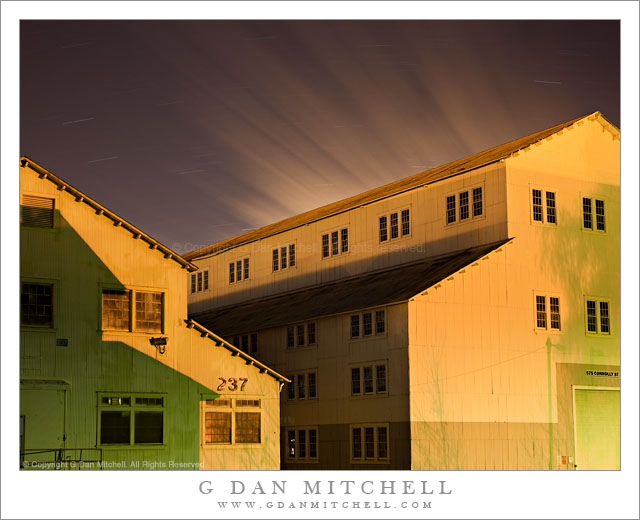
Yellow Buildings, Shadows, Moving Clouds – Night photograph of two large yellow buildings, shadows, and streaks for clouds moving across the sky above the Mare Island Naval Ship Yard, California.*
Recently I was part of a conversation about photography, focused on some technical questions about equipment, in which one participant sought to define the issue by writing that you are only has good as your poorest picture.
Simple and direct sayings like this one may have the virtue of quickly clarifying an important concept or truth and (something I could learn more about!) doing so in few words. Unfortunately, there are often downsides, too. Because they are so declamatory, it is easy for some people to simply accept them without thinking. Being simple, they often don’t fit all cases. And sometimes they are just plain wrong.
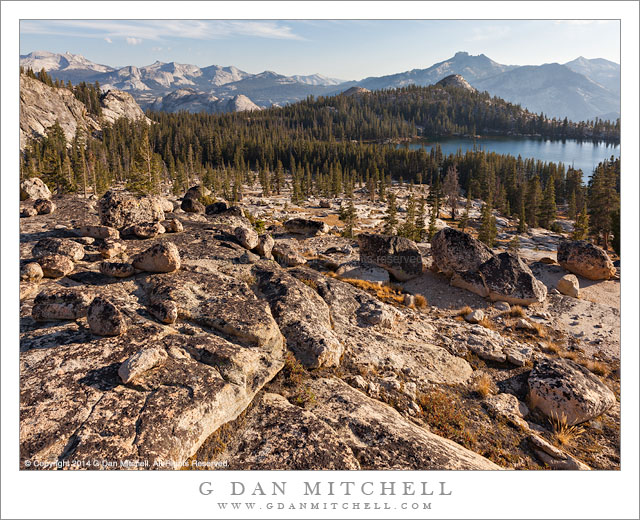
View of rugged northern Yosemite terrain of forest, lakes, and peaks, as seen from the top of a glaciated granite ridge
I went exploring on this evening, checking out the spine of this glaciated granite ridge above the lake where we were camped. It was only a short walk, first along the forested shore of the lake, then up the gradual incline of smooth granite benches and over a few bits or broken terrain to the top. This wasn’t the highest point around, but it was high enough, and it was full of trees that would catch the evening light as the day came to an end.
This is quintessential high Sierra scenery. Underfoot is glaciated granite, topped with glacial erratic rocks and boulders left behind when glaciers retreated from this area thousands of years ago. The granite has weathered, and where sand and plant material collect in pockets and cracks plants have managed to take hold, ranging from small grasses to rugged trees. Below the granite ridge the soil is thicker and forest trees grow around a subalpine lake. The terrain drops off into the canyon of the Tuolumne River on the other side of the lake and in the distance are the high, alpine peaks of the Cathedral Range.
G Dan Mitchell is a California photographer and visual opportunist whose subjects include the Pacific coast, redwood forests, central California oak/grasslands, the Sierra Nevada, California deserts, urban landscapes, night photography, and more. Blog | About | Flickr | Twitter | Facebook | Google+ | 500px.com | LinkedIn | Email
Proof that I have to be able to laugh at myself sometimes… I spent 10 days photographing in the Yosemite backcountry at the beginning of this month. At one of the locations we visited there is a large and beautiful granite bowl with tons of potential photographic subjects. At one point I was high on a ridge above the bowl, photographing small features in late-day light, including exfoliated granite slabs, tiny trees growing from narrow cracks, colorfully stained rock, and more.
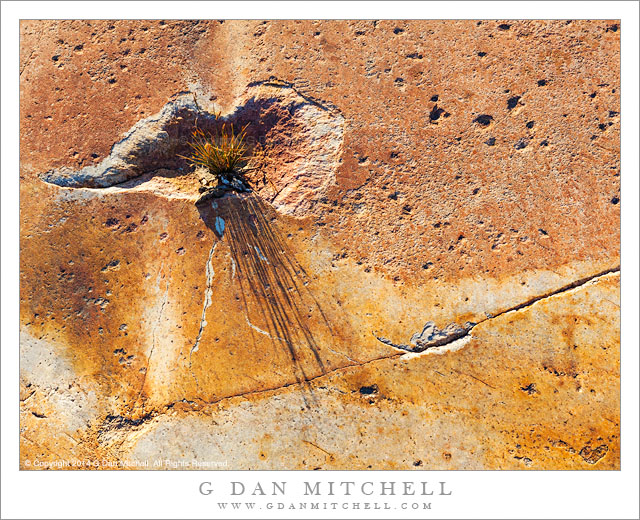
Partway through the evening’s work I found a little divot in the granite, in which a small clump of grass grew. It was surrounded by colorfully stained and glacially polished granite, with interesting cracks and texture cutting through it at various angles. The low angle sun raked across the short clump of grass and created a shadow that stretched across the granite surface. It seemed like an obvious photograph of the “intimate landscape” type, and I spent some minutes working it and making a series of photographs in both portrait and landscape orientation, and trying various crops of this little scene.
Although I had admired the file earlier while scanning through the hundreds of images I brought back from this trip, it wasn’t until today that I finally got to it for serious post-processing work. I opened it up, converted the raw file, brought it into Photoshop and began to work on it. I liked those angles angled cracks and the intense color of the stained rock, and the short blades of grass cast shadows across the polished granite in just the way I remembered.
But wait, what is that lumpy shadow below and to the left of the grass? NOOOOO! There is a marmot turd in the little cleft in the rock! You’d think that Your Intrepid Photographer might have seen that while composing the shot, but no…
Morning Musings are somewhat irregular posts in which I write about whatever is on my mind at the moment.
G Dan Mitchell is a California photographer and visual opportunist whose subjects include the Pacific coast, redwood forests, central California oak/grasslands, the Sierra Nevada, California deserts, urban landscapes, night photography, and more. Blog | About | Flickr | Twitter | Facebook | Google+ | 500px.com | LinkedIn | Email
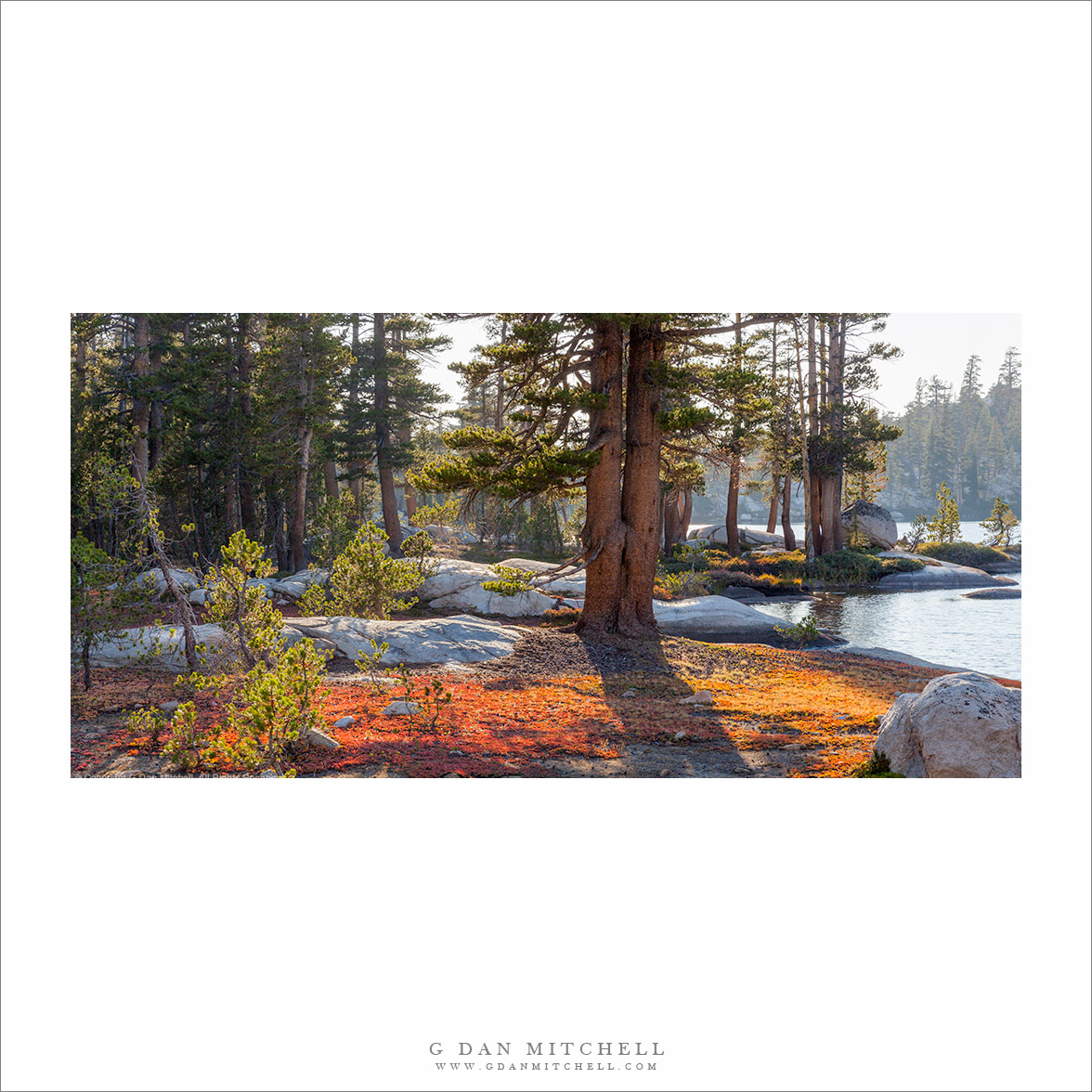
“Late Season Shoreline” — Brilliant late-season red bilberry carpets shoreline meadows around a Sierra Nevada lake, Yosemite National Park
As I have written elsewhere on more than one occasion, every August I begin to pay attention to hints that summer will end and that autumn is on its way. Early in the high country summer everything is in a state of rapid change — plants are in a hurry to take advantage of a short growing season and the availability of runoff water, and that water itself flows everywhere. After the explosion of early season growth and the production of flowers and cones things slow down, and at some point in August a feeling of quiet and stability begins to take hold.
The hints of change that I look for range from almost immaterial — a feeling about the sound of wind or the angle of light — to quite objective. In the latter category are changes that occur in the cycles of plant life. Corn lily plants change from green to yellow and gold and then to brown, and topple over. A few yellow leaves begin to appear on willows and even the aspens. But one of the strongest signs for me is the appearance of the red bilberry leaves in clear areas in the forest and near the edges of lakes. While the autumn bilberry leaves do not appear to be all that colorful in regular light, when backlit they turn the ground a gaudy range of colors from yellow and gold to bright red.
COMMENT OR QUESTION? Scroll down to the comment form.