
Sierra Nevada Trees And Granite

Sierra Nevada Trees And Granite
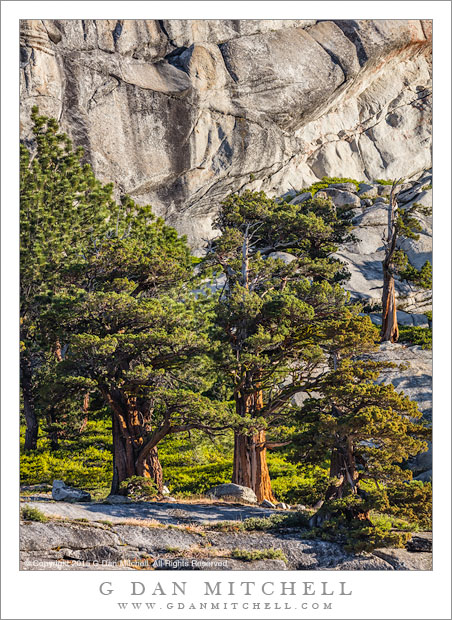
Trees grow at the base of a granite face, Yosemite National Park

Sierra Nevada Trees And Granite. Yosemite National Park, California. July 14, 2015. © Copyright 2015 G Dan Mitchell – all rights reserved.

Trees grow at the base of a granite face, Yosemite National Park

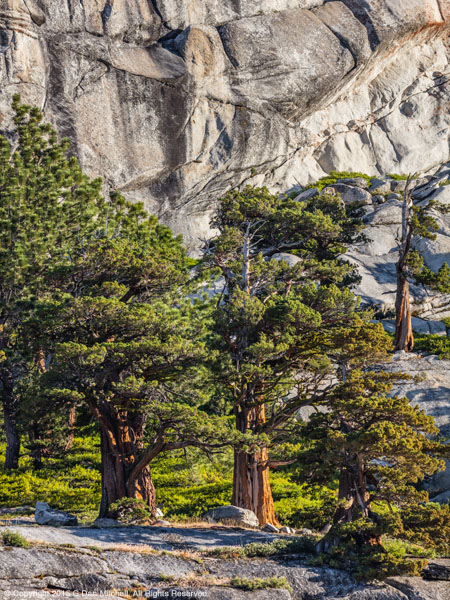
I originally worked up this photograph for an article on the relationship between supposed realism in photographs and post-processing. (“Photographs And Reality: A Complicated Relationship”) I selected it because the scene posted a particular common challenge, namely a dynamic range that was wider than the typical dynamic range of presentation media, and because capturing the full scene required me to make some exposure decisions that intentionally produce an original “straight out of camera” image that wasn’t lovely, but which protected the scene data I would need to work with the photograph in post.

The subject is a group of large-trunk trees growing on granite slabs at the base of a Yosemite high country granite dome. This landscape — more or less the landscape of much of Yosemite — is interesting in so many ways. Here the trees seem to somehow grow out of little more than cracks in solid granite, and shortly beyond where they stand the rock becomes too steep and too solid to support more large trees. While such scenes can be found throughout the park and in many more inaccessible areas, this one is right alongside Tioga Pass Road!


G Dan Mitchell is a California photographer and visual opportunist. His book, “California’s Fall Color: A Photographer’s Guide to Autumn in the Sierra” is available from Heyday Books and Amazon.
Blog | About | Flickr | Twitter | FacebookGoogle+ | LinkedIn | Email


All media © Copyright G Dan Mitchell and others as indicated. Any use requires advance permission from G Dan Mitchell.
Photographs and Reality: A Complicated Relationship

Over the past few weeks the arguments about “photoshopping” and “manipulation” have again come to the fore, this time as the result of the so-called “scandal” around alterations to some photographs by Steve McCurry. The discussions have evolved in all sorts of ways — as they typically do — some of which I regard as unfortunate: pronouncements about which techniques are “ethical” or “unethical,” declarations that photographs must be “true,” the usual stuff about “getting it right in the camera,” and more. In my view, much of this is naive and unrealistic.

Sierra Nevada Trees And Granite

At the heart of the issue are some problematic notions, including the following.

  • The camera sees accurately, and any modification of what comes out of the camera subverts the camera’s truth. Some assume that the way the machine “sees” is more accurate than the way our eyes and brains see, and that it is the preferred mode of seeing. There are huge problems with this assumption, beginning with the fact that people and cameras see in very different ways. (I’m more interested in how people see.) The eyes scan a scene, adapting to localized elements of the subject, and the full image never exists aside from a kind of mental abstraction of it. The camera non-selectively records light levels from the entire scene at one instant, all with the same “settings.” There’s much more to this, and the subject is far too big to fully deal with here. Suffice it to say that your eyes/brain are not a camera, and this makes a very big difference.
  • Modifying photographs in post-production (or  “post”) makes them less honest and accurate. Some think that modifying what comes from the camera is dishonest. In fact, if the way that humans see is our model for accurate seeing, as I believe it should be, the way the camera sees is often quite inaccurate. (Who sees in black and white or telephoto or with tilt/shift adjustments or with colored filters or constrained to rectangles?) In order to render an image that is more faithful to the way humans see, it is often necessary to massage the image that comes from the camera.
  • The use of techniques for “manipulating” or “photoshopping” photographs is unethical. Some take the position that “manipulating” images is wrong, but it seems absurd to make such a blanket statement. If your photograph was slightly underexposed, how is it unethical to increase the brightness in post so that it looks exactly as it would have looked with a slightly longer exposure? How can it be OK to use a telephoto lens but not OK to crop in post? Why would it be OK to use a tilt/shift lens but not to adjust perspective lines in post? Are the “rules” the same for photojournalism and for photographic abstractions?

People often want to see this set of issues as a binary, where things are either right or wrong, but it is nothing like that at all.

Before I offer an example, I would like you to try an exercise — and doing it and considering the results is very important for understanding what follows. Go look at some subject in the bright sun that includes some shadows. As you do, look at the brightest areas in the scene, and consider whether you can see any details, however faint, in those brightest areas. You should be able to. Now shift your gaze to a shaded area. You should be able to see some detail there, too. (Your pupils likely closed down a bit when you looked at the bright area — in photographic terms, you used a smaller aperture — and they likely opened up a bit when you looked at the shadow area.)

This presents a classic photographic problem. Virtually no digital camera and no film can handle the widest dynamic ranges of common scenes that we photograph. Producing a realistic photograph of such scenes requires “manipulation,” and without it the scene will not correspond at all to what we see.  Continue reading Photographs and Reality: A Complicated Relationship

Sierra Shoreline

Sierra Shoreline
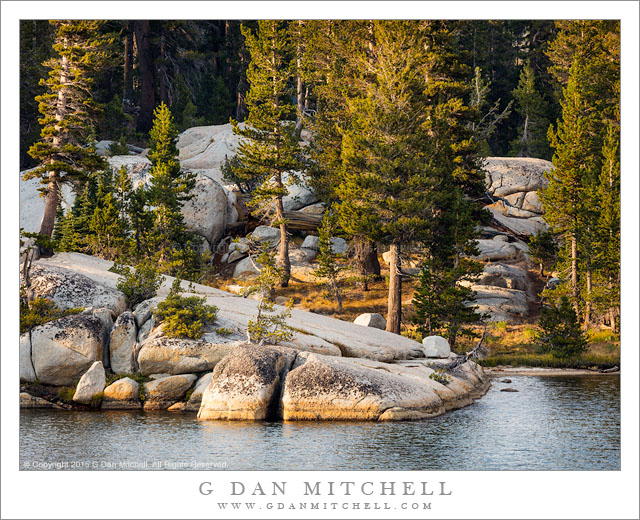
Forest and granite boulders at the water’s edge, subalpine Sierra Nevada lake

Sierra Shoreline. Yosemite National Park, California. September 9, 2015. © Copyright 2015 G Dan Mitchell – all rights reserved.

Forest and granite boulders at the water’s edge, subalpine Sierra Nevada lake

I’m looking backwards and forwards with this photograph. Backwards to a visit of more than a week to a Yosemite backcountry lake with a couple of photographer friends near the end of last year’s summer season — a season that brought another year of drought and tremendous wildfires. All of that aside — but, boy, did we deal with wildfire smoke! — we had a beautiful period of late season light on many days, and a few days of rain from an early season storm near the end.

And I’m looking forward… to getting back into the summer Sierra before too much longer. Spring has been quite busy since our last big adventure, a visit to Death Valley back at the end of March, and aside from bird photography and a few odd trips here and there, well, it is really time to get back into the field for a more extensive period. Tioga Pass Road has now been open for a couple of weeks, and the High Sierra awaits. I hope to be back there soon, and back at places like this one and it this high country light.


G Dan Mitchell is a California photographer and visual opportunist. His book, “California’s Fall Color: A Photographer’s Guide to Autumn in the Sierra” is available from Heyday Books and Amazon.
Blog | About | Flickr | Twitter | FacebookGoogle+ | LinkedIn | Email


All media © Copyright G Dan Mitchell and others as indicated. Any use requires advance permission from G Dan Mitchell.
Dunes, Before the Sun

Dunes, Before the Sun
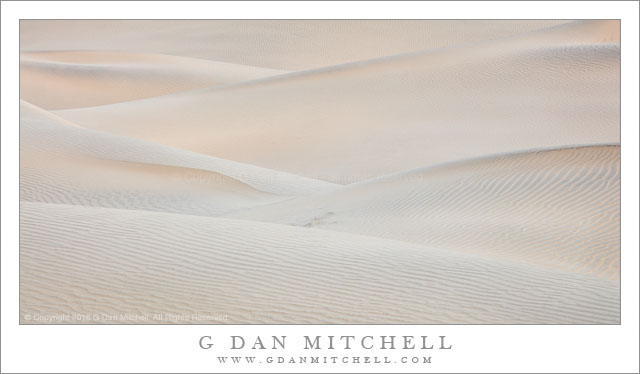
Sand dune shapes in soft light, Death Valley National Park

Dunes, Before the Sun. Death Valley National Park, California. March 31, 2016. © Copyright 2016 G Dan Mitchell – all rights reserved.

Sand dune shapes in soft light, Death Valley National Park

There are still a few more photographs to share from this year’s spring visit to Death Valley National Park back at the end of March. To answer the inevitable question, we arrived after the peak of the “super bloom” — but there were still flowers and there are always plenty of other things to see. We visited some familiar sites and sights, and we also investigated some areas that were new to us. (It is a big park — even though I’ve been going regularly for over 15 years there is still plenty of new thing stuff to see.)

On the last morning of our trip, after days featuring wind and dust storms and even rain, it appeared to be calm. I got up well before dawn — what else is new? — and headed to a nearby area of dunes. Rather than going to the “usual spot,” I drove on to a location that I had been thinking of for a while, parked, loaded up my pack full of camera gear, grabbed my tripod, and headed out the pre-dawn light across a playa, heading toward some low dunes. Twenty or thirty minutes later I arrived, still before sunrise, and I had some time to photograph in the beautiful soft pre-dawn light.


G Dan Mitchell is a California photographer and visual opportunist. His book, “California’s Fall Color: A Photographer’s Guide to Autumn in the Sierra” is available from Heyday Books and Amazon.
Blog | About | Flickr | Twitter | FacebookGoogle+ | LinkedIn | Email


All media © Copyright G Dan Mitchell and others as indicated. Any use requires advance permission from G Dan Mitchell.
Photographer and visual opportunist. Daily photos since 2005, plus articles, reviews, news, and ideas.