
Tag Archives: 20 mule team

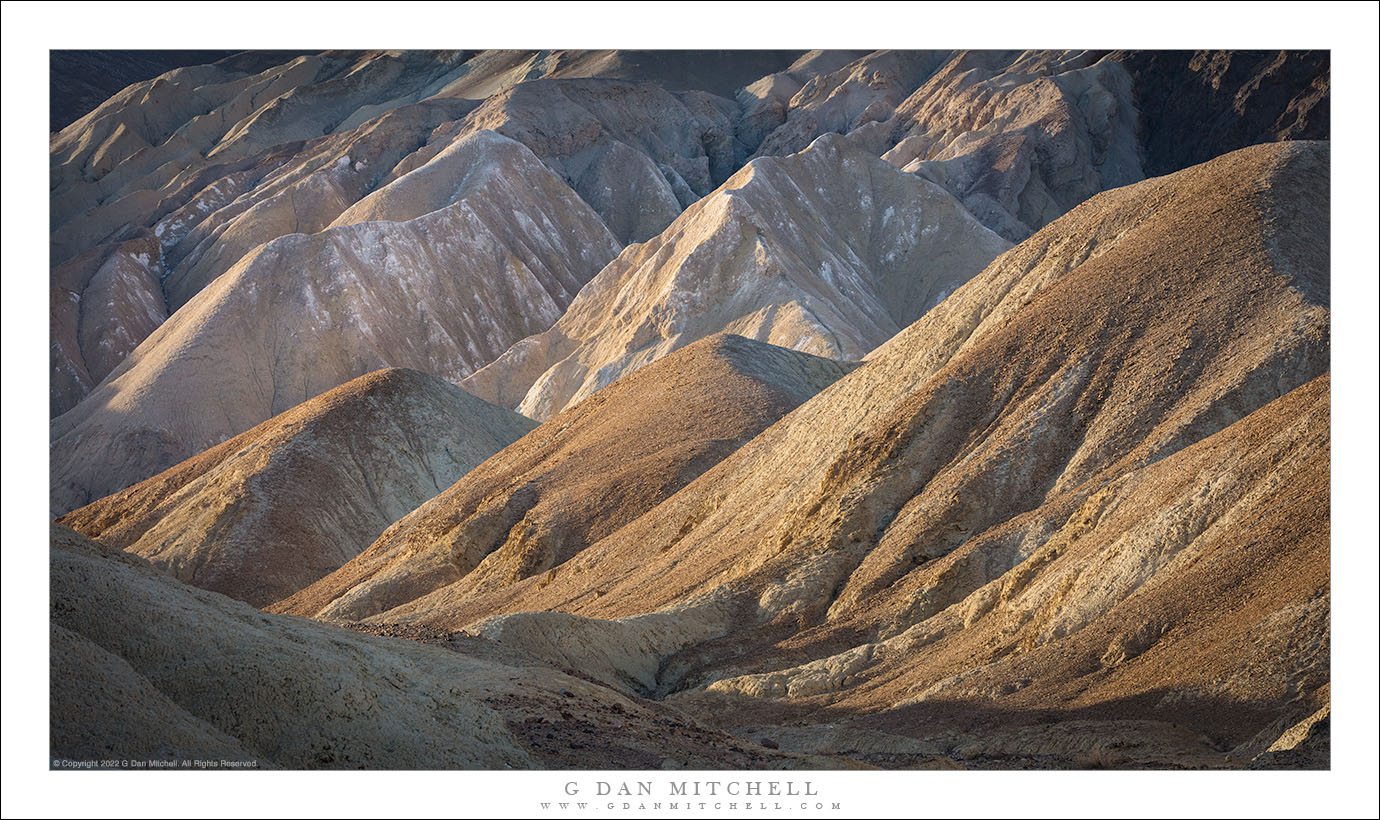
Badlands Valley

Badlands Valley
A small wash passes beneath badlands terrain in morning light, Death Valley National Park.

Badlands Valley. © Copyright 2022 G Dan Mitchell.

A small wash passes beneath badlands terrain in morning light, Death Valley National Park.

There is a lot going on in this photograph of the Death Valley National Park landscape. Early morning light is coming from behind and to the left of the camera position and striking the eroded landforms from the side. Although it is sometime after dawn, it is early enough that the light still has a warm, post-sunrise color. All of the complex structures in the scene are interconnected — they all drain toward the desert wash at the bottom of the frame.

More than almost any other landscape that I know, the appearance of the desert changes radically depending on the direction, quality, and color of the light. I have sequences of photographs made over a half-hour period in which the transition is striking. At first, before dawn, the light is soft and blue-toned. At first light it may become intensely colorful if the sunrise cooperates. A half hour later the color fades toward that familiar desert midday harshness.


G Dan Mitchell is a California photographer and visual opportunist. His book, “California’s Fall Color: A Photographer’s Guide to Autumn in the Sierra” is available from Heyday Books, Amazon, and directly from G Dan Mitchell.

Blog | About | Flickr | FacebookEmail

Links to Articles, Sales and Licensing, my Sierra Nevada Fall Color book, Contact Information.

Scroll down to leave a comment or question. (Click this post’s title first if you are viewing on the home page.)


All media © Copyright G Dan Mitchell and others as indicated. Any use requires advance permission from G Dan Mitchell.
Canyon and Strata

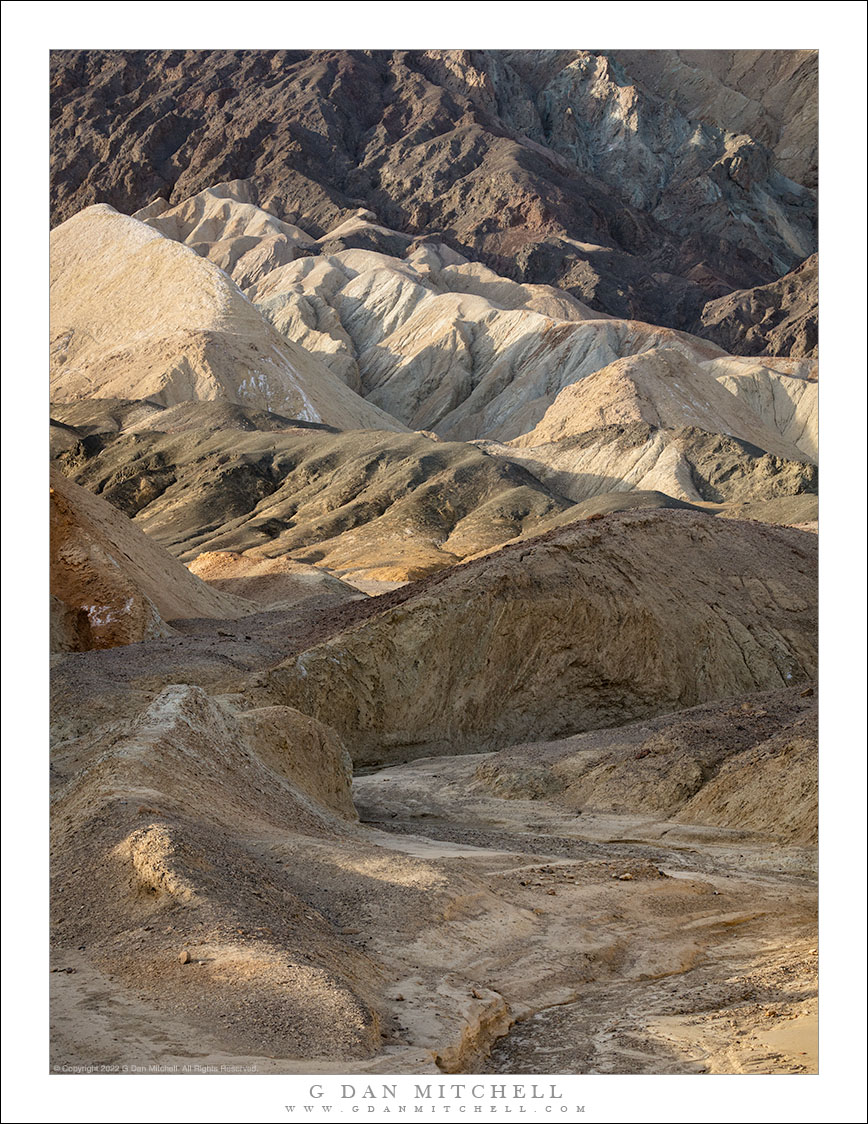
Canyon and Strata
A desert wash in a winding badlands canyon leads toward contrasting strata, Death Valley National Park.

Canyon and Strata. © Copyright 2022 G Dan Mitchell.

A desert wash in a winding badlands canyon leads toward contrasting strata, Death Valley National Park.

This juxtaposition of very dark and very light layers in this badlands terrain has long fascinated me. Often the contrasts among the various layers are relatively subtle, even where obvious colors are involved — but here we see nearly the darkest forms right next to some of the lightest. The material in the foreground is perhaps closer to the typical coloration.

There is a lot to look at in terrain like this, especially when viewed from a slight elevation. In some ways the largest forms mimic and expand on the smallest. Tiny irregularities combine to produce larger versions of themselves, and then these combine to produce larger gullies, which themselves collect together to form that great washes that drain the landscape.


G Dan Mitchell is a California photographer and visual opportunist. His book, “California’s Fall Color: A Photographer’s Guide to Autumn in the Sierra” is available from Heyday Books, Amazon, and directly from G Dan Mitchell.

Blog | About | Flickr | FacebookEmail

Links to Articles, Sales and Licensing, my Sierra Nevada Fall Color book, Contact Information.

Scroll down to leave a comment or question. (Click this post’s title first if you are viewing on the home page.)


All media © Copyright G Dan Mitchell and others as indicated. Any use requires advance permission from G Dan Mitchell.
Desert Holly, Black Formation

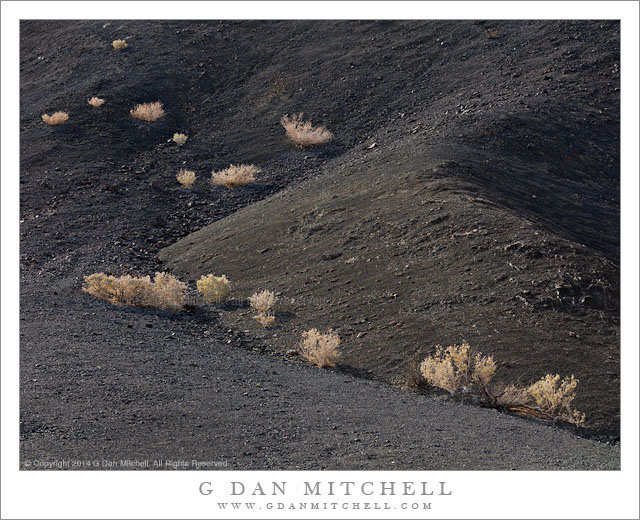
Desert Holly, Black Formation

Desert Holly, Black Formation. Death Valley National Park, California. April 3, 2014. © Copyright 2014 G Dan Mitchell – all rights reserved.

Desert Holly plants grow on a black formation, Death Valley National Park

This area of Death Valley National Park, not far from the popular Zabriskie Point overlook, shares some of the same geology with that often crowded location. However, you don’t have to go too far from that parking lot to find locations where you can be almost alone, especially early in the morning. This area is one such spot—easily accessible but not marked in any sort of obvious way. Yet it is a great place to spend hours looking at geological forms, sparse plants, and spare effects of light and color.

The desert holly plants grow in some of the most arid locations, and often appear to be the only plants that are able to survive where it grows. You might find a plant or two in a rocky wash, growing out of a crack in a rock wall, or on this dark (volcanic?) material. One can only imagine how hot this black earth must get in the heat of the Death Valley summer! Besides often being the only visible living thing in some very stark areas, desert holly also can change its appearance depending upon how the leaves are doing and on where the light comes from. Light from behind the plant can make it take on an almost golden glow.

G Dan Mitchell is a California photographer and visual opportunist whose subjects include the Pacific coast, redwood forests, central California oak/grasslands, the Sierra Nevada, California deserts, urban landscapes, night photography, and more.
Blog | About | Flickr | Twitter | FacebookGoogle+ | 500px.com | LinkedIn | Email

Text, photographs, and other media are © Copyright G Dan Mitchell (or others when indicated) and are not in the public domain and may not be used on websites, blogs, or in other media without advance permission from G Dan Mitchell.