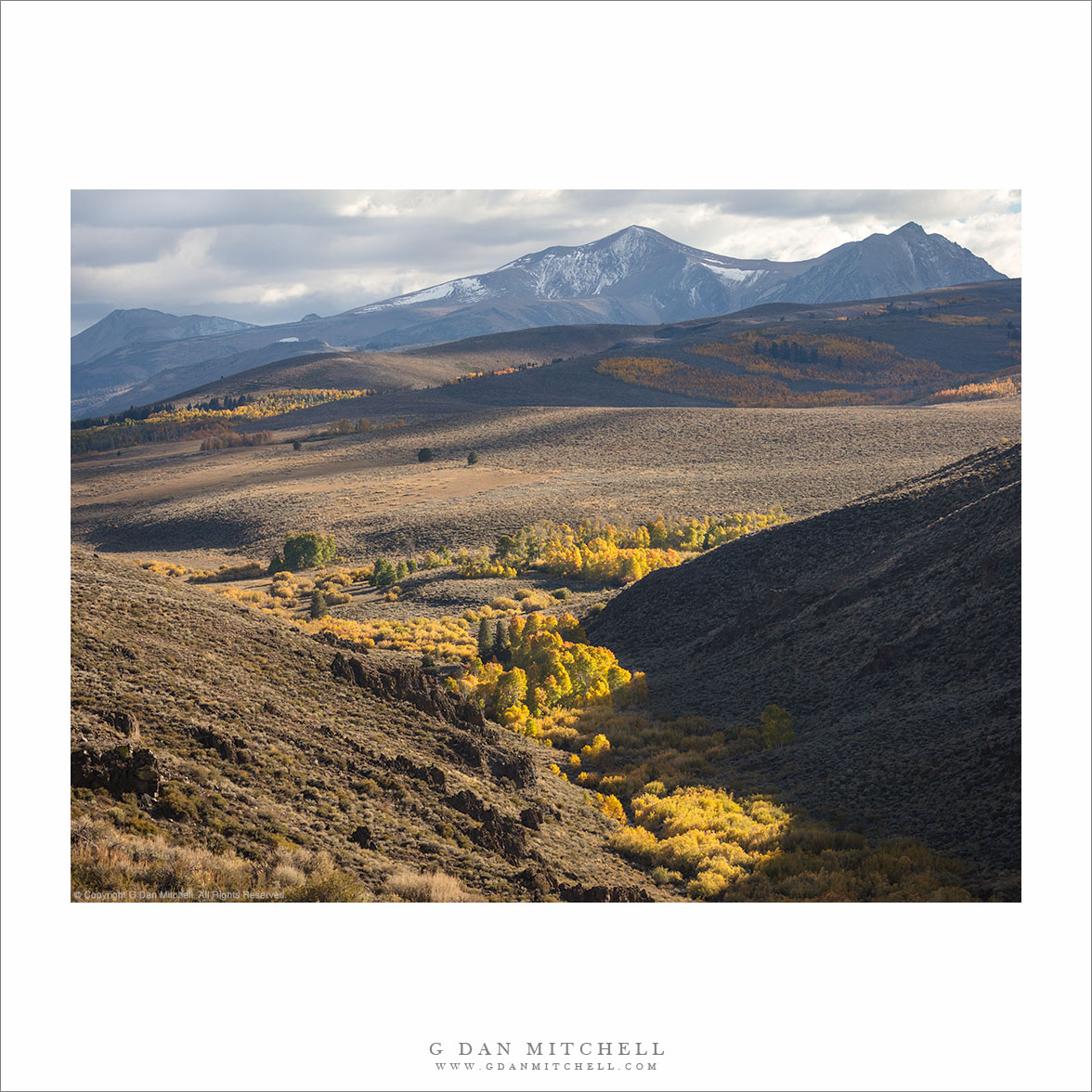
“High Desert Aspen Trees” — Aspen trees with autumn foliage ascend a high desert gully in the Eastern Sierra Nevada.
These sage-covered foothills are at an elevation of 8000′ and higher, but they are brown and dry, especially this late in the season. Technically this spot is part of the Sierra Nevada — it certainly seems so when you look at these peaks. However, it feels more like high desert than part of the mountain range.
The little grove of aspens grows in the bottom of the canyon that drains the nearby highlands. These trees were approaching their peak color, but with changing light I had to work quickly. Cloud shadows were moving across the landscape, and the shadow of the low hill at bottom right was starting to intrude on the colorful trees.
“Aspen Path” — A path winds through a grove of autumn aspen color, Eastern Sierra Nevada.
I had been thinking about photographing in this grove for two days prior to making this photograph. I had looked it over while driving past, and had even gotten out and wandered through it without taking pictures. What finally brought me back was wind — a tremendous wind storm that was making it difficult to photograph out in the open.
My first idea about this location and the wind was that I would photograph the fallen leaves. But as I entered the grove I did not see the shot I was looking for, so I kept walking. I finally came to what looked like the end of the path at the base of a tree-covered hill. Still not seeing a photograph, I turned around and started back. It was only then that I saw the glow of the backlit canopy of leaves and found this composition.
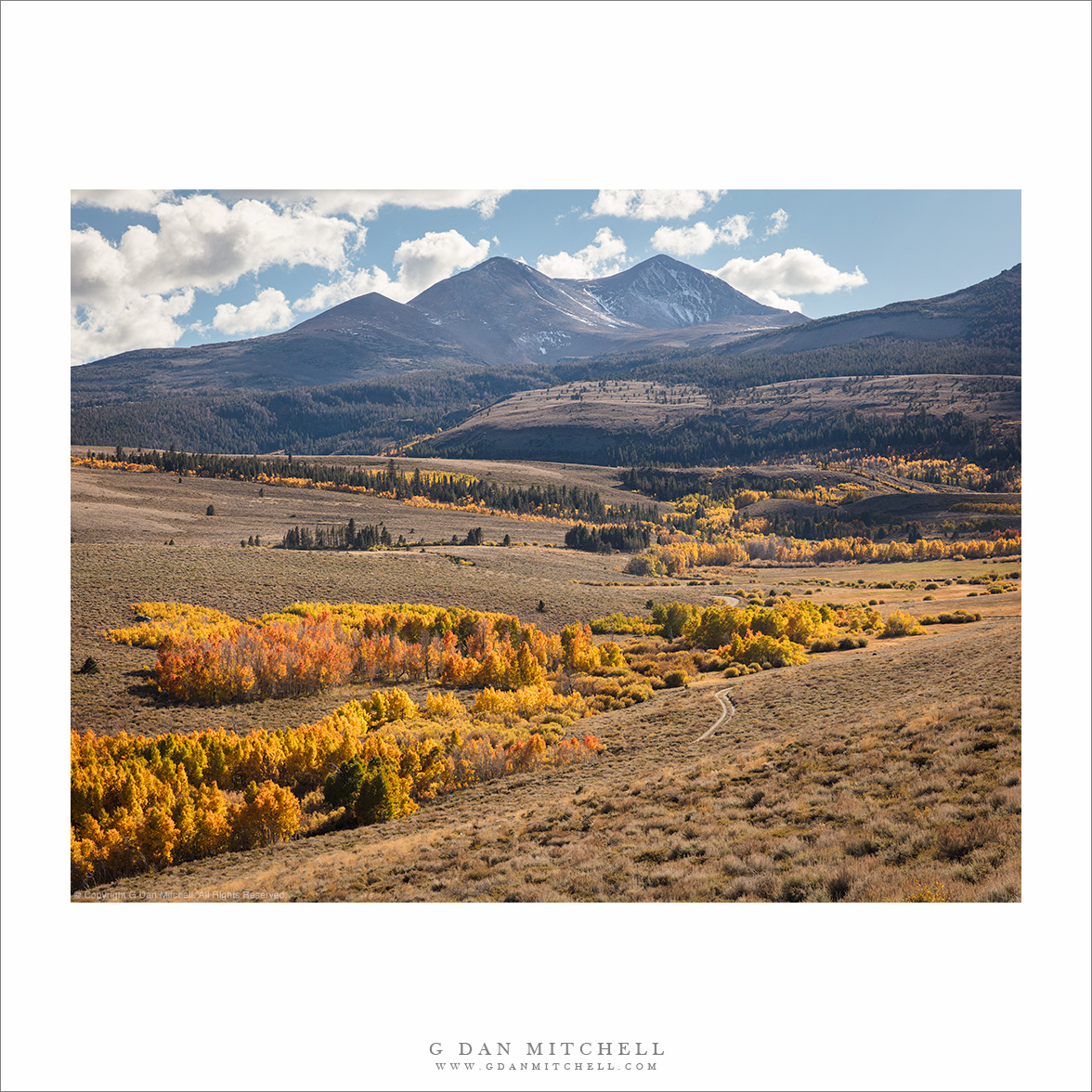
“Dunderberg Meadows” — Autumn aspen stretch across the landscape beneath Eastern Sierra Nevada peaks.
Transition zones in the mountains fascinate me — places where one sort of landscape runs into another. In this photograph from the Eastern Sierra Nevada, aspens extend across high desert sagebrush terrain and right into the lowest conifer forests. The demarcation between sagebrush and forest is fairly sudden, but the aspens live in both.
Decades ago my entire notion of the Sierra Nevada revolved around the forest and alpine zones. For that reason, and because I usually approached the range via its gentle west slope, I did not know about this high desert terrain. It is possible that the first time I encountered this zone was when exiting on the east side after a long walk in the high country — and it was a shock to me.
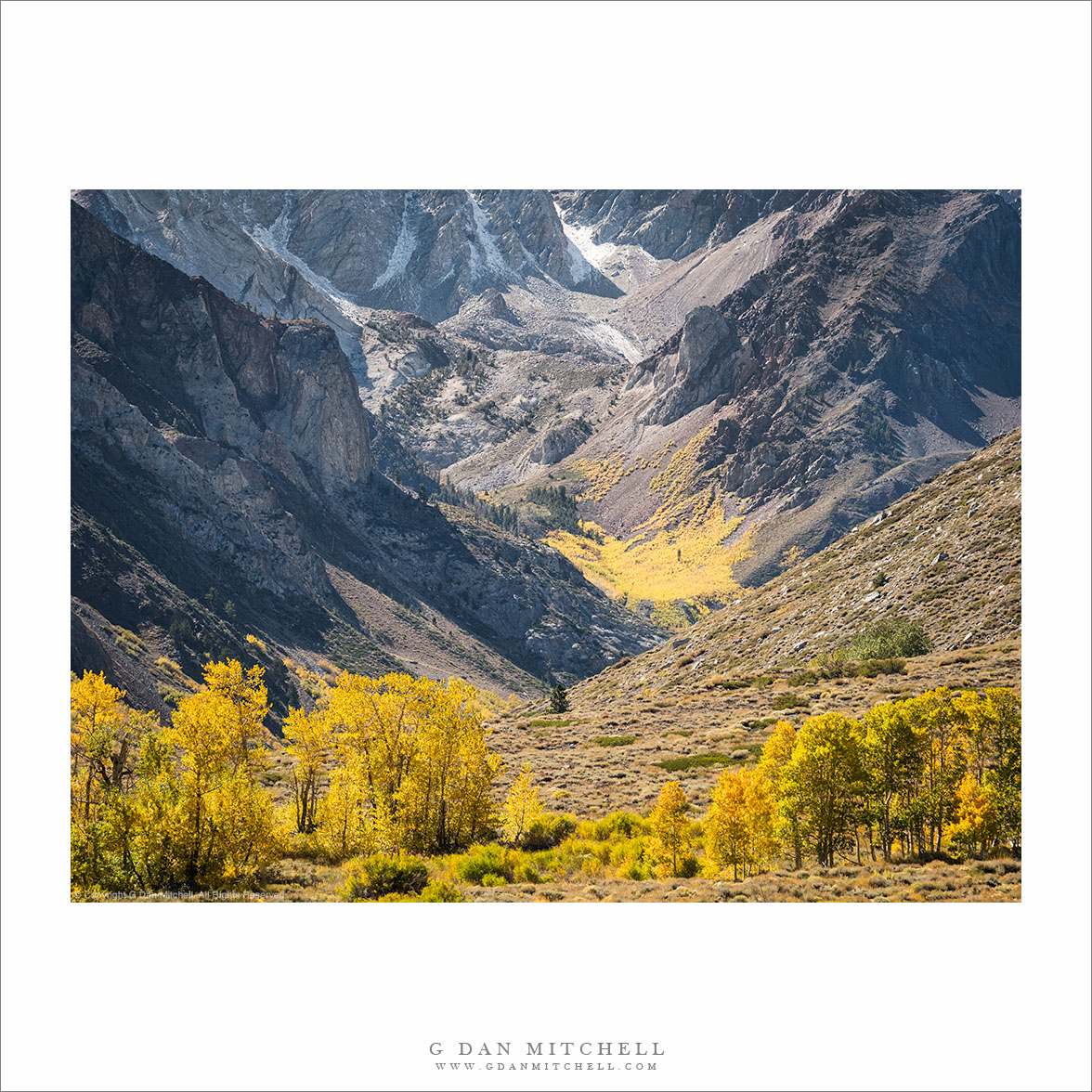
“East Side Canyon, Autumn” — An east-side Sierra canyon with autumn cottonwood and aspen trees below snow-dusted slopes.
Well, I thought that I had shared the last of this fall’s Sierra Nevada aspen photographs. But then I took another look at my raw files and decided that a few more were worth working up. This is one of a set of four in that group. It features one of the steep canyons that rise along the eastern escarpment of the Sierra. There is a row of cottonwood trees in the foreground and larger groves of autumn aspens far up the canyon.
You can’t tell from the photograph, but it was almost impossible to make pictures here doe to high winds. I had parked along a rough gravel road and was alternately making photographs and cowering behind my vehicle as gusts swept through. Between that wind storm and the snow that came in a few days later it was a tricky year for aspen photography in the Sierra.
Photographer and visual opportunist. Daily photos since 2005, plus articles, reviews, news, and ideas.
Manage Consent
To provide the best experiences, we use technologies like cookies to store and/or access device information. Consenting to these technologies will allow us to process data such as browsing behavior or unique IDs on this site. Not consenting or withdrawing consent, may adversely affect certain features and functions.
Functional
Always active
The technical storage or access is strictly necessary for the legitimate purpose of enabling the use of a specific service explicitly requested by the subscriber or user, or for the sole purpose of carrying out the transmission of a communication over an electronic communications network.
Preferences
The technical storage or access is necessary for the legitimate purpose of storing preferences that are not requested by the subscriber or user.
Statistics
The technical storage or access that is used exclusively for statistical purposes.The technical storage or access that is used exclusively for anonymous statistical purposes. Without a subpoena, voluntary compliance on the part of your Internet Service Provider, or additional records from a third party, information stored or retrieved for this purpose alone cannot usually be used to identify you.
Marketing
The technical storage or access is required to create user profiles to send advertising, or to track the user on a website or across several websites for similar marketing purposes.