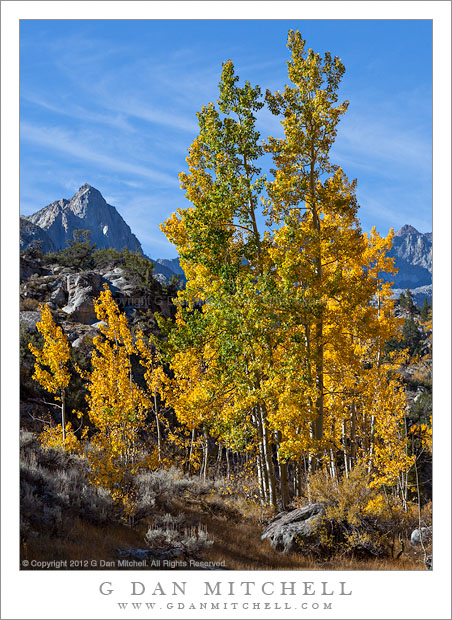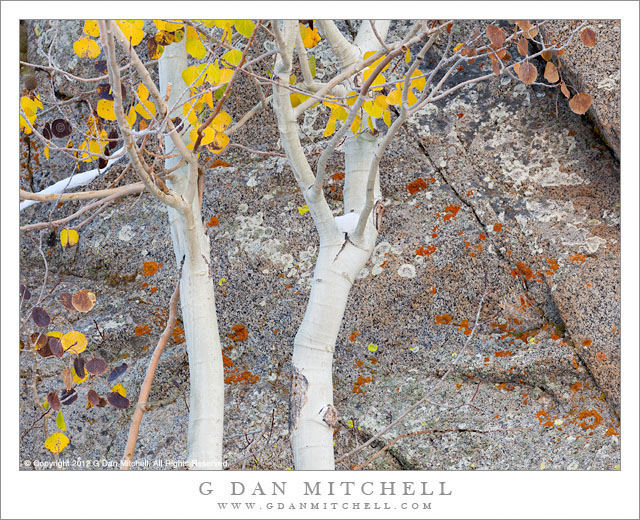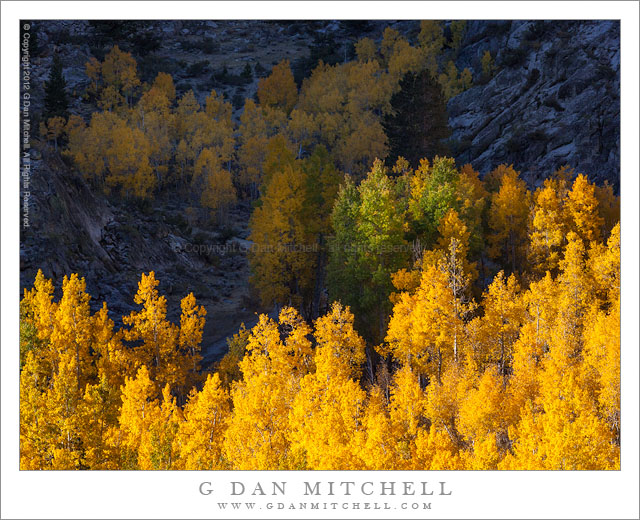
An aspen tree with morning backlight, photographed high above Bishop Creek Canyon
I’m continuing to indulge in my fascination with back-lit subjects today. This solitary aspen tree was located in an odd, out-of-the-way spot in the North Lake area, high in the Bishop Creek drainage. I had finished shooting at the lake and in the nearby aspen groves when I got the idea of walking the approach road a bit and finding a spot with a view to the canyon far below and to its shadowed walls on the far side of the canyon. For the sort of shot I had in mind, almost any small aspen tree would do as long as it was in the right place with the right background, and you would not think of this one as being anything special if you saw it – it is small, located on a dry and rocky section of hillside, and among a few other scattered small trees. However, it turned out to have what I wanted – a clear shot of the shadowed far hillside for background, separation from other trees, a few remaining leaves, and that backlight.
Photographing a location like North Lake can be an interesting experience. It holds at least a couple of the iconic Sierra autumn scenes with which many are familiar. (You can often find workshop participants lined up along a particular beautiful spot along the shoreline.) As with so many such subjects, most start with those impressive and familiar views – and they are worthy of photographs. But it is equally true that return visits to such a place, especially when they lead to more thorough observation, turn up a lot of interesting subjects that are not those familiar ones that first attracted our attention and lead to a much more complete knowledge of the place.
G Dan Mitchell is a California photographer and visual opportunist whose subjects include the Pacific coast, redwood forests, central California oak/grasslands, the Sierra Nevada, California deserts, urban landscapes, night photography, and more. Blog | About | Flickr | Twitter | Facebook | Google+ | 500px.com | LinkedIn | Email
Aspens in fall color in the lower reaches of Parker Canyon above Parker Lake, Sierra Nevada
As the fall aspen color season comes along, I’ll share photographs of this annual phenomenon, both from the current year and from past seasons. This photograph comes from last year, the autumn of 2011. That was a fall color season to remember in the eastern Sierra Nevada range, and for several reasons. First it was unusual in that several strong winter-type storm fronts swept over the Sierra during the first week or so of October. While an occasional front that drops a light coating of high elevation snow is not unusual this time of year, a series of storms that dropped up to a foot of snow in many places was a surprise. (Many of us were perhaps tricked into thinking that this was an indication of a third consecutive heavy precipitation year – but we were certainly wrong about that!) So a scene that might typically hold little or no snow at this mid-October date does have snow, and a fairly low elevations as well. Second, the development of aspen color took a few interesting twists and turns that year. There was some good color early on up high, but then the snow came and both made it less accessible and took down some of the early leaves. So this early color was interrupted, only to return in grand form a week or so later – and there was a lot of wonderful color by the middle of the month when I made this photograph.
Parker Canyon is an area that I identify with a bit. I often hike out to Parker Pass on the Sierra crest from inside Yosemite – it is a nice day hike that gets into some lovely alpine country and even is conducive to one of my favorite pastimes in the high country, cross-country hiking. So I’ve been at the pass a number of times… but have never gone much beyond it. I understand that the trail over Parker Pass heads into some very high country once it leaves the park boundaries. In addition, I’ve often looked to this area for some later color when I head to the eastern Sierra to photograph the aspens, where the area known as “Parker Bench” can have some great aspen stands. On this day I hiked from the end of the road up to Parker Lake, joining lots and lots of other folks out to see the fall color show. I did the hike more or less in the middle of the day, following early morning shooting and passing the time before the later light, and I did not necessarily expect to find a lot of interesting light to photograph. However, there were clouds! And these clouds muted the harsh midday light and added some interesting shadows to the landscape. In addition, the dark rock of Parker Canyon created an appealing contrast with the bright and colorful aspens near the upper shore of Parker Lake.
G Dan Mitchell is a California photographer whose subjects include the Pacific coast, redwood forests, central California oak/grasslands, the Sierra Nevada, California deserts, urban landscapes, night photography, and more. Blog | About | Flickr | Twitter | Facebook | Google+ | 500px.com | LinkedIn | Email
Early fall color comes to McGee Canyon in the eastern Sierra Nevada, California.
I’m going to use today’s post not only as the opportunity to share another daily photograph, but also to share some observations about the arrival of the fall aspen color season in the eastern Sierra Nevada range, where I spent a good part of the past week.
I made the photograph at the very end of a three-day backpack trip up into the McGee Creek drainage, where we settled in at a 10,000+” lake for a couple of nights to enjoy the late-season solitude. (Before starting the pack trip I had spent a couple of days in Tuolumne Meadows, and upcoming posts will concern that part of the trip.) McGee Canyon is an eastern Sierra “type” – a typical trailhead canyon that rises from the high desert, into forests, through increasing rugged and rocky country, and finally reaches the crest of the range at a pass. On this early afternoon we were fortunate to get a few clouds, moderating the intense sun and adding a bit of texture to the landscape. The photo was somewhat casual – still wearing my full pack, I shot hand-held.
About the onset of fall color… I have watched this transition carefully for a number of years. While I have learned a lot about how the process unfolds, I have also learned that many aspects of it defy precise prediction. Every September, those of us who chase eastern Sierra aspen color start to watch for signs that might provide clues about the nature of this season – the amount of snow during the previous winter, how late it remained before melting out, long-range weather forecasts, early color changes in many other plants that can show up even in late August, and more. But, truth be told, in the end every aspen season seems to hold surprises and defy out attempts to know in advance how it will play out. A season may start with early color up high, only to be interrupted by early storms. Or a season may start late and then move very quickly. Or poor early color in one part of the range may lower expectations… only to be followed by great low-elevation later on. Or there may be any number of other possible variations, too numerous to list.
All of this is my way of saying to take my observations with a suitable dose of salt. :-)
Several weeks ago I began to read the typical early September notes about “early color” here and there, especially in portions of the Rockies and some areas of the Southwest. I was intrigued, but not ready to believe it. I read and hear these reports of early color every season – and generally the correlation between what is written and what occurs in the actual event is weak.
This has been an odd summer season for me, for reasons I won’t go into here. As a result, I had not been to the Sierra since early July or so – a very large gap of time for me, since I rarely allow more that a couple of Sierra-free weeks to occur in the summer. I was not there at all during August – which is almost unheard of. I usually catch my first hint of oncoming autumn on one of those late-August visits. It is hard to put my finger on precisely what it is, but invariably (well, almost invariably, since it didn’t happen this year…) there will be a day when I sense “something” in the air that reminds me that summer will end very soon – whether it is a breeze, a quality of light, a change in the plants, I can never tell for sure. But I am sure when I experience it.
Soon there are more concrete signs. The golden-brown dried meadow areas start to expand, the wildflowers are harder to find, corn lily plants begin to turn golden-yellow, bilberry leaves turn dark red (and brilliant red when back-lit) and the leaves of willows near streams and lakes turn yellow. By mid-September all of this is typically underway, and at this point I start thinking about aspen color in earnest. Whether it is because we tend to go to different places to find our aspens or because we have experienced different seasonal variations, individuals will tell you to look for the aspen show to begin at somewhat varying times. I tend to look for real aspen color around the very beginning of October, and to expect a peak roughly a week into the month in the higher country. Except for watching for the odd tree with a branch full of yellow leaves, I don’t expect to seem much real color in September.
But… I just returned from a pack trip that was right in the middle of September… and I saw a significant amount of aspen color. As I drove over the Sierra crest on my way to the east side I was not expecting to see aspen color, and I did not see much. Despite the other sources of fall color, the aspens just east of Tioga Pass and down in Lee Vining Canyon were almost uniformly as green as I expected. When we arrived at our eastern Sierra trailhead, there were a few yellow leaves here and there, but nothing too out of the ordinary. However, a mile or two up the trail I was quite surprised to find large stands of aspens in which many trees were showing color – just a few leaves on some, but perhaps a quarter or a third of the tree in the most extreme cases. In my experience, this is unusually early – but at least a week and arguably perhaps a bit more. (Not all of the color in the photograph comes from aspens, by the way.)
What does this mean? I’m not sure. If I had a bit more time I would have investigated one or two other east-slope canyons to see what is going on elsewhere – it could be that this canyon is somehow out of sync with others. But I doubt it. All I’ll say is the following: Some aspen color is already beginning to appear in some areas of the eastern Sierra. While no one knows when the main show will arrive (or what it will look like), if I were making plans for a visit to the eastern Sierra to photograph aspen color, at this point I would lean toward going a little bit early rather than a little bit late. However, as always, realize that you cannot count on the timing or the quality of the display, and flexibility increases your odds of being there at a good moment.
More articles on Eastern Sierra aspen photography:
G Dan Mitchell is a California photographer whose subjects include the Pacific coast, redwood forests, central California oak/grasslands, the Sierra Nevada, California deserts, urban landscapes, night photography, and more. Blog | About | Flickr | Twitter | Facebook | Google+ | 500px.com | LinkedIn | Email
Rugged rocks and surf along the Big Sur coastline at Soberanes Creek.
I’m not certain if this spot has a real name or not, but it seems like it might be something like Soberanes Cove or perhaps Soberanes Bay, since it is at the outlet of the stream that comes down to the Soberanes Canyon from tall, steep coastal hills before entering the Pacific in this rugged, rocky area of the northern Big Sur coast not far below Carmel. Here, as the Coast Highway heads south, it makes a bit of an inland turn to cross the stream and then turns back toward the ocean to rise over another prominence that extends further toward the water. As it does so, a view opens back across the coastal bluff and over this rock-filled section of water toward the rocky coastline.
This was an “interesting” light evening along the coast – in some ways very difficult light, but with short-lived sections of more light that was very beautiful. The fog was hugging the shore line, sometimes extending a bit inland to the coastal hills, cutting off all of the late-day light. But occasionally, where the shore curves inland a bit, as in this cove, the overcast opened up a bit and perhaps even pulled away from the immediately coast and allowed some filtered light to strike the rocks and the water and the shoreline.
G Dan Mitchell is a California photographer whose subjects include the Pacific coast, redwood forests, central California oak/grasslands, the Sierra Nevada, California deserts, urban landscapes, night photography, and more. Blog | About | Flickr | Twitter | Facebook | Google+ | 500px.com | LinkedIn | Email
Photographer and visual opportunist. Daily photos since 2005, plus articles, reviews, news, and ideas.
Manage Consent
To provide the best experiences, we use technologies like cookies to store and/or access device information. Consenting to these technologies will allow us to process data such as browsing behavior or unique IDs on this site. Not consenting or withdrawing consent, may adversely affect certain features and functions.
Functional
Always active
The technical storage or access is strictly necessary for the legitimate purpose of enabling the use of a specific service explicitly requested by the subscriber or user, or for the sole purpose of carrying out the transmission of a communication over an electronic communications network.
Preferences
The technical storage or access is necessary for the legitimate purpose of storing preferences that are not requested by the subscriber or user.
Statistics
The technical storage or access that is used exclusively for statistical purposes.The technical storage or access that is used exclusively for anonymous statistical purposes. Without a subpoena, voluntary compliance on the part of your Internet Service Provider, or additional records from a third party, information stored or retrieved for this purpose alone cannot usually be used to identify you.
Marketing
The technical storage or access is required to create user profiles to send advertising, or to track the user on a website or across several websites for similar marketing purposes.