
Tag Archives: eos

Canon EOS 5D II: Early Observations on Image Quality

I posted earlier today about increasing availability of the Canon EOS 5D II at places like B&H, so I thought it might be useful to begin posting on some of my experiences with the camera during the couple of weeks (and perhaps a thousand frames) that I’ve had it. Here is a copy of something I posted elsewhere earlier this week, in response to a post concerning image quality from this camera:

I’ve shot with cropped sensor bodies extensively in the past. I have shot with a full-frame 5D for the past two years. I recently began shooting with a 5DII and have done a thousand or so frames with it.

I cannot see image quality problems in my images, even in those that stress the ability of the camera in ways that should produce them if they are there: shooting wide dynamic range scenes, using high ISOs (up to 1600), inspecting at large on-screen magnifications, and making careful prints.

My photos have very low noise all the way through the shadows to pure black, even in some photographs where I’ve pushed the shadows either during RAW conversion and/or via the shadow/highlight tool in post. I’m seeing very highly detailed images with smooth tonal transitions. As far as I’ve seen the 5D II has a rather substantial dynamic range – as reported in a number of tests – and it is at least as great as that of the 5D.

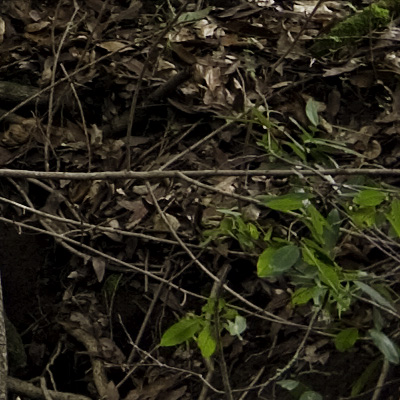
Let me repost a couple of 100% magnification crops that I posted elsewhere from the 5DII.

The first was shot at ISO 100 at, IIRC, f/16 using a 35mm prime with the camera on tripod. The crop is a 100% magnification section from the very far lower right corner of the shot. The dark areas were pushed slightly, too, so if there were noise anywhere it would certainly appear here – but I don’t see it even at this resolution, which would be equivalent to a print width of five or six FEET wide. Seems like pretty good resolution to me! (It also speaks well for the EF 35mm f/2 lens.)
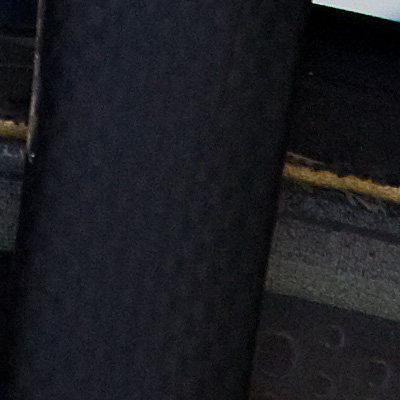
The second example is pretty much a noise “torture test” – it is a very dark section of a much larger image. (Again a 100% crop). It was shot using a 100-400mm zoom handheld at ISO 400 in cloudy conditions. There is some noise in the shot, but that is entirely normal – and this noise would be completely invisible even in a very large print. (The pattern on the lighter fabric near the left side of the frame is that of the fabric itself.)
My observations from 100% on-screen pixel peeping are confirmed by the more important test of printing.


(If my post has helped you with a purchase decision, making your purchase from B&H through this link will help support the blog. Thanks!

Aarrgg! Broken Camera!

Last night I joined The Nocturnes for night photography at Mare Island Naval Shipyard. Things began in the usual uneventful way – perhaps 40 photographers assembled as Tim Baskerville went over the “rules” of the game, I shot a few photos of the group, and then I headed off to start photographing the interesting shipyard structures under the light of a nearly full moon.

I began by working on improving a shot that I had attempted on another visit, a scene of a brick building with an attached green building in front of a metal roof structure with the power plant smokestack in the background, this time with some very interesting shadows cast by the overhead shipyard structures. Finishing this shot, I set up another of an overhead truss structure illuminated by moonlight with star trails behind. So far so good – and I felt like I was getting in the groove for a productive evening.

I composed a third shot, again with that shadowed wall of the brick building but this time with the base of a giant steel tower in front of it. I pressed the shutter release… and something didn’t sound right. Tried again, and still no go. I took the camera off the tripod and saw the dreaded Canon “err 99” message in the display. No panic, though; I’ve seen this before and know enough to remove the battery, card, and lens and give it another try. Ah, still no go. After removing the lens and jumping through a few other hoops I figured out that the mirror was in the “up” position, more or less waiting for the shutter to open… which it didn’t do.

So, perhaps 15 minutes into this night photography session I had an inoperable camera. I packed up and headed home, where I did a bit of Internet searching and found other descriptions of exactly this issue. It looks like I need to have Canon replace the shutter mechanism.

(I’m going to bring up one odd factor with Canon. It seems that a good percentage of the people who encountered this problem did so after exactly the same sequence of events that I followed in shooting long exposures with mirror lockup engaged. A number had even been using the 24-105 beforehand, as I had been. Hmmm… Later: I’ve been contacted by another photographer who had precisely the same situation and had some dialog with Canon about the situation…)

So, at the moment I’m without a camera. I’m giving some thought to picking up a 5D II a bit ahead of my planned schedule and either keeping the repaired 5D as a backup or selling it. (It would be a good deal for someone, especially with a brand new shutter.) Of course, as luck would have it, it appears that all of the body-only versions of the 5D II that were available last week are now out of stock…

Seems like a good day to take a hike. Without a camera. :-)


G Dan Mitchell is a California photographer and visual opportunist. His book, “California’s Fall Color: A Photographer’s Guide to Autumn in the Sierra” (Heyday Books) is available directly from him.

G Dan Mitchell: Blog | Bluesky | Mastodon | Substack Notes | Flickr | Email


All media © Copyright G Dan Mitchell and others as indicated. Any use requires advance permission from G Dan Mitchell.

Using Prints to Test Four Canon DSLRs

Miles Hecker has posted interesting test results in his Canon EOS big guns image quality shootout:

As some of you know, I am a landscape photographer. I migrated to full frame digital SLR’s from medium format film. I used to shoot 6×4.5, 6×7 and 6×9 film with the end product being prints of 20″x30″ and larger. As such, I chose to investigate only one area of the 5Dmk2 in this exercise, overall image quality or IQ for short. For this test, I decided to construct a still life with a wide range of color, lots of detail and very controlled lighting to obtain what for me are valid results.The test would produce 100% crops for pixel peeping. The final analysis of IQ however would be made using real life obsevers and detailed sections of 16″x24″ and 20″x30″ photographic prints.

What I like about his test methodology is that it eliminates the very difficult issue of normalizing on-screen tests of cameras with different sensor sizes and photosite densities but doing something that I have felt would make the most sense, comparing large prints from the different test cameras. In this case he tested the Canon EOS 1DsM3, 5D2, 5D, and 50D. 

I won’t spoil the fun by telling you the results here, but let’s just say I’m not at all surprised at the results.

Testing the Canon 5D II for Noise

From Night Photography blog by Andy Frazer: More 5D Long Exposure Tests:

Seattle-based night photographer Brian Chapman has posted another set of 5D MkII long exposure tests, this time all taken at night. Although this set was taken at ISO 400, underexposed, and then pushed during RAW conversion, the results are very interesting.

Brian Chapman’s experiments are essentially a night photographer’s torture test – shooting at high ISO, underexposing, compensating in post, adjusting the image, and including areas of uniform color and luminosity. If you aren’t familiar with real life noise issues in digital photography you might think, “Ugh! Noise.” If you have done night photography and made prints for images like those in the test you might be thinking, “Hey, that’s pretty darn impressive!”