
Tag Archives: fractured

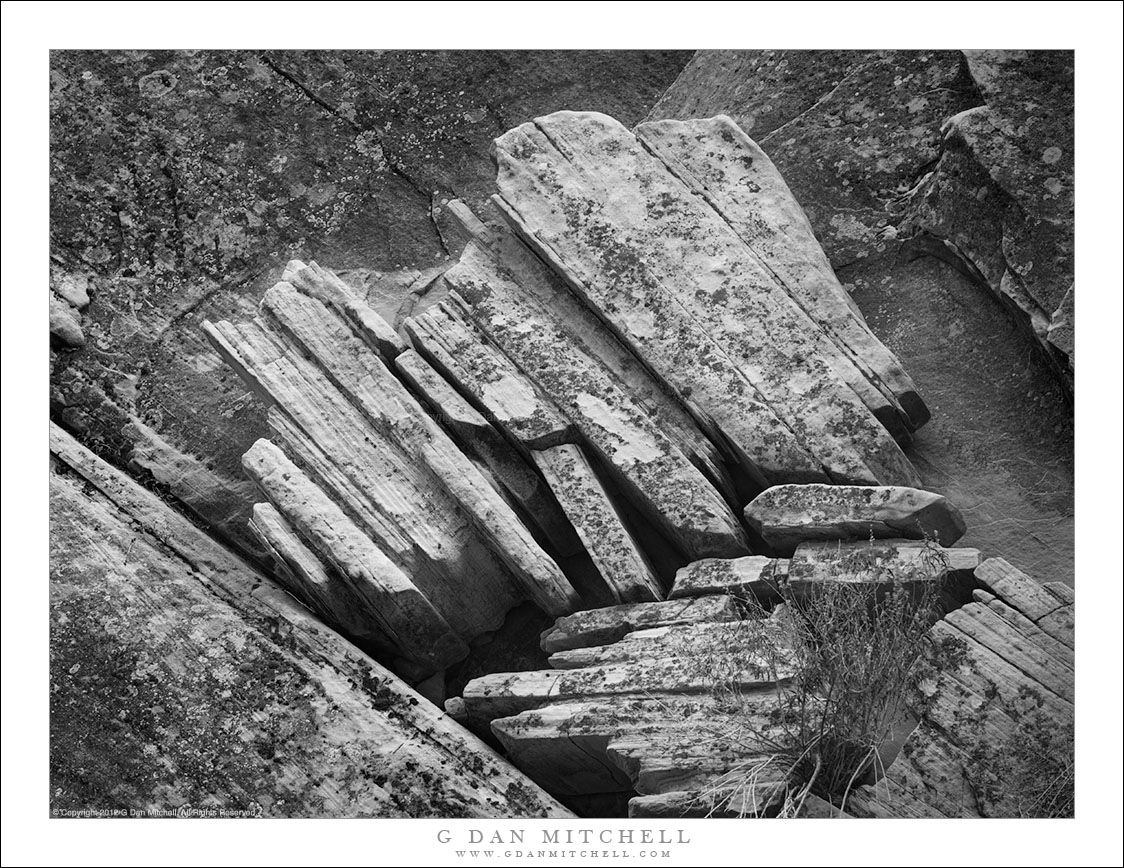
Disrupted Strata

Disrupted Strata
The fractured and bent layers of a fractured boulder in a Utah slot canyon.

Disrupted Strata. © Copyright 2012 G Dan Mitchell – all rights reserved.

The fractured and bent layers of a fractured boulder in a Utah slot canyon.

This jumble of rocks sits in a Southern Utah canyon, piled on debris and the lower face of a cliff that runs along the banks of a small creek. The bottoms of such canyons are, for obvious reasons, places full of all sorts of debris that either falls from the surrounding cliffs or is washed down the canyon in periodic floods. A good part of the challenge of making progress through such terrain involves contending with this detritus.

As is so often the case in these landscapes, the initial appearance of features may mislead the viewer about their history. Rocks, of course, seem quite solid and immutable. But this little vignette of almost nothing but rock actually shows more about how much it changes than about its stability. This rock was formed in layers laid down by water a long, long time ago. Those layers were compressed, folded, upended and broken over time. Here we see a snapshot of that process. Lying atop a smoother section of the cliff, this deteriorating boulder’s layers are made apparent as they break apart and realign.


G Dan Mitchell is a California photographer and visual opportunist. His book, “California’s Fall Color: A Photographer’s Guide to Autumn in the Sierra” is available from Heyday Books and Amazon.

Blog | About | Flickr | FacebookEmail

Links to Articles, Sales and Licensing, my Sierra Nevada Fall Color book, Contact Information.

Scroll down to leave a comment or question.


All media © Copyright G Dan Mitchell and others as indicated. Any use requires advance permission from G Dan Mitchell.
Cliff and Trees

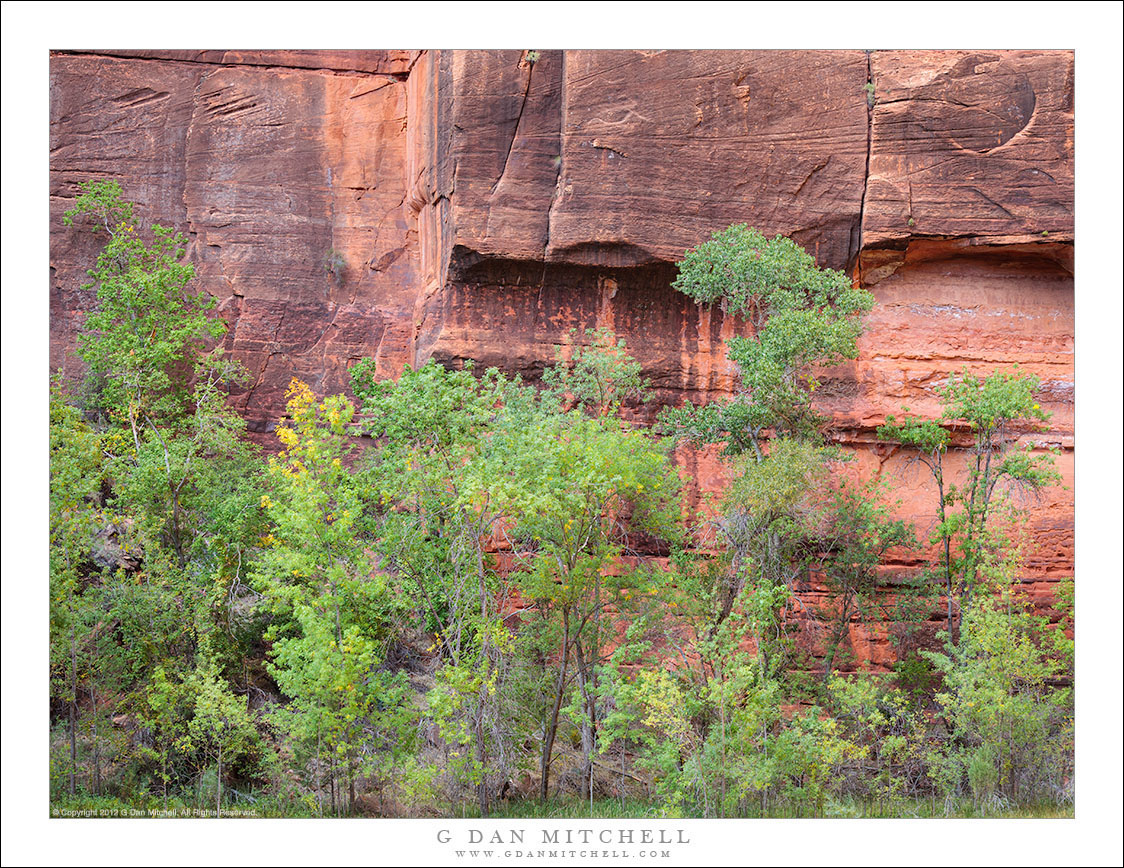
Cliff and Trees
Trees and brush at the base of a sandstone cliff along the Virgin River, Zion National Park.

Cliff and Trees. © Copyright 2012 G Dan Mitchell – all rights reserved.

Trees and brush at the base of a sandstone cliff along the Virgin River, Zion National Park.

For an autumn photograph there isn’t a lot of autumn color here! Back in 2012 I made two trips to Southern Utah. The pattern of fall color change in Utah, in my somewhat limited experience, is both different than what I’m used to in California and spread out across many weeks and the many climate zones of the state. The first lesson I learned was very early in October: the aspens in Utah change earlier than those in the Eastern Sierra that I know so well. A second lesson was that the cottonwoods and other trees and bushes in the redrock canyon country change next, and they can be spectacular. The third lesson — illustrated here — is that the colors in Zion Canyon apparently change quite a bit later. I haven’t hit the peak there yet, but I understand that it can be as late as the beginning of November.

This visit was barely two weeks into October, and much of the vegetation in Zion Canyon was still quite green. This photograph comes from a very popular and often crowded area just beyond the road-end at the upper end of the canyon, where many begin their walk/wade up the Virgin River. This is, I think, one of those places that is “iconic for a reason.” This section features a relatively flat and wide canyon bottom, full of trees that can benefit from occasional flooding. But for me the massive canyon walls that follow the river’s course are the main show — the sandstone here is massive and nearly vertical.


G Dan Mitchell is a California photographer and visual opportunist. His book, “California’s Fall Color: A Photographer’s Guide to Autumn in the Sierra” is available from Heyday Books and Amazon.

Blog | About | Flickr | FacebookEmail

Links to Articles, Sales and Licensing, my Sierra Nevada Fall Color book, Contact Information.

Scroll down to leave a comment or question.


All media © Copyright G Dan Mitchell and others as indicated. Any use requires advance permission from G Dan Mitchell.
Dormant Plant, Fractured Rock

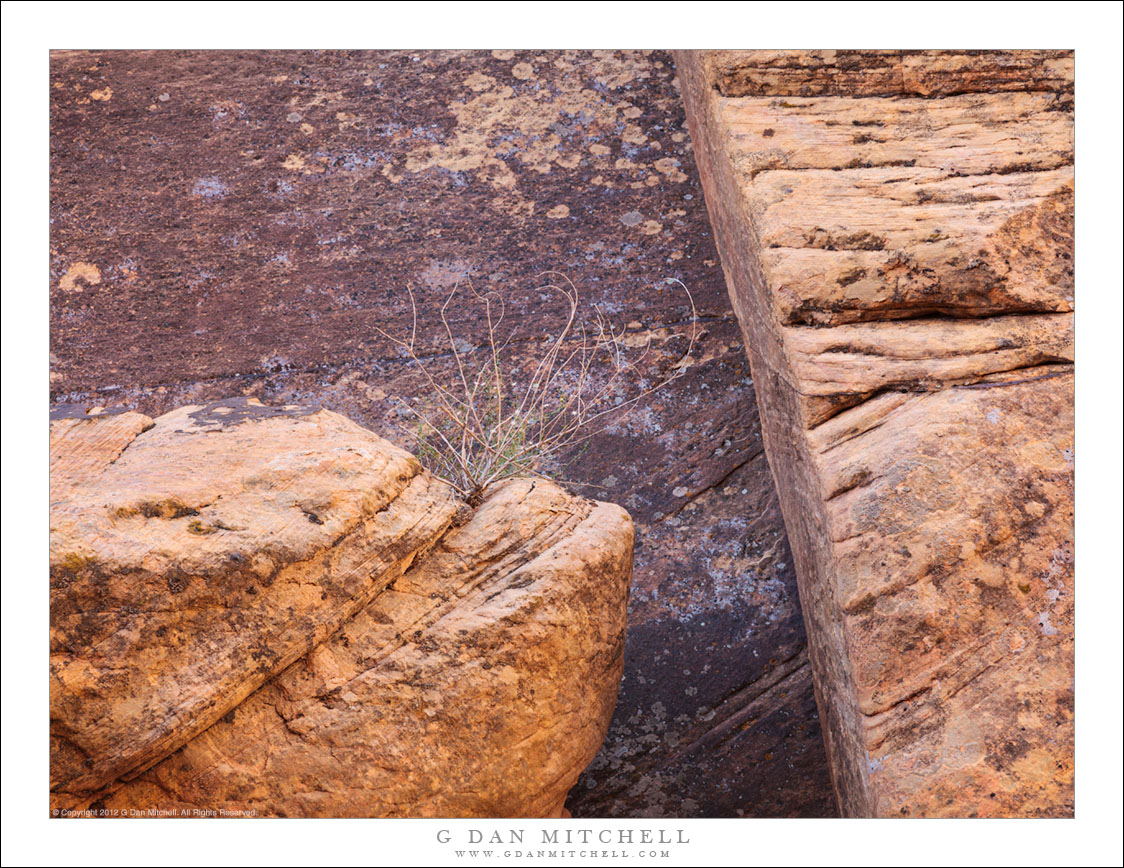
Dormant Plant, Fractured Rock
A nearly dormant plant grows on a fractured boulder against a cliff wall in a Utah slot canyon.

Dormant Plant, Fractured Rock. © Copyright 2012 G Dan Mitchell – all rights reserved.

A nearly dormant plant grows on a fractured boulder against a cliff wall in a Utah slot canyon.

To my way of thinking, slot canyons bring several primary associations. The narrow, twisting vertical walls are near the top of the list. The unusual surfaces of the wash floor are another: sand, mud, rocks. Above all (literally and figuratively) is the light entering far above and then bouncing back and forth among the canyon walls as it descends, picking up the colors of the rock and becoming softer and softer.

There are other associations, too, and although they might not be quite so immediately apparent, once you see them they are everywhere. Almost everything here is, of course, affected by water. The canyons were cut by it and the process continues. When the water periodically moves cataclysmically, rocks and boulders are redistributed downstream and mixed together with material from many different sources. As the water continues to eat into rock it undermines the higher structures, and gravity brings down rock from younger state. All the while the moving water grinds away and polishes the lower reaches of the canyon.


G Dan Mitchell is a California photographer and visual opportunist. His book, “California’s Fall Color: A Photographer’s Guide to Autumn in the Sierra” is available from Heyday Books and Amazon.

Blog | About | Flickr | FacebookEmail

Links to Articles, Sales and Licensing, my Sierra Nevada Fall Color book, Contact Information.

Scroll down to leave a comment or question.


All media © Copyright G Dan Mitchell and others as indicated. Any use requires advance permission from G Dan Mitchell.
Sculpted Sandstone

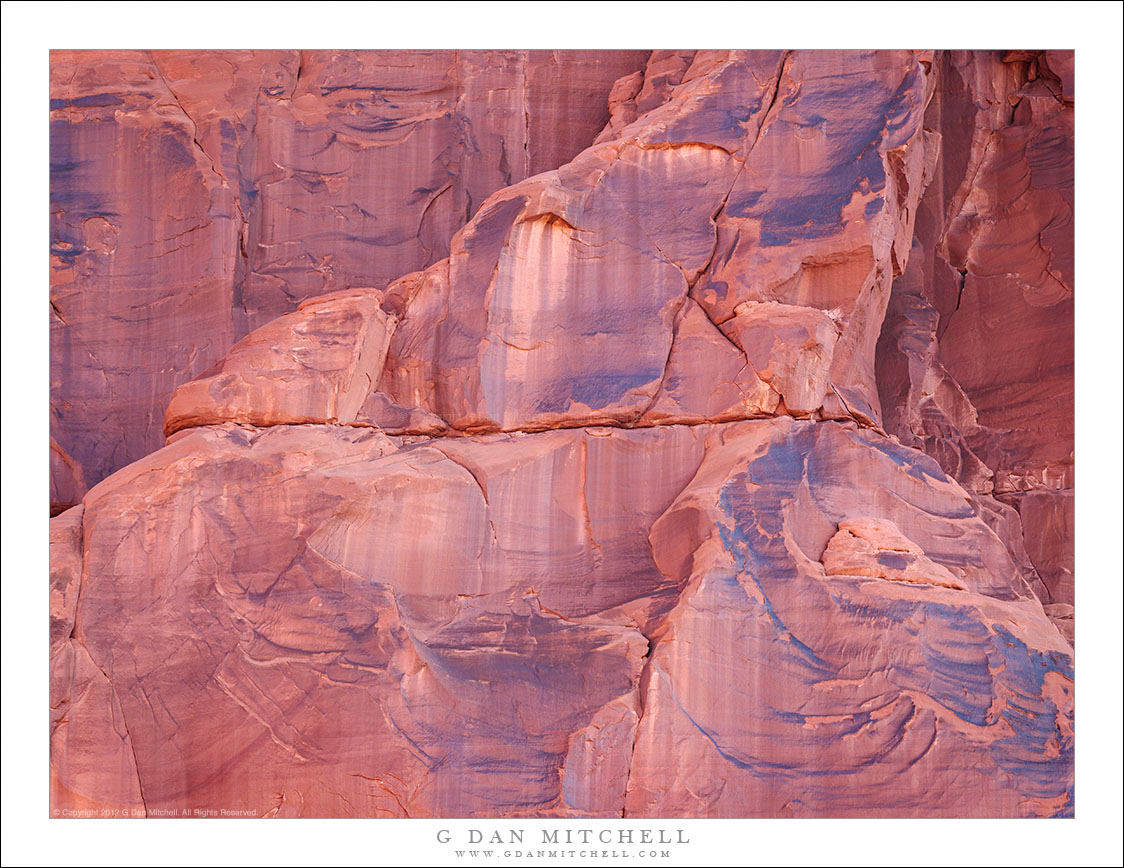
Sculpted Sandstone
Detail of a section of eroded sandstone cliff at Arches National Park.

Sculpted Sandstone. © Copyright 2012 G Dan Mitchell – all rights reserved.

Detail of a section of eroded sandstone cliff at Arches National Park.

To be honest, I’m not sure I could find this bit of sandstone cliff again if I went back to Arches National Park and looked for it. I think I have a vague idea of where it was, but if I’m correct it was just one small section of a much larger wall that ran for a significant distance. But isn’t that part of the challenge of the red rock country, that there are so many impressive and fascinating walls with unending variations of color and form?

The basic shapes of the rock walls, arches, buttresses, and ridges are fascinating in their own right. But the surface textures of the rock are immensely varied and interesting. The blue material coats these rocks in many places, and it can outline erosion patters in the rock. There are vertical lines everywhere, formed by water oozing, dripping, flowing, and occasionally flooding across the faces. And the color can vary from hour to hour as the angle and quality of the sunlight change, and as light reflected from other red rock surfaces intensifies the color.


G Dan Mitchell is a California photographer and visual opportunist. His book, “California’s Fall Color: A Photographer’s Guide to Autumn in the Sierra” is available from Heyday Books and Amazon.

Blog | About | Flickr | FacebookEmail

Links to Articles, Sales and Licensing, my Sierra Nevada Fall Color book, Contact Information.

Scroll down to leave a comment or question.


All media © Copyright G Dan Mitchell and others as indicated. Any use requires advance permission from G Dan Mitchell.