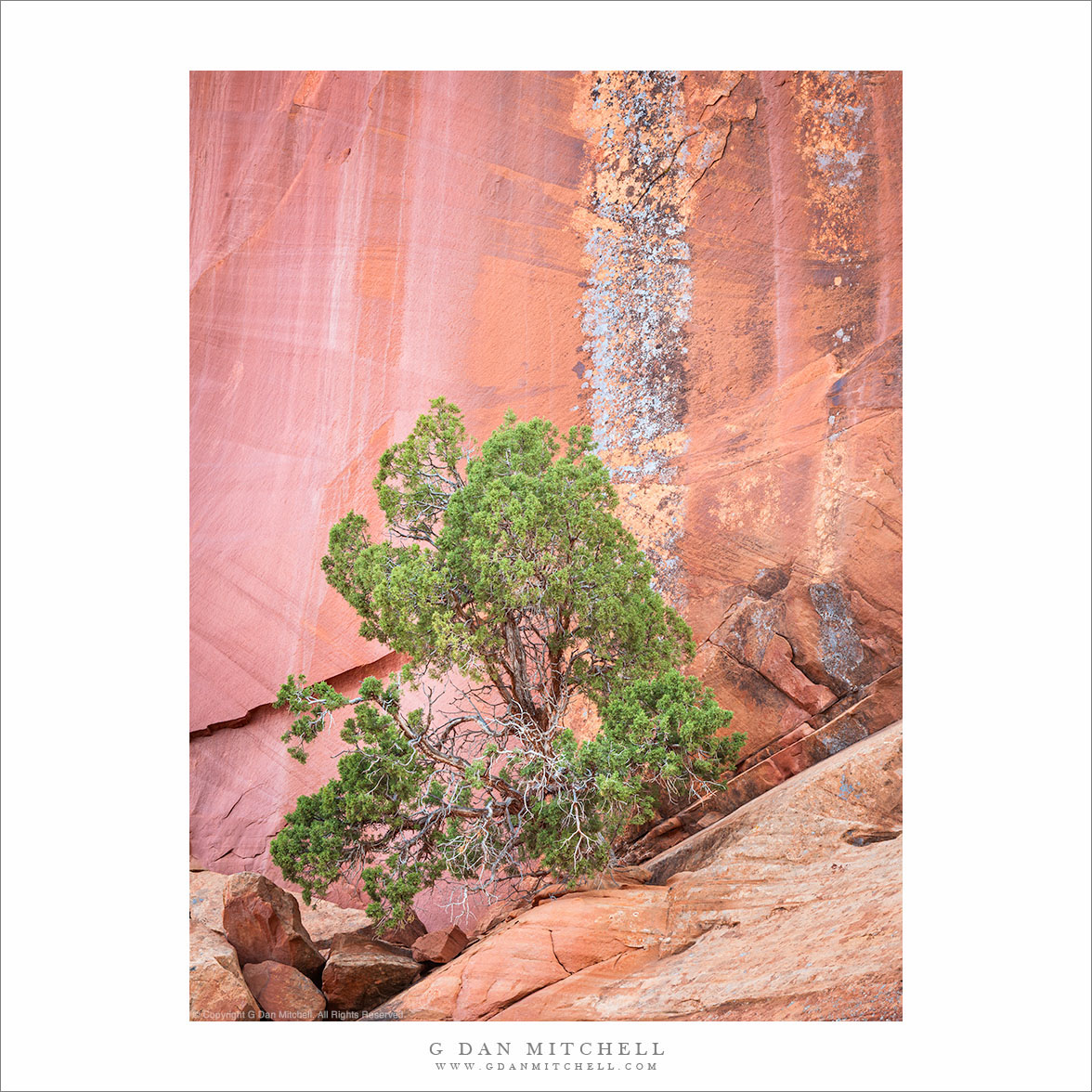
“Juniper Tree, Water-Stained Cliff” — A Juniper Tree, Water-Stained Cliff solitary juniper tree grows at the base of a water-stained sandstone cliff.
Several things about the scene caught my attention as we passed through this area in of Capitol Reef National Park. The background is one of the thickest and most monumental strata in this area of the park. The surface of this solid rock is, however, marked in all sorts of ways. Notably there are stains from flowing water, and in a couple of vertical bands the flow has been regard enough to encourage the growth of lichens.
“Tree, Sandstone Cliff” — A solitary juniper tree grows at the base of the sandstone cliff.
This photograph comes from a visit to Southern Utah with a couple of photographer friends some years ago. We took a week to make a loop through the southern part of the state that took in Cottonwood Canyon, the Escalante area, and a few days in the Capitol Reef neighborhood. That latter location is where I made this photograph of a juniper tree in front of a massive sandstone cliff face.
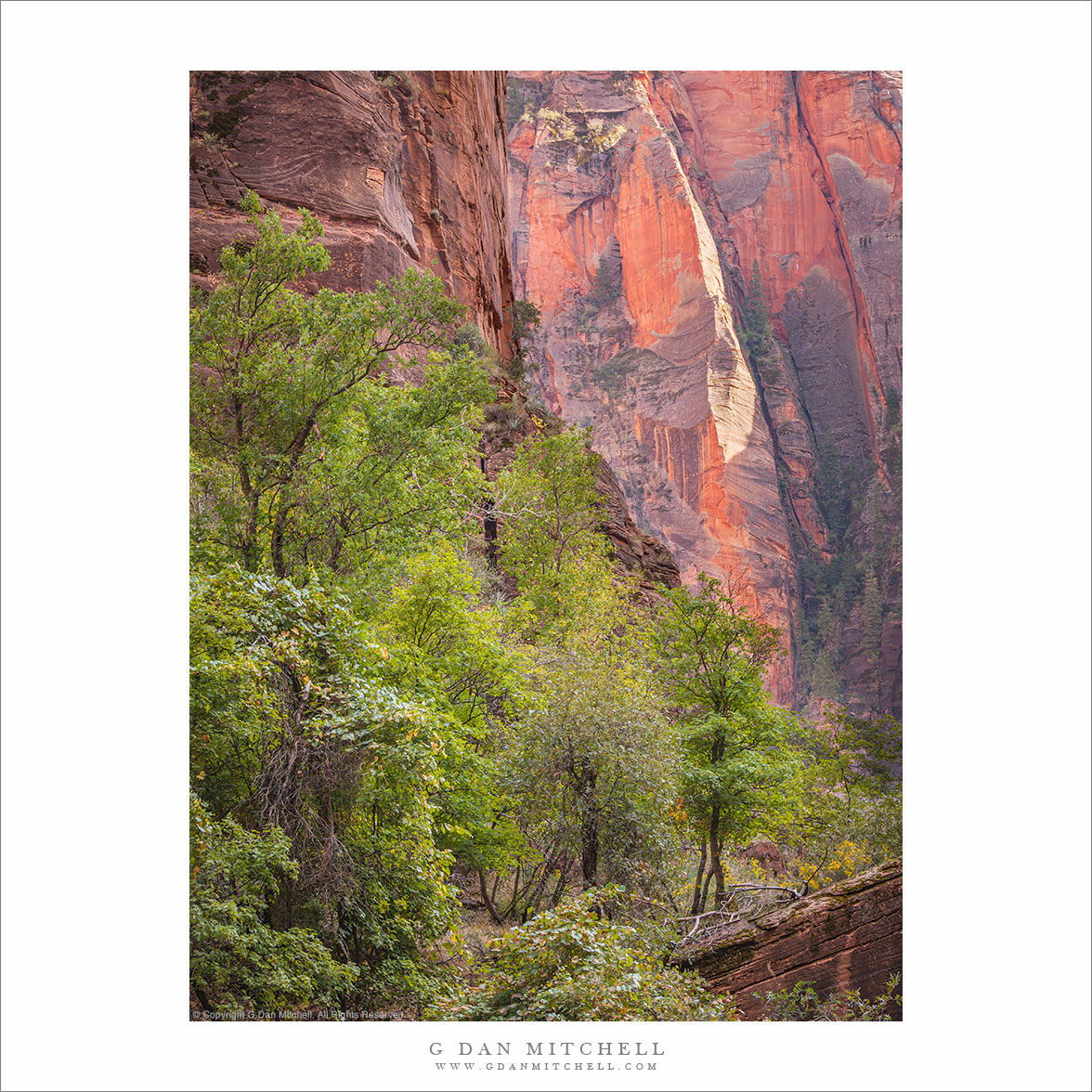
“Trees and Sandstone Cliffs” — Trees near the base of sandstone cliffs, Zion Canyon.
There is a lot going on here related to textures and colors. Color first: the cliff and tree colors are almost complementary. The green trees at the base of the cliff are in full shade. The further cliff face is getting both direct and reflected light. The cliffs seem massive and solid, but the surfaces are surprisingly varied. We see lighter and redder sections contrasting with almost-blue darker areas.
I was a little surprised to see trees growing so close to the base of he cliff. Often these areas are littered with accumulated rockfall debris, but here the trees don’t show any signs of that. It isn’t easy to tell from the photograph, but some of the trees are actually growing from cracks in the rock wall.
“Trees in Morning Light, Granite Dome” — Trees grow on a bit of talus at the base of a Yosemite dome.
Scenes like this are a big part of what characterizes Yosemite, especially the park’s high country: trees growing on granite, domes, forests, and that “range of light” atmosphere. The features are so common that it is possible for a longtime visitor to almost take them for granted.
I have paused at this spot on virtually every visit to the Yosemite high country for decades. The dome rising to the left in the photograph was my original interest — it is a beautiful dome in an especially aesthetic location. But later on the trees became an equal attraction — easy to overlook among millions of other trees, but once you see them you don’t forget.
Photographer and visual opportunist. Daily photos since 2005, plus articles, reviews, news, and ideas.
Manage Consent
To provide the best experiences, we use technologies like cookies to store and/or access device information. Consenting to these technologies will allow us to process data such as browsing behavior or unique IDs on this site. Not consenting or withdrawing consent, may adversely affect certain features and functions.
Functional
Always active
The technical storage or access is strictly necessary for the legitimate purpose of enabling the use of a specific service explicitly requested by the subscriber or user, or for the sole purpose of carrying out the transmission of a communication over an electronic communications network.
Preferences
The technical storage or access is necessary for the legitimate purpose of storing preferences that are not requested by the subscriber or user.
Statistics
The technical storage or access that is used exclusively for statistical purposes.The technical storage or access that is used exclusively for anonymous statistical purposes. Without a subpoena, voluntary compliance on the part of your Internet Service Provider, or additional records from a third party, information stored or retrieved for this purpose alone cannot usually be used to identify you.
Marketing
The technical storage or access is required to create user profiles to send advertising, or to track the user on a website or across several websites for similar marketing purposes.



Join the discussion — you are welcome to leave a comment or question. (Comments are moderated and may not appear immediately.)