Recently I have heard some photographers suggest that IBIS-equipped cameras have made tripods obsolete. IBIS is a fine thing, but that overstates the case.
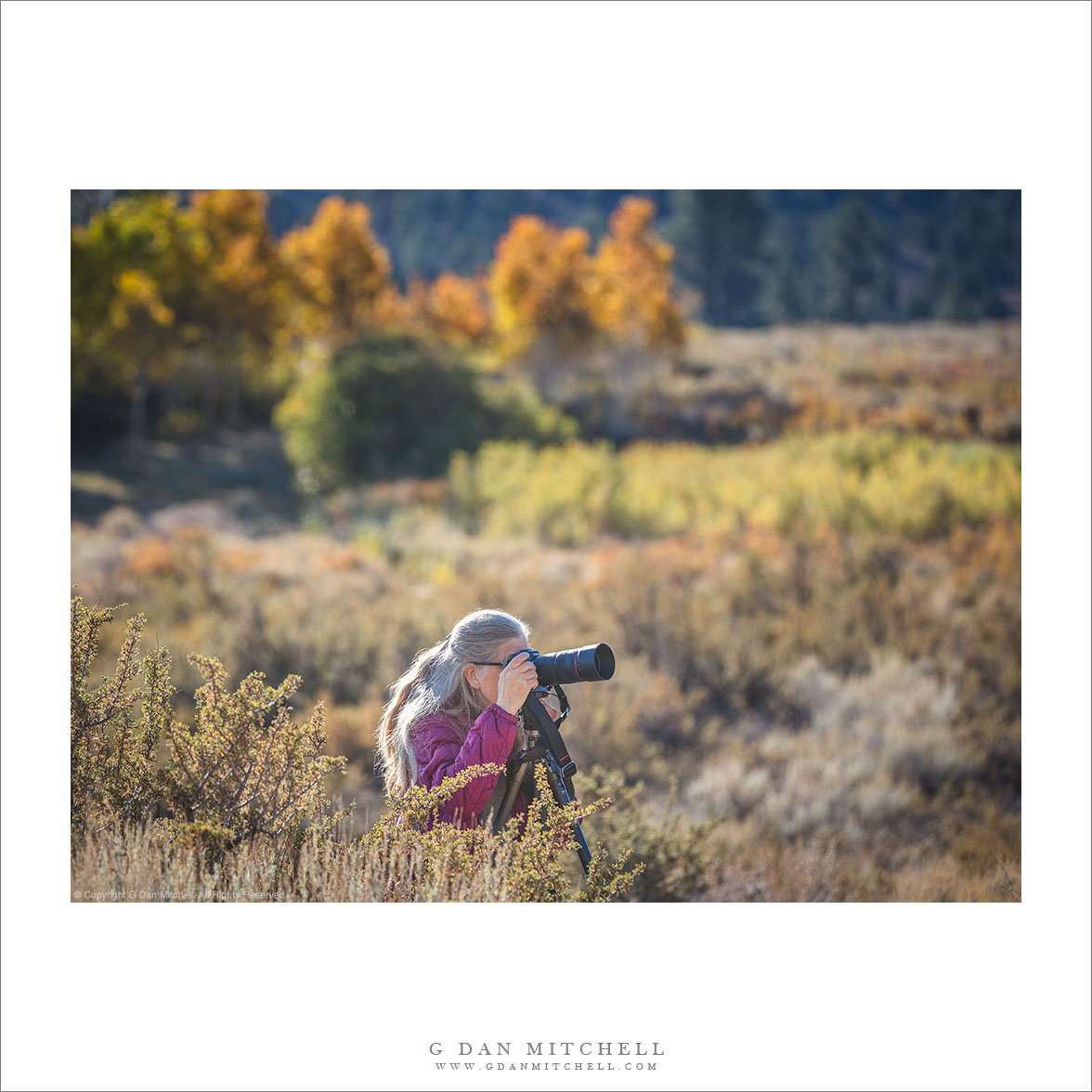
“Photographer Patricia Mitchell” — Photographer Patricia Mitchell at work in early morning autumn light in the Eastern Sierra Nevada.
Contemporary cameras incorporate remarkable advances in camera and lens image stabilization. Some newer cameras with IBIS (In-camera Image stabilization) claim to extend the useful range of shutter speeds for handheld photography by as much as seven stops.
IBIS can be very useful for photographers who shoot handheld. I do urban night street photography using a handheld, IBIS-equipped camera that supports high ISOs — and I can capture subjects that would have been just about impossible to photograph a few decades ago.
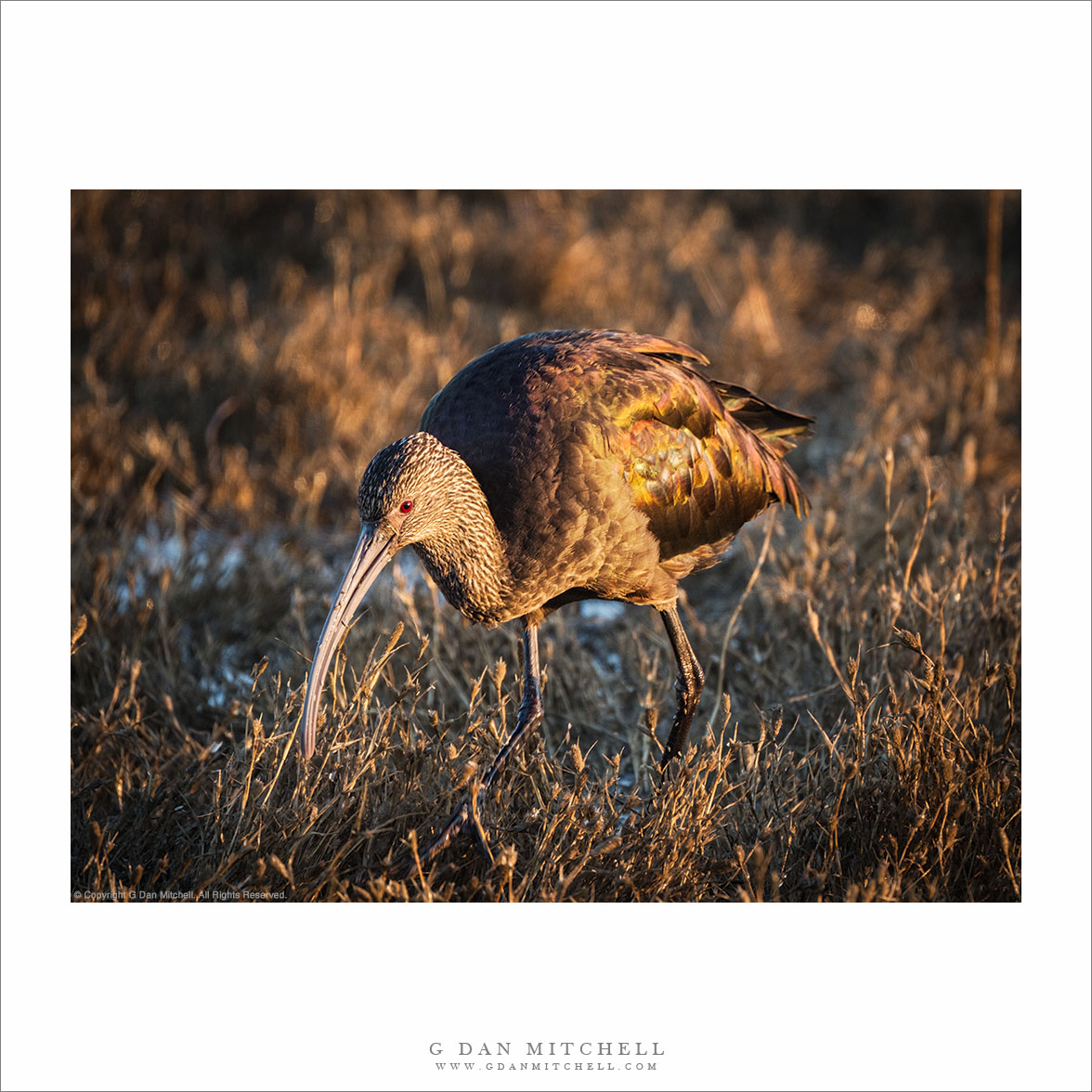
“White-Faced Ibis” — A white-faced ibis feeding in California Central Valley wetlands.
Photographing this and some other birds was a serendipitous event at the end of October. I was on my way from the San Francisco Bay Area to Yosemite to photograph autumn color. Rather than show up during the midday flat light period in the Valley, I decided to detour to a wildlife refuge, just to take a look around. I wasn’t really expecting to see much this early in the season, but I was surprised to find plentiful sandhill cranes, egrets, and white-faced ibises.
At one point I came upon a big flock (or, technically perhaps, two flocks intermingled) of ibises and egrets. Although I had intended my visit to be brief, I ended up spending some serious time photographing this group. The birds were feeding among short wetlands plants near the edge of a large pond in the early morning light.
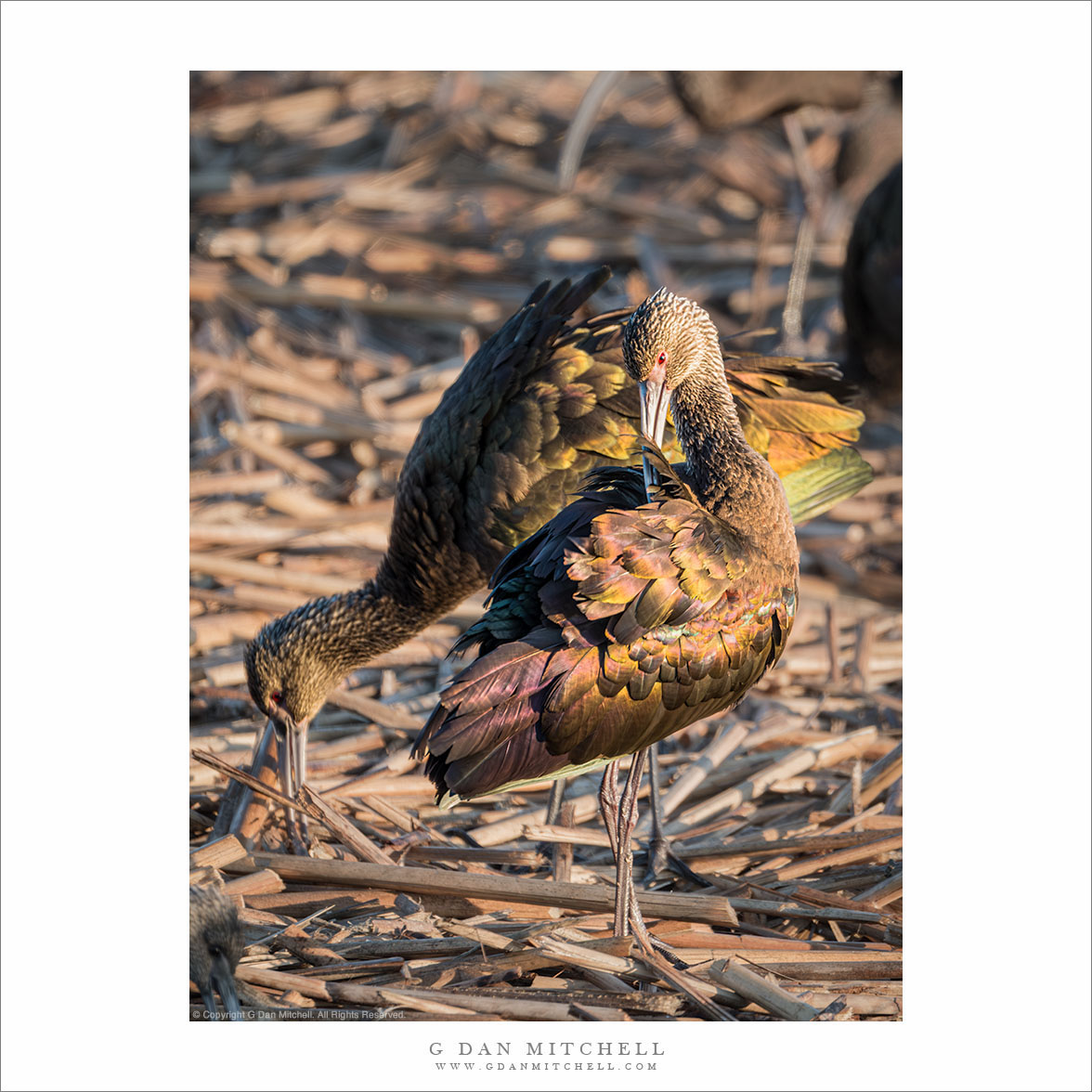
“Two Ibises” — Two white-faced ibises browsing at the edge of a wetland pond.
This photograph qualifies as one of the first of my 2025-26 fall/winter migratory bird photography. In truth, this subject was a bit of an afterthought — I simply detoured past this location on my way to Yosemite to photograph fall color at the end of October. I did not really expect to see too many birds, but I found plentiful Ibises and egrets.
Ibis plumage is quite something. In flat lighting, the birds can seem almost black. But when the light is just right, the birds’ plumage becomes iridescent, incorporating all sorts of colors: red, yellow. green, maroon. The transformation can be astonishing.
A small collection of shallow water feeders in Central Valley wetlands.
Today’s photograph is something that is a bit more of a record perhaps — a photograph of three sorts of wetland birds that are not among those that typically loom largest in our attention. The long-beaked birds at the left are white-fronted ibises. I think that the brown birds are teals — perhaps cinnamon teals? The taller black and white birds are black-necked stilts.
All of these are shallow-water feeders. The ibises and stilts give this away with their long legs and beaks, while the ducks dispense with the dignity that comes from standing erect and simply get up close and personal with the water and the muck beneath it. I’ve written before about how I came to photograph such critters not from an initial attraction to birds, but more to discovering them in the landscape. This leads to several aspects of my relationship to birds: I’m not an expert on them, and I’m still learning new things about them all the time. (This week’s new nugget is that there are “diving ducks” and “dabbling ducks.” Who knew?)
G Dan Mitchell is a California photographer and visual opportunist. His book, “California’s Fall Color: A Photographer’s Guide to Autumn in the Sierra” is available from Heyday Books, Amazon, and directly from G Dan Mitchell.
Photographer and visual opportunist. Daily photos since 2005, plus articles, reviews, news, and ideas.
Manage Consent
To provide the best experiences, we use technologies like cookies to store and/or access device information. Consenting to these technologies will allow us to process data such as browsing behavior or unique IDs on this site. Not consenting or withdrawing consent, may adversely affect certain features and functions.
Functional
Always active
The technical storage or access is strictly necessary for the legitimate purpose of enabling the use of a specific service explicitly requested by the subscriber or user, or for the sole purpose of carrying out the transmission of a communication over an electronic communications network.
Preferences
The technical storage or access is necessary for the legitimate purpose of storing preferences that are not requested by the subscriber or user.
Statistics
The technical storage or access that is used exclusively for statistical purposes.The technical storage or access that is used exclusively for anonymous statistical purposes. Without a subpoena, voluntary compliance on the part of your Internet Service Provider, or additional records from a third party, information stored or retrieved for this purpose alone cannot usually be used to identify you.
Marketing
The technical storage or access is required to create user profiles to send advertising, or to track the user on a website or across several websites for similar marketing purposes.