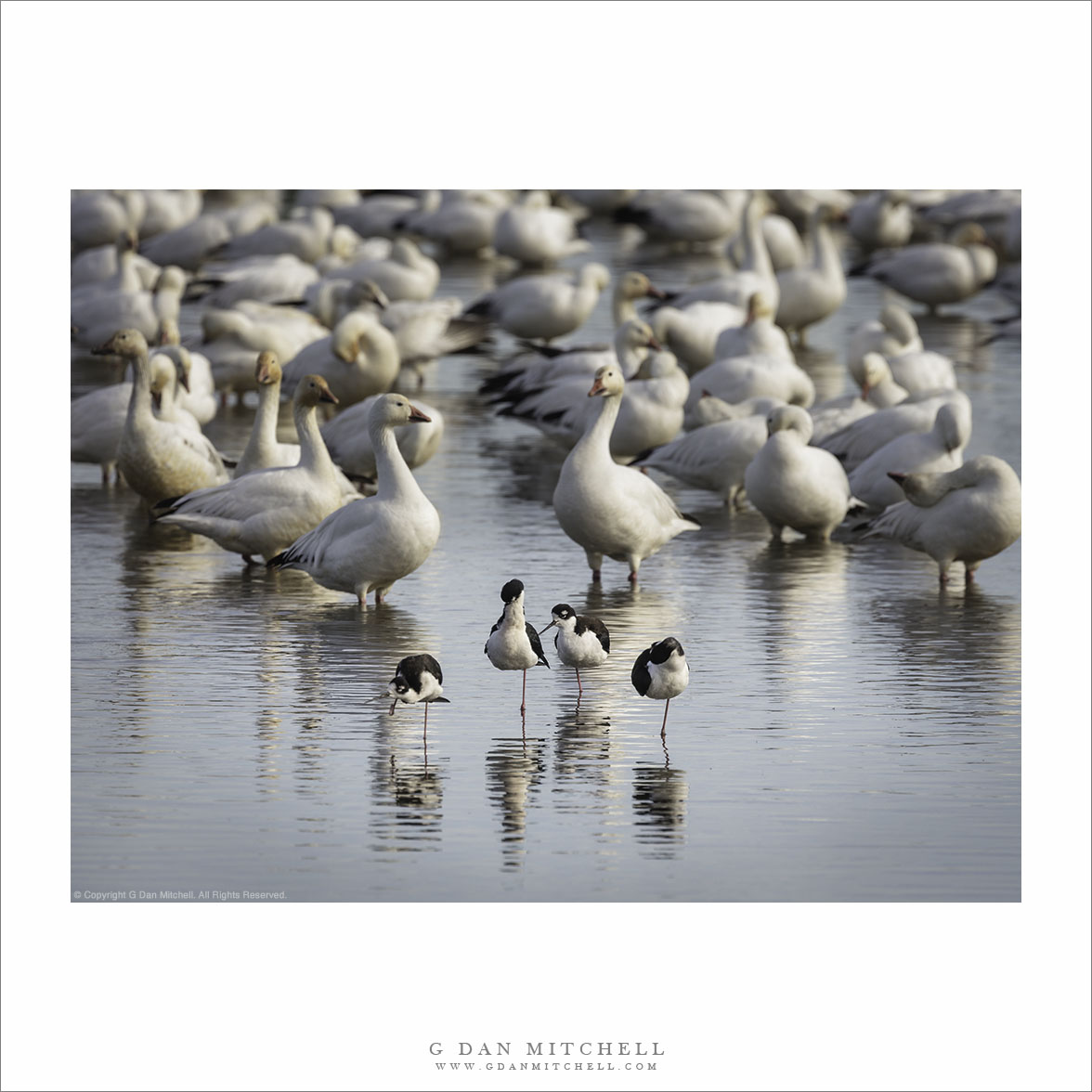
“Stilts and Geese” — Four black-necked stilts wade in front of a flock of snow geese.
This photograph comes from my second-to-last trip of the season to photograph migratory birds in California’s Central Valley. (See ya’ next year, geese!) Early in the season I try to time my visits for the best bird photography weather — a bit of morning fog, clearing later in the morning, and interesting clouds for sunset. But at this point, merely weeks before the geese would depart, I could not be as choosy!
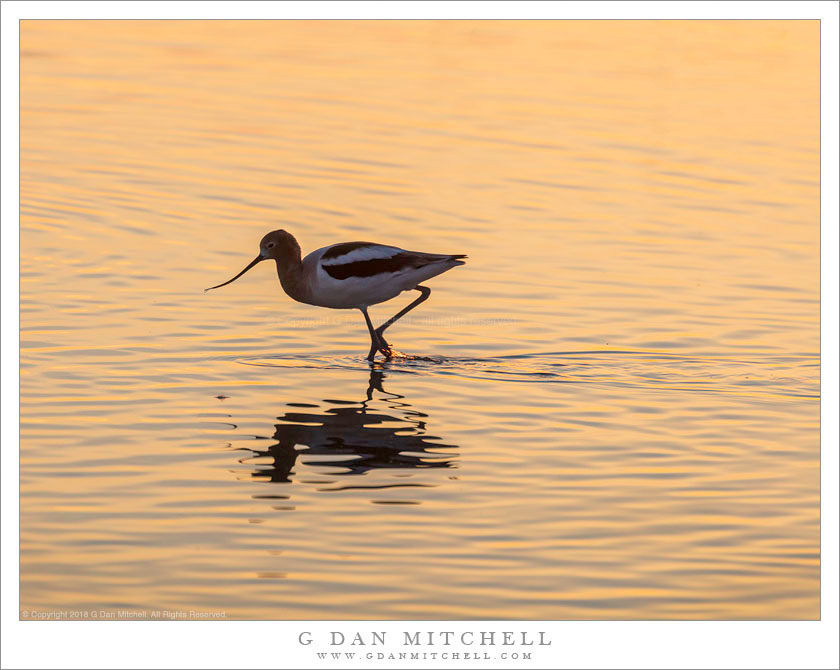
An avocet feeds in shallow water reflecting sunset light
I remember, many years ago, taking a college class that included a section on birds in the San Francisco Bay Area. The birding gene didn’t initially take for me — that came many years later — but I remember what must have been a very effective presentation on differences among shore birds. The birds found along the edges of bodies of water vary greatly in size and shape, from very small to quite large, and their leg and bill sizes vary, too. What I recall is the obvious point, that I hadn’t thought of before, that each bird, with its long or short legs and its long or short bill, is adapted to a different niche in this environment, and even to differing depths of water.
The avocet is a striking bird in many ways. This one, like most that I’ve seen, was an almost solitary specimen. If another was nearby I did not see it. The bird has long legs, which it puts to use by wading in a few inches of water as it feeds. The long, curved beak allows it to reach down and pluck edibles out of the water. This one was feeding close to the shoreline and moving toward water that reflects the sunset sky, so I held still and waited for it to move into just the right position, where the colors of reflected sky were most strongly reflected in the water.
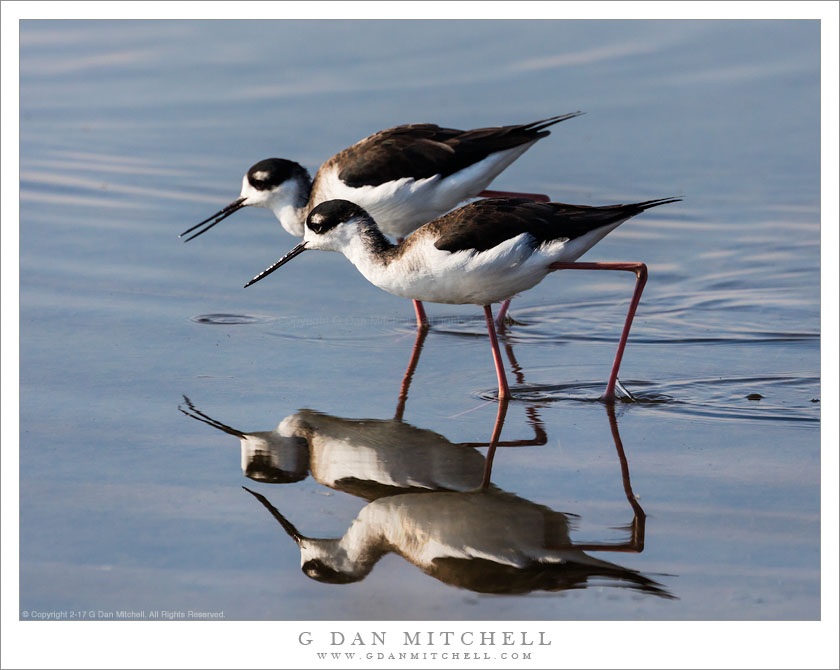
A pair of wading black-necked stilts and their reflections
For decades I did not think of myself as a “bird person,” much less a “birder.” I’m still no birder — I’m not great at identifying the critters and I don’t necessarily seek out new sightings as much as photographic opportunities. However, my fascination with them has increased as I have spent more time photographing them. The first time I intentionally went out to photograph birds, I had basically no idea what I was seeing — it was just, “Wow! Lots of birds!” And that was exciting. This led to a focus on photographing migratory birds, and ,ore recently I’ve become more aware of some of the smaller birds, too.
One of the first to these “smaller birds” was the black-necked stilt. At first I only noticed them tangentially while looking for other things. On a few occasions when those “other things” were nowhere to be found, I turned my camera toward the stilts. They are attractive, though sometimes gangly, birds, with their stark contrast of black and white feathers. They often permit a relatively close approach, and they frequently work their way slowly around a small area, making it easier to photograph them. But getting somewhat unusual photographs of them requires patience and some luck. They do fly, but when they do it is often sudden and very quick… and not at all easy to keep them in the viewfinder. And while one feeding stilt is interesting, that is a pretty common sight. It is more challenging to try to photographs groups of them in ways that are visually linked and interesting. This pair obliged for a moment to two, coming close together and moving in parallel before separating and going their separate ways.
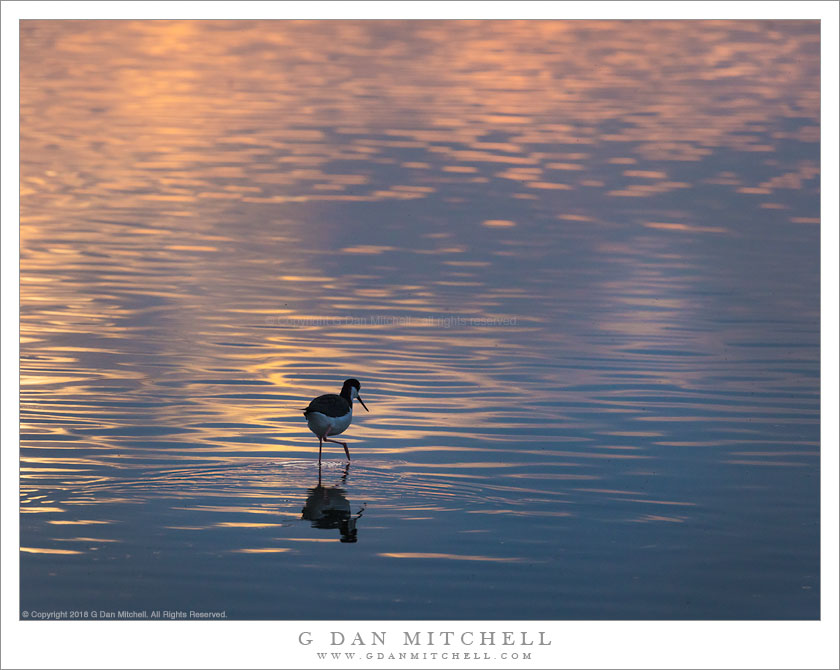
A black-necked stilt wades in shallow water reflecting sunset sky.
In this place where we gathered to photograph migratory birds on New Year’s Day, our attention often turns to the most impressive sights — giant flocks of thousands of birds, collected on ponds and fields, or suddenly rising into the sky all at once. Or perhaps to other birds at dawn, or to their return at dusk. Sometimes the landscape and sky can produce spectacular scenes.
The end of this day wasn’t like that. We did find a very large flock of geese, but they were hunkered down on a close-cropped field, feeding in low and flat light as much of the sunset was cut off by clouds to the west and haze was everywhere. However, sometimes it is possible to find smaller subjects at times like these, and we spotted a few of these black-necked stilts wading in shallow water with a bit of colorful sky as a backdrop.
Photographer and visual opportunist. Daily photos since 2005, plus articles, reviews, news, and ideas.
Manage Consent
To provide the best experiences, we use technologies like cookies to store and/or access device information. Consenting to these technologies will allow us to process data such as browsing behavior or unique IDs on this site. Not consenting or withdrawing consent, may adversely affect certain features and functions.
Functional
Always active
The technical storage or access is strictly necessary for the legitimate purpose of enabling the use of a specific service explicitly requested by the subscriber or user, or for the sole purpose of carrying out the transmission of a communication over an electronic communications network.
Preferences
The technical storage or access is necessary for the legitimate purpose of storing preferences that are not requested by the subscriber or user.
Statistics
The technical storage or access that is used exclusively for statistical purposes.The technical storage or access that is used exclusively for anonymous statistical purposes. Without a subpoena, voluntary compliance on the part of your Internet Service Provider, or additional records from a third party, information stored or retrieved for this purpose alone cannot usually be used to identify you.
Marketing
The technical storage or access is required to create user profiles to send advertising, or to track the user on a website or across several websites for similar marketing purposes.