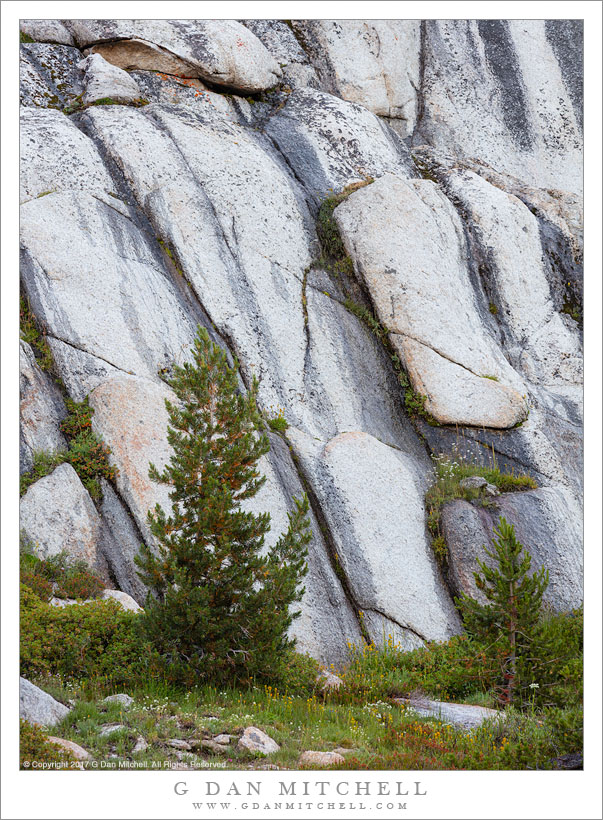
A tree next to an eroded and fractured rock face, John Muir Wilderness.
Here I am back, once again, to that trip into the John Muir Wilderness from which so many recent posts have come. Believe it or not, there still may be a few to come! With a full week to photograph there, I had ample opportunities to explore all sides of this area.
Above our camp the landscape opened up, becoming more rugged and alpine. This is a land of exposed rocks, glacially smoothed and ground down, with rocks and slabs interspersed with meadows. As I followed a creek up into this drainage, often skirting along the edge of wet, meadowy areas, I saw some interesting rock patterns a bit higher up at the base of a nearby ridge, so I climbed up to photograph the rocks and the small trees and wildflowers growing there.
G Dan Mitchell is a California photographer and visual opportunist. His book, “California’s Fall Color: A Photographer’s Guide to Autumn in the Sierra” is available from Heyday Books and Amazon.
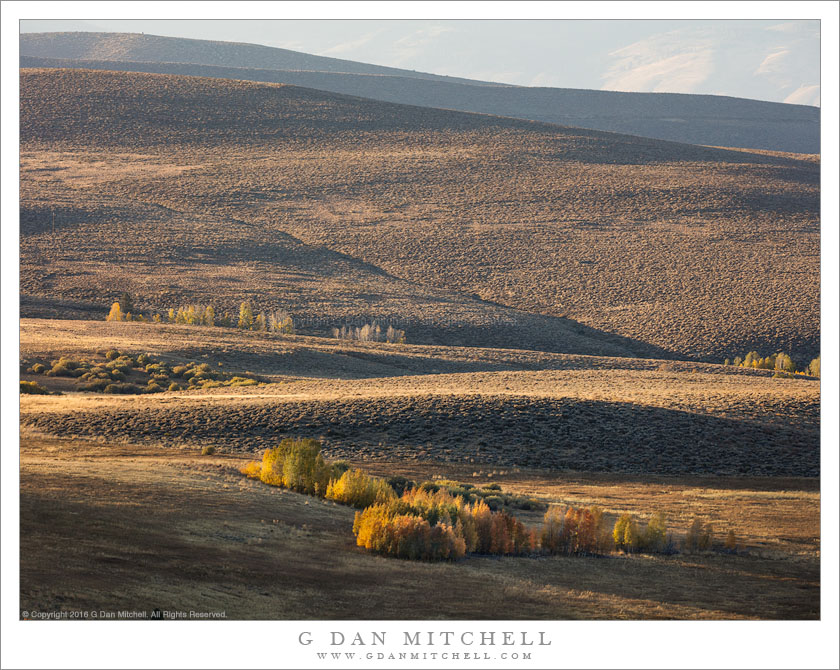
High desert aspen groves on sage-covered eastern Sierra hills
I’m continuing with one more characteristic eastern Sierra autumn photograph, though perhaps not the most common sort of view of the subject. The photograph does include some small groves of aspen trees in fall colors, but they are dwarfed by the immense scale of the rolling eastern Sierra foothills, covered by high desert sage brush, and cut with valleys containing creeks draining the eastern slopes of the range. I made this photograph in the early evening, just before sunset, as the low angle sun was sweeping across the crest and casting light and shadow almost parallel to the slope of the hills.
We usually look for fall aspen color in country that is higher and/or wetter — often somewhere up one of the great eastern Sierra canyons or perhaps along a ridge near the crest. But aspens grow in many places, some of which are unexpected or even surprising. They grow a good distance from the Sierra itself, sometimes far out in the high desert, and in areas that hardly seem alpine at all. Sometimes these are smaller trees, seeming to get by on less water and perhaps in a harsher climate, but occasionally they manage to form decent sized groves.
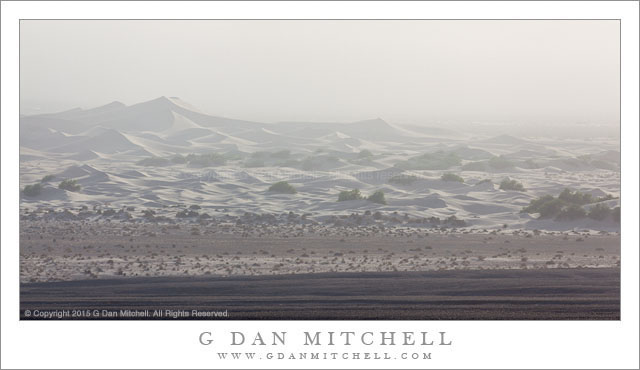
Dust from a desert sand storm fills the air and obscures mountains
You’ll have to look closely to make sense of this one. Made on April 1st, there is a certain sense about this photograph of a minor April Fools joke played at my expense. I had experienced several days of very dusty conditions in Death Valley. On the first day I was way up in the Panamint Mountains at dawn, only to discover that I was still within a cloud of dusty air the extended up to well above 8000′ of elevation. I never did figure out where it was coming from, as the Valley itself certainly wasn’t producing it. That night the winds came to the Valley and blew a decent sand storm through my camp. The next day I figured that I would try to find a way to evade the blowing dust.
I got up very early — as always — and headed out of Death Valley and to the east toward Nevada. I then took a long back road route back into the park. This route took me on back-country gravel roads through the Amargosa Range, eventually dropping down into a deep canyon before heading back to Death Valley. Driving in these mountains and down this canyon, I forgot about the dusty conditions — here there wasn’t more than a bit of hazy atmosphere and the wind didn’t work its way into this canyon either. At the bottom of the canyon the route finally emerged from a narrow canyon and arrived at the top of a huge gravel fan stretching down toward the Valley. And here I saw the extent of the dust and wind, as the entire Valley was full of dust that was well-distributed yet thick enough to almost completely obscure the mountain range on the other side. My day of clear weather came to an abrupt end as I descended into the dust and wind and headed back to my camp.
An afternoon desert dust storm obscures sand dunes
Where there are dunes, there will be sand storms and dust storms. The dunes are largely the result of geography that interrupts prevailing winds and causes them to drop their load. When unusually high winds blow through these areas and through dry playas, they inevitably pick up the loose sand and dust and it becomes airborne once again. The immediate effects on a visitor to such places at these times are several. There is dust and sand everywhere — you simply cannot escape it. The night before the wind and sand came through my camp. Fortunately I use a very strong mountaineering when I visit Death Valley since I’ve seen these winds and what they can do. So I used every stake I had, attached stabilizing lines to the tie-out points on the fly, and zipped everything up tightly. I heard the wind and the sand, but my tent was snug and secure. Others were not so lucky (or so prepared?) and all night I heard people outside in the campground trying to tie down flapping tents, recover blowing gear, pound in more tent stakes… or giving up and crawling into their cars. As tight as my tent is, in the morning there was a thin coat of dust everywhere inside.
The next day I headed up into the mountains where I figured it might be less windy. I spent a lot of the time in a deep canyon, and I did escape the wind. In fact, I was pretty much cut off from the outside world — and, therefore, a bit surprised to emerge from the bottom of the canyon into Death Valley to find that the dust was still blowing like crazy. The air was so thick that mountains on the far side of the valley were almost completely obscured, and as I drove south down the valley there were strong cross-winds and blowing sand. I stopped at this slightly elevated spot off to the side of some dunes, put on a long lens (in the relatively dust-free confines of my vehicle) and photographed the dunes, aiming the camera straight into the blowing dust. Yes, this is what a sand storm looks like. (And, yes, I’ve seen worse. Much worse.)
G Dan Mitchell is a California photographer and visual opportunist whose subjects include the Pacific coast, redwood forests, central California oak/grasslands, the Sierra Nevada, California deserts, urban landscapes, night photography, and more. Blog | About | Flickr | Twitter | Facebook | Google+ | 500px.com | LinkedIn | Email
Photographer and visual opportunist. Daily photos since 2005, plus articles, reviews, news, and ideas.
Manage Consent
To provide the best experiences, we use technologies like cookies to store and/or access device information. Consenting to these technologies will allow us to process data such as browsing behavior or unique IDs on this site. Not consenting or withdrawing consent, may adversely affect certain features and functions.
Functional
Always active
The technical storage or access is strictly necessary for the legitimate purpose of enabling the use of a specific service explicitly requested by the subscriber or user, or for the sole purpose of carrying out the transmission of a communication over an electronic communications network.
Preferences
The technical storage or access is necessary for the legitimate purpose of storing preferences that are not requested by the subscriber or user.
Statistics
The technical storage or access that is used exclusively for statistical purposes.The technical storage or access that is used exclusively for anonymous statistical purposes. Without a subpoena, voluntary compliance on the part of your Internet Service Provider, or additional records from a third party, information stored or retrieved for this purpose alone cannot usually be used to identify you.
Marketing
The technical storage or access is required to create user profiles to send advertising, or to track the user on a website or across several websites for similar marketing purposes.